Summer Journeys Past and Imagined
Ordinarily, Melanie and I would be ending our weeks-long stay in Paris after a glorious Baltic Sea cruise with friends, Pam and Don Wycliff. Covid-19 curtailed all that. Instead of visiting the beautiful cities of Oslo, Bergen, Copenhagen, Berlin, Gdansk, Tallinn, St.Petersburg, Helsinski and Stockholm, we were moored, so to speak, in Granger, Indiana, sheltered-in-place. For weeks now, we have not ventured far from home. We’ve escaped for a brief car ride to see the flowering spring trees and the rose-colored leaves of the Redbud Trail. Our groceries are done online; we pick up our prescriptions at the pharmacy drive-through; we attend church services on Zoom. We now travel virtually. We have Zoom visits with the grandkids in D.C. and Portland and with our children in Boston and Las Vegas. Zoom travels also include New Orleans, Cape Cod, Madison, Duluth, Taos. In this new normal of our lives, we socialize with friends and family for virtual cocktails, conversation, dinners and Codenames-a spy game.
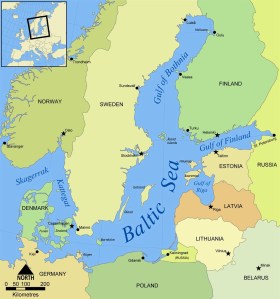 Our now aborted cruise was to be a grand celebration of Pam and Don’s tenth wedding anniversary. For me, the travel to the Scandinavian countries and to St. Petersburg was at the top of my happiness file, a preferable term to bucket list which has an ominous finality to it. At the conclusion of the cruise, Melanie and I were going to spend several weeks in Northern France and, time permitting, a quick jaunt to southern France to see our friends there. Both Melanie and I have long wanted to visit the Normandy beaches. We had hoped to visit our dear friends, the Lallement family, who produce champagne in Verzenay. We hope to cruise the Baltic next spring, but that will depend on the worldwide status of the pandemic and the availability of a vaccine. Until then, I continue to dream of voyages that might have been.
But I can write about our travels of last summer and fall. When I first began to think of writing about those journeys, the trees were a vibrant, lush green, the air warm and humid. Since then the orchestral beauty of autumnal leaves have faded. The winter snows have melted, and the blossoming buds of spring have given way to a new abundance of lush green canopies. And only now in mid-summer I write about the summer past.
As a youngster, I enjoyed watching the Dinah Shore Chevy Show. At the end of each episode, Dinah, in expressive voice, sang this musical refrain, “See the USA in your Chevrolet.” Since retirement seven years ago, Melanie and I have been doing exactly that, but not in a Chevrolet. Our travels of late have been either in a Toyota or Honda. And we’ve become fond of train travel, which at our age we find relaxing. In summer 2019, we boarded trains, sometimes round trip, other times one-way, to Portland, Oregon, Boston and the nation’s capital. I flew from Las Vegas to Maine to join Melanie and our friends Faith and Skip, who had just celebrated their fiftieth wedding anniversary, and with whom we spent several days at their lake cabin.
One glorious afternoon we all took a ride through the Maine countryside and stopped at a Revolutionary-era graveyard. The gravestone etchings, weathered over the last two hundred and fifty years, were almost impossible to read. Upon our return to the lake cabin, we discovered a tick on Melanie’s leg. Fortunately, we were able to dislodge it. And happily, Melanie had no lingering after effects of lime disease. Another surprise of our Maine visit was reuniting with my former next door neighbors in St. Louis, Bob and Marge Moskowitz, whom I’ve not seen in over twenty plus years. By happenstance, we learned of our proximity to each other through Facebook. Both are artists who live and teach in southern California, but paint in Maine at their summer home studio. For my fiftieth birthday, Bob came to California to do a portrait of me and my two sons. That painting hangs today in our living room.
From Maine, we motored to Boston to visit Amanda, Melanie’s daughter. On a day trip to New Bedford, we visited the whaling museum which opened up another imaginary voyage for me. Having grown up in southern Louisiana, the whaling communities along New England’s coast were foreign to me. It was not until I was a graduate student at Brown that I first encountered the ethnic Azoreans and Cape Verdeans who dominated the whaling industry. The museum catapulted me into a fascinating world of whaling. We spent about two hours there and I could have easily doubled that time meandering among the instructive exhibits.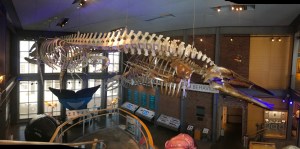 Hanging in the interior atrium of the museum were several skeletons of whales. They reminded me of the biblical story of Jonah and the whale and of the Disney story of Pinnochio and his father, Gepetto, who was swallowed by the whale. To me, each of these parallel allegories is a story of distress and survival.
On board a replica of a whaling vessel, I was astonished that at 5’10,” which is not very tall, I had to lower my head. The ships were built obviously for men shorter than I, but most assuredly, given the roughness of sea living and the hard work of whaling, they were much stouter and stronger. This suspicion was validated by the photographs in the exhibit, and equally confirmed by the images of Paul Cuffee, a prominent merchant, seaman, and whaler of black and Indian parentage. Cuffee served as a privateer during the American Revolution. I vaguely remember reading about him in my early schooling. A Quaker, he was a strong opponent of slavery and, like Frederick Douglass, a fierce abolitionist. Throughout the museum, there were dizzying exhibits of historic whaling instruments and period furniture. Intriguing were the permanent collections of lithographs, watercolors and whaling etchings. There were paintings by Dutch and Flemish masters, Chinese artists, including illustrative drawings by a native son, George Gale, depicting daily life in the whaling community. Gale’s sketches were remarkably detailed, almost lifelike.
I remember New Bedford during my graduate school days at Brown as a town of garment factories. It was there, in the warehouse district, where I bought my winter coat and where I took new graduate students from warm climes to buy their cold weather clothing. These same warehouses have been converted to halls of antique shops. Aficionados of whatever ilk roam the aisles in search of discarded treasures. My roving eyes lighted on a 1950s Sheaffer fountain pen and pencil set, which I happily purchased. They, with the quill and glass pens that I also bought, now reside among my collection of fountain pens.
Before leaving the museum, Melanie, Amanda, and I visited the gift shop. There, among the stacks of books were Herman Melville’s Moby Dick and a new Putlizer prize biography of Frederick Douglass by David W. Blight. I had only read excerpts of Herman Melville’s masterpiece in high school, and in college, Douglass’ autobiography. Melanie read not long ago a graphic novel about his life which she thoroughly enjoyed. I committed myself to read Blight’s biography and Moby Dick.
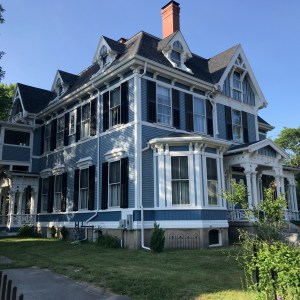 Upon our departure from the museum, we walked leisurely through town admiring stately, architecturally appealing houses. Gazing bewilderingly from one dwelling to another, I fancied walking throughout these houses, admiring the furnishings, speaking to those, who over the decades called these places home. Each home had its unique character. I studied carefully each home’s landscaped garden, judging amusingly whether it complemented or detracted from the home’s attractiveness.
Another day, the three of us visited the JFK library, an imposing structure along the bay. Disappointingly, the museum seemed barren of furnishings, exhibits and artifacts due, no doubt, to the relatively short tenure of Kennedy’s presidency. Among the exhibits were numerous pictures — President Kennedy and John-John in the oval office, he and his family sailing or playing touch football at Hyannis Port, the presidential couple. Most striking was that iconic picture of him and his brother, the attorney general , their heads bowed contemplating the enormity of the Cuban Missile Crisis, their dark profiles set against the bright light filtering into the room. The starkest and most startling exhibit was that of Mrs. Kennedy’s pink blood stained suit. I remember in vivid detail the day President Kennedy was shot. I was a senior in high school. My classmates and I were in the school yard during our daily calisthenics when over the loudspeaker Father Grant, the principal, announced in a subdued voice that the president had been shot and killed. We all stood still, shocked and in disbelief. Led by Father Grant, my classmates and I, many of us in tears, recited the Our Father. I still feel the chills of that moment.
In late summer, on a hot, sometimes rainy day, my friend, Bob Kill, and I took a day-long trip to his hometown of Delphos in western rural Ohio along Route 66. While this is not the famed Route 66 that Nat King Cole crooned about, it still holds many fond memories for Bob of his teenage and early adult years. Before reaching Delphos, we cruised through Archbold and passed in front of the house that Pat and Bob lived in during the early days of their sixty-one year marriage. When we reached the small town of Delphos, we stopped to pick up his sister Cindy, who now lives in the family home. While there, I leafed through a scrapbook of yellowed newspaper clippings of Bob as a high school basketball phenom. Shortly thereafter, we picked up the ninety-three year old widow of his high school hoops coach and took a tour down memory lane along the tree-lined streets of modest homes as Bob pointed out the various Kill family residences.
John Kill, Bob’s great-grandfather, emigrated from Luxembourg in the 1850s and settled in the tiny village of Landeck, before eventually moving several miles to the larger town of Delphos. Although it only has nineteen houses, Landeck does have a Kill road on its west side.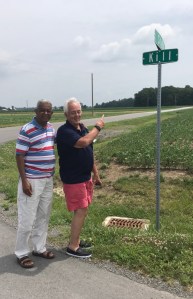 There is even a favorite bar called the Town Tavern, where we lunched with Bob’s two sisters, Cindy and Linda, his niece Stacey and nephew Philip. We feasted on the tavern’s “signature dish” of Fried Bologna Sandwich.
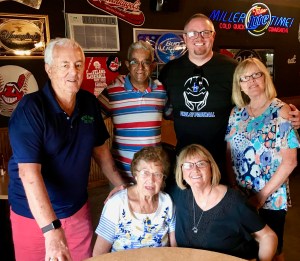 The locals say “Baloney.” Certainly not a healthy choice, but that sandwich was scrumptious. From the nonstop merriment of laughter, it was clear that the sisters adored their older brother. And being in this lively group, I felt like part of the family as I listened to family lore. Cindy and her family lived in Landeck when she first was married. Bob told the story of a family gathering on the same day as President Ronald Reagan’s “Hands Across America” promotion. It was said that Cindy and her family only needed two more people and they could have had a Hands Across Landeck celebration.
Before heading home we made a brief visit to the towering Catholic Church of St. John the Evangelist in Delphos. The sanctuary with its stained glass windows and religious icons invited the visitor to prayer and reflection. The soft glow of light filtering throughout the large church signaled peace and serenity. Mindful of the generations of hardworking immigrants who worshipped here and their descendants who still do, I lingered for a while in prayerful meditation before saying farewell.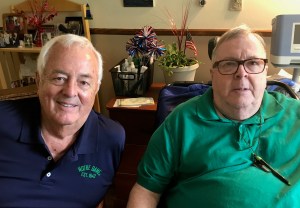 We stopped in Fort Wayne to visit Bob’s brother, Denny, who is in a nursing home. We were then off to Granger where we arrived at 6:00pm, the exact time that we had promised Melanie.
Our fall travels were grandkid visits to Portland and D.C. Reading, board games, swinging in the park, hikes, coloring, riding bikes, bedtime stories and hanging out with Mamie (Melanie) and Papi (Alfred) kept grandparents and grandchildren occupied and exhausted. In D. C. Melanie and I visited for the first time the African American Museum. After four hours, we had not yet visited the entire museum. There is so much to see and learn. We’ll definitely return. On our first day in Portland, we had lunch with Paul, Katie and her parents on what was their last day in the city. They were heading back to northern California, Crescent City, where Katie’s parents live, after visiting Katie’s sister who lives just across the Columbia River in Washington.
Later in the fall, we were back in Boston for my prostate cancer operation at Brighmam and Women’s Hospital. My surgeon from Dana-Farber was a Canadian-born Vietnamese. My surgery happened on Veterans Day. That he was Vietnamese and I, a Vietnam Veteran, added to the day’s significance. He seemed touched by this, particularly when I said to him that he and I had come full circle. Seven months have passed. I’ve recovered nicely with no imminent signs of cancer.
It’s now mid-July and Covid-19 has America captive. And although many states are opening up, Melanie and I stay close to home. When we do venture out, we take all the necessary precautions, face mask and hand sanitizer. If we must enter a public building, we do so cautiously and leave quickly. Our Baltic Sea cruise and visit to France have been postponed, and we are hopeful that a vaccine will allow us to set sail next summer. Since the pandemic is running amok with no signs of abatement, even travel to see our grandkids, whom we miss terribly, is risky. For now, we are content to visit with them via Zoom, FaceTime or Google Chat. And memories of voyages past and still to come keep me adrift in pleasant reverie. Such is my world.
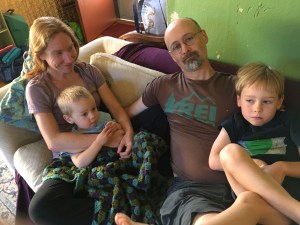
Ethan, Nicole, Eliot, Theron
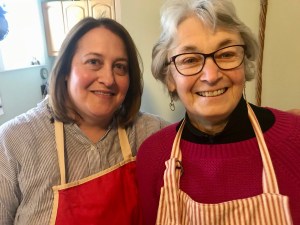
Amanda and Melanie
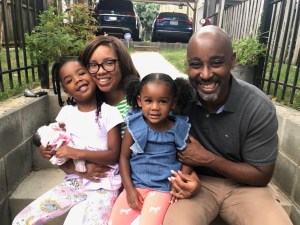
Alfred, Nashida, Michelle, Juliette
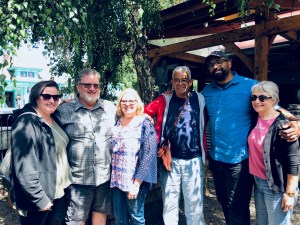
Paul with in-laws

5 responses to “Summer Journeys Past and Imagined”
Leave a reply to Russo, Michele C Cancel reply
Recent Comments
 | Tim Size on Provençal Homecoming |
 | rnpamela on Provençal Homecoming |
 | dlsmithmd57 on Nerdy New Orleans |
 | Don Wycliff on Nerdy New Orleans |
 | Paul Guillaume on Nerdy New Orleans |
 Alfred Guillaume
FYI, I do receive notification when you submit a new post. I received it the outher day. It is an impressive account of your travel and activitie.
Ciao!
> >
Alfred,
This is so interesting. You provide so many details that help us really see what you described. Thanks for taking the time to write these stories and sharing them.
Michele
Our job is to love others without stopping to inquire whether or not they are worthy. That is not our business and, in fact, it is nobody’s business. What we are asked to do is to love, and this love itself will render both ourselves and our neighbors worthy. — Thomas Merton
Thanks Michele.
Thank you, Alfred. This will be a joy later today. I will live vicariously through your adventures with Melanie!
Best to you both,
Anne
Anne McGraw
Director of Corporate &
Foundation Relations
[South Bend Symphony Orchestra http://www.southbendsymphony.org]
[Facebook][Instagram][LinkedIn][Twitter][YouTube]
127 N. Michigan St.
South Bend, IN 46601
Phone: 574-232-6343
Fax: 574-232-6627
________________________________
I hope you will like it. We are living in strange times. Our travels are now imaginary as our minds traverse the world.