Getting Kicks on Route 66
Last spring in southern France, over wine and conversation with our French friends , we all decided to do a road trip together to the American southwest. For them it would be a new way to discover America outside of the big cities like New York, Chicago or Miami. In the months that followed, we began our planning, and with the help of our AAA travel agent we had a well-organized trip that would take us through St. Louis toward Utah and the national monuments. Along the way, we would visit friends and family in Missouri, Arizona, Nevada, Utah and Colorado. Initially, we were to be five, but,unfortunately, because of health issues, one of our friends, Martine, from whom we rent when we stay in southern France, could not make the trip. But Christian and MariThé did, and after spending a couple of days in Chicago, they joined us at our home for a week exploring Michiana. Of course, one of the places we took them was to Shipshewana to see the Amish. They were fascinated, as I continue to be, by the Amish way of living. Their adherence to a life unencumbered by materialism and technological advances of the modern world is laudable.
Our southwest journey began with a visit to the Cahokia Mounds, a pre-historic Native American site that began to fade well before Columbus’ exploration of the “New World.” We explored St. Louis, but heavy rains limited exploring the city on foot. We had to bypass the botanical gardens, but a break in the weather did allow us to walk through Laclede’s Landing and the park at the Arch. The swollen Mississippi and the debris caused by the storm prevented us from traveling on paddleboat down the river. Looking at the Arch in front of the court house, we thought that the Dred Scott Street sign was an eerie reminder of a dark chapter in American history. In 1857, the Supreme Court denied citizenship to blacks. The street with the Arch as a backdrop hung in stark contrast to the hope of future generations that the Arch and its magnificent splendor symbolized.
Every time I am in St. Louis, I visit my old neighborhood in the Central West End. I don’t know what draws me there. Happy memories are overshadowed by personal pain. Perhaps, it’s the seduction of its quiet, shaded streets of stately three-story brick homes. I lived at 4728 Westminster Street, just off Euclid Street with its array of shops, restaurants, art galleries and antique stores. The neighborhood has a uniquely European flavor. When I moved there in the summer of 1989, the area had already begun gentrification; my home built in 1904, had recently been refurbished. The rain that was threatening at Cahokia Mounds met us with a vengeance in St. Louis. Visibility was so low that for a few minutes I had to pull off the road. Later in the evening, when the rain subsided, we had dinner at Llewelyn’s, the Irish pub on McPherson Street just around the corner from my old house. Their sweet potato fries were always a big hit with my sons, AJ and Paul.
The next evening we had a tri-lingual dinner in English, Spanish and French with our dear friends, Pablo and Patricia at their beautiful home. Pablo was the World Languages Chair at Saint Louis University when I was the Academic Vice President. As it is whenever we are with Pablo, his colorful stories kept us laughing.
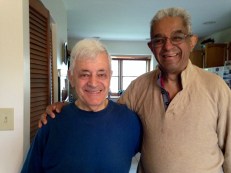
Pablo y Yo
On Sunday I attended Mass in Hyde Park at Holy Trinity, a gothic style church with tall stone pillars reminiscent of European churches. It was perhaps the smallest Sunday service I’ve ever attended in a Catholic church. All of the thirty congregants including the priest were over fifty. But what the church lacked in attendance was overshadowed by its abundance of friendliness. Stranger that I was, several people greeted me merrily, welcoming me to the service. Just before Mass ended I was asked to introduce myself. I could not leave easily after Mass as several people, including the celebrant, wanted to know more about me. The celebrant, a man who appeared to be in his late 70s , was the most talkative , revealing his enthusiasm for biking and giving a detailed accounting of how at 1 am in Breaux Bridge, LA as he was biking he encountered a priest walking. He expressed his surprise at seeing him walking so late at night only to receive the priest’s retort that he too was amazed to see another priest biking so late at night.
The next morning, bidding farewell to Pablo and Patricia, we headed to the Southwest. Finally, after many years of listening to the velvet voice of Nat King Cole singing about the iconic Route 66, there I was on May 1, 2017, rolling along Route 66 in a rented mini-van with Melanie and our friends from Southern France, MariThé and Christian. As Cole sang the litany of cities and towns along the route from Chicago to L. A., we breezed past small and large farms, and cruised slowly through worn, forgotten towns. On one stretch of the two-lane Route 66 highway in Missouri, a parade of vintage Corvettes zoomed toward us. I imagined days of a by-gone era when caravans of cars rolled along long stretches of Route 66, its occupants dreaming of a better future in the West and others, whom fate blessed with more fortune, seeking lazy days on the beaches of Santa Monica. As we made our way through Joplin, MO on Langston Hughes Avenue, a mural on the side of a brick building caught our attention. We stopped for a closer look and marveled at the bright colors depicting contrasting images of pastoral scenes juxtaposed with an image of the Harlem Renaissance poet, Gwendolyn Brooks.


The thrill of being on Route 66 was so great that I now have it listed in my Happiness File (Bucket List) to drive the entire length from Chicago to L. A., all 2,448 miles of it. But before I do, I must read John Steinbeck’s epic novel, The Grapes of Wrath, about the mass exodus to the west of Oklahoma farmers escaping the dust bowl. Though it was the major hub for travelers to California in its heyday, it is now a chain of disconnected highway that at large intervals overlaps with Interstates 44 and 40. But for those unadulterated remaining fragments, the open road coupled with slow drives through mall towns would be a wonderful way to experience slices of an American past .


Until then, I am content to have this opportunity to experience what it was then like stopping at the original, but non-functioning, Lucile’s gas station, and eating in a replica of a 1950s diner. In Elk City, Oklahoma, the National Museum of Route 66 gave us further insights into life along this iconic highway.
Now that we’re in Santa Fe, one of our favorite places to visit, we’re enjoying our time in a beautiful and spacious Adobe-style house about twenty minutes from Santa Fe’s center.
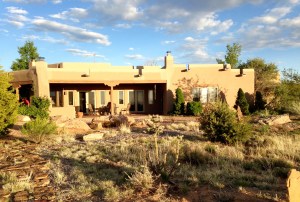 As we arrived, a road runner darted across the property. During the next three days we were hoping to see him again, but to no avail. This elegant home was a welcome retreat from the window shopping along the plaza and gallery hopping. Highlights included introducing our friends to Georgia O’Keeffe’s art at the small museum dedicated to her early work and to the Basilica of St. Francis. We had scrumptious Mexican food at Tune-Up Café, a simple, rugged local place that we’ve enjoyed on previous visits, and at La Choza, new to us and recommended by a friend from South Bend, and at Café Pasqual, where we’ve also dined before. But mostly we’ve enjoyed the evenings sitting on the terrace over cheese and wine, watching the colorful sunsets of red, yellow and orange descend behind the distant mountains.


Before beginning our trek northward to Taos, we visited the student exhibition of seniors from the New Mexico School for the Arts in the Santa Fe Community Center. Initially, we had thought we were going to an exhibition of painting by senior citizens, but to our surprise we saw a display of art that, in my view, was equal, or superior, to any student art exhibition at a university.
When we first arrived in Santa Fe, we saw several posters around town promoting what we thought would be an exhibition at the International Museum of Folk Art. So, as we proceeded out of town, we stopped there only to find out it was a sale of folk art. By the time we arrived, there were hundreds of cars in the parking lots. The event opened at 10:00 am and we arrived at 10:30 am. What we did not realize until then is that this is an annual event that draws people from all over the country. Needless to say, by 10:30 am many of the best pieces had already been sold, but we did manage to buy a beautiful beaded belt and an Indian ceremonial mask. We learned that much of the art that is sold is bequeathed to the museum by collectors and that the museum then sells the pieces that are not kept in its permanent collection. The quality of pieces for sale warrants a return trip, but in the future we’ll arrive before 10:00 am.
From the moment we began to see the changing landscape west of Elk City, OK, from a verdant green to the more dusty ruggedness typical of the Southwest, we began to see spectacular panoramic vistas. Each landscape being the most beautiful until we saw the next eye-catching scenery. Seeing this southwestern terrain through the eyes of our French friends was a totally new experience. Their exclamations of awe and wonderment gave us a deeper appreciation for the beauty of this land. Their connections to this territory is through the western movies with cowboys galloping across the plain. As we rolled along, my mind was centered on the Native People who roamed this land, and who almost came to extinction.
The rich culture of the indigenous people is as apparent in the Taos Pueblo as at Cahokia Mounds. 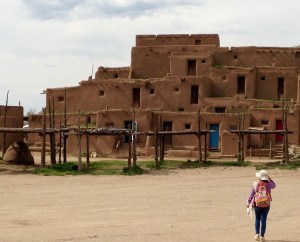 Unlike at Cahokia, there are still Native People living the traditional ways in this UNESCO designated historic site. Our guide was a young tribal woman who related the tribe’s history. She told of the conquest by the Spanish who brought the Catholic faith to the tribe using force to make the Indians build the church. Today the tribe practices both the Catholic faith and its indigenous religion. A nursing student, our guide expressed her intention to return to the tribe and work among her people. Once the tour was finished, we were free to visit the pueblo and the small shops where the Naive People sold their crafts. MariThé bought jewelry, and Alfred bought Melanie a leather pouch with beading signifying the stepped architecture of the pueblo and the colors of the rainbow representing good luck. What we enjoyed most was talking to the vendors. One young potter talked to us about his horse hair pottery; and another elderly gentlemen with beautiful dark tones to his skin, and an expressive face bemoaned how he missed President Obama. At another shop, the vendor told Melanie that he joined the Navy because he wanted to see the world, and he related to her the different places he had been. There is a genuine warmth and kindness among the Pueblo people. For Melanie and me, this was our second visit to the Taos Pueblo. Each time we feel intensely the sacredness of place and the unwavering spirituality of the Pueblo Indians that has continued throughout generations from pre-historic time to the present.

5 responses to “Getting Kicks on Route 66”
Leave a reply to Bob Kill Cancel reply
Recent Comments
 | Tim Size on Provençal Homecoming |
 | rnpamela on Provençal Homecoming |
 | dlsmithmd57 on Nerdy New Orleans |
 | Don Wycliff on Nerdy New Orleans |
 | Paul Guillaume on Nerdy New Orleans |
 Alfred Guillaume
You certainly have a way with words my friend. Reading your blog helped me “see” the Route 66 road and begin to experience the travels I took on the road through TV back-in-the-day. The photo from St. Louis speaks many words itself.
Alfred, Sorry we missed you in St. Louis. Did you know that my first GM job was with Switzer Licorice and their plant was in Laclede’s Landing. Unfortunately it was destroyed by lightning several years ago and then demolished.
As for driving on Rt. 66 and getting a thrill, did you know there is a stretch of highway in Ohio starting in Fayette and ending in Piqua called Rt. 66? It goes through Archbold, where our children were ,and Delphos where I was born and raised. Put that on or in your Happiness file. You can do it in a day from South Bend and I’ll drive.
Our children were BORN in Archbold…..sorry!
Yeah! That day trip with you sounds good. Let’s do it, but I am not sure it is the Route 66. The original starts in Chicago.
Check your maps..it is Rt. 66!