Stomping in D. C.
Unlike jazz great Benny Goodman, we’re not stompin’ at the Savoy, we’re stomping in D.C. with two of the prettiest girls in town, our granddaughters, Michelle and Juliette. The latter, the latest arrival of our four grandchildren, was born in mid-October just two weeks after the birth of our third grandchild, Theron, who joined his big brother, Eliot, in Portland, Oregon. In less than a month’s time we doubled our riches.
After our travels to Las Vegas and Portland over the Christmas holidays, we finally made it to D.C. where unexpectedly we’re having cold winds and sporadic snow. But Juliette’s smiles and Michelle’s laughter make us impervious to the outside chill. Their joy also helps push back the angst we’re experiencing from the fiasco out of the White House. Our days are filled with little conversations about cartoon characters, building blocks, dolls and little people chitchat. It’s heartwarming to see how big sister fawns over little sister. She kisses her from head to toe. Sibling rivalry, I’m sure will come later. Juliette communicates with radiant smiles and soft babbling while Michelle expressively speaks in full sentences that grandparents don’t always grasp and that need a parental interpretation. The joy of being a grandparent is being more free (and able) to notice and marvel at the remarkable changes in each child’s development, changes you did not readily appreciate in your own children as they grew because you were so overwhelmed in adjusting to parenthood.
When we speak in French to Juliette her fixated eyes twinkle in wonderment as it does when her Senegalese nanny does the same. If Juliette is our Francophone granddaughter, (at least for the time being) Michelle is our Hispanophone granddaughter. She already has the gift of two languages because of her Spanish-language daycare. Since our last visit in September her language skills have advanced in both English and Spanish. Saturday afternoon we took a stroll to the park as Michelle rode in her little red wagon.


At the park, Michelle loved best the swings and the sliding board, particularly climbing, then sliding, gleefully with her legs in the air.
A bond is developing between the sisters. Michelle loves her little sister and Juliette’s eyes focus attentively when Michelle speaks to her. As with any siblings, there will be differences between them. Each will develop her own tastes, preferences and interests. But except for the occasional attention grabber by the older sister, the two enjoy each other. Michelle is very relational but at Juliette’s age her facial expressions were more serious, even intense, Juliette’s softer with more frequent smiles.


Grandchildren are addictive. Their unconditional love, their spontaneous laughter, the awe in their glances, even the occasional temper outburst, are all endearing. Well, perhaps not the latter. Luckily, it’s the parents’ job to calm the waters, so to speak. We would love to live nearer to see them more often, but with grandkids on both coasts (and newlyweds, Paul and Katie, will have kids one day), living centrally in the Midwest is ideal for now. Portland is easily accessible by air, although we’ve driven a couple of times. D. C. is very accessible by car, plane or train. And even though we’ve extended our visit this time, the days seemed to pass by too rapidly. Alas, we depart tomorrow, but not before spending an afternoon and evening with Melanie’s high school friend, Faith and her husband, Skip, who live in Northern Virginia.
AJ and Nashida live in an interesting neighborhood in the Northwest section that is slowly being re-gentrified. Their backyard is a stone’s throw from Rock Creek Park, billed as an oasis in the city. Their neighborhood was home to upperclass blacks during the thirties through the fifties. Duke Ellington grew up here. Their home is sandwiched between 14th and 16th Streets. Fourteenth Street is a veritable United Nations with its potpourri of restaurants and shops representing East Asia, the Middle East, Africa, Europe, and Latin America. We’ve gone twice to Le Caprice, a French eatery for authentic croissants, flaky on the outside yet buttery on the inside. There we met Naomi, the cashier, from Bénin. A connoisseur of Indian cuisine, AJ frequents a little hole in the wall just around the corner from his home. Because we needed to mail some important documents we walked about two miles along 14th Street to the post office and then lunched at The Matchbox on the other side of the street. Our server there was Sarah from Ethiopia. It is not uncommon to hear several languages walking along 14th. Sixteenth Street is lined with churches and embassies. One of the nation’s oldest Unitarian churches, All Souls, where former presidents attended, is located on this street. When we visit D. C. we alternate attending service there and at the city’s oldest black Catholic Church, St. Augustine.


Now before I end this blog, I’d like the reader to decide if Juliette favors her Papi. I can’t get anyone to agree. AJ gives a lukewarm acknowledgement that she does. Yes, her eyes are rounder, but her head and the lower part of her face, particularly when she smiles, resemble me. So here are two pictures side by side.


At the very least, both babies are cute. I’m sure you can agree to that!
Romping in Portlandia
It’s Christmas Eve on a raw, chilly day in Portland. Since our arrival a few days ago, we’ve gotten acquainted with two-and-half month old Theron. We’re enjoying being with him and his big brother Eliot. Reliving the glow of parenting without the daily responsibilities of nourishing and disciplining is arguably the most joyous state in grand-parenting. In its place is the freedom to play, to laugh, to act silly and romp like a child. With the nearly four-year old Eliot, we’ve been having grand conversations, marveling at his advanced vocabulary, listening to his stories, admiring his skill in the matching game and simply being childlike with him in the games he likes to play. This morning we took a walk wth him, his papa and little brother as he rode his balance bike. Ah! Cuddling with Theron is a heavenly gift.


What bountiful joy there is in his smile and wide eyes as he listens intently to Melanie and me, especially when we speak French. We enjoy hearing his contented gurgling. There’s music to his soft cries, but that opinion may not be shared by his sleep-deprived parents. On the floor, he swims in place, legs flailing wildly. By the time we see him again in the summer, those legs will be pushing him across the floor.
As I write this, Eliot and his Mamie are making Christmas ornaments for the tree. He enjoys learning new things. Inquisitive and quick to learn, he was fascinated by Melanie’s reading to him from a Heifer International magazine about milk other than cow’s — yak, goat, sheep, water buffalo, camel. And, like many kids his age, he loves to draw. His artistry is on display on the corner walls of the dining room. And, like his Mamie, he loves books, especially those about trucks. This afternoon we will decorate the Christmas tree, and later, like many others across the globe, we’ll retire for the evening in anticipation of St. Nick’s arrival and, for Christians, the heralding of the newborn, Jesus.


At the children’s Christmas Eve Mass, the priest asked the kids what gift would they like to give the world. The first child to respond, said”peace;”another shouted “love,” and the last gleefully chimed “hope.” Hope captures the true meaning of Christmas that is manifested in the unadulterated innocence of children. Our special Christmas gift is the sharing of love with Eliot and Theron.


Christmas morning as expected was full of excitement! Too early for Theron, but Eliot’s joy in unwrapping gifts was contagious. The simplest of gifts elicited squeals of pleasure! Stickers were as equally appreciated as the Lego car. In addition to the gifts around the tree was the treasure hunt for hidden presents, the clues of discovery embedded in several rhymed verses of Melanie’s imagination. It’s a decades old Smith family tradition begun by her father. And what may well become another Smith tradition is the Christmas dinner of Thai food created by Chef Ethan. Earlier today, as we exchanged Christmas greetings with the Guillaume Family in D. C., we learned of another non-traditional meal, red beans and rice with roast, prepared by Chef Alfred that may as well become another tradition.
The day after Christmas festivities, Melanie and I gave Ethan and Nicole a respite from parenting. In the early afternoon, Melanie and I took the kids for a long walk with stops at the library, where I spent considerable time in the children’s corner reading to Eliot, and at Jack-in-the Box for a french fry treat. During our walk Eliot stopped several times to examine more closely a leaf, a stone or some other object with his magnifying glass. Each time he marveled at a new discovery.
Our brief visit ends tomorrow with a return to the bitter cold that awaits us in South Bend. Our next travel adventure is in January to D.C. to meet our new grand-daughter, Juliette, and her big sister, Michelle.


Caroling in Vegas
“Oh what fun it is to ride in a one horse open sleigh!” Yes, such as it is, we were caroling in the desert last night. Just several days ago, we flew over the snow-covered region of Northern Indiana and landed in parched and barren Nevada — the desert’s winter chill, a welcomed respite from the arctic cold. We’re here in sunny Las Vegas to celebrate our son, Paul’s, second masters, this time in special education from the University of Nevada Las Vegas.


His first, an MFA in photography, a couple of years ago, was from the School 0f the Museum of Fine Arts, Boston. It’s there where he met our lovely daughter-in-law, Katie, also an MFA in photography. Needless to say, we are bursting with pride. Paul came to Las Vegas initially as a high school teacher for Teach for America. Having completed his two year obligation with Teach for America, he’s now enjoying teaching in a Title I high school that is largely Latino.
As part of this celebratory graduation week, we dined at the iconic Top of the World restaurant and had a panoramic view of the neon-lit city and its famed mile-long strip. As the restaurant turned slowly on its axis, we saw in the distance, the bright glow of the Trump Tower, looming large with no edifice near it matching its height or showiness. Though duly forewarned by our waiter not to be alarmed, we were startled by the bungee jumper whizzing by just outside our window. As the saying goes, “Whatever happens in Vegas stays in Vegas,” and here there are many surprises! But this is not an adventure, I’ll ever want to experience.
And those carols? Paul and Katie invited us to a piano bar, the Classic Jewel, for Opera on Tap. Ugly Christmas sweaters were encouraged but not required. The superb operatic singing made for a pleasant evening!


Singers from the Sin City Opera thrilled the patrons with a sundry of Christmas carols, traditional and pop, in beautiful tenor and soprano voices. There were choruses, duets, and solo performances and an audience sing-a-long of favorite carols. The evening ended with a rousing chorus from La Traviata. We met several of Paul and Katie’s friends, including one of Paul’s colleagues who sang a beautiful aria. Katie and Paul earned the second place prize for the most imaginative sweaters. Sporting a Santa Claus hat and beard, Paul adorned his sweater with pre-tied package bows. We enjoyed chatting with the singers learning about their interest in opera, how they came to this city and what keeps them here. The climate, of course, was a big attraction, but we also learned that there is an active arts scene. Admittedly, as one of the singers commented, it’s hidden and you have to look for it.
 Another fun thing we did was drive one evening through the Nascar Speedway transformed into fields of glittering Christmas lights. Quite a panoramic display that rivaled the glimmer of the Strip!
Our son and daughter-in-law, artists themselves are beginning to discover Las Vegas’ charms. We’ve been having engaging conversations with them learning more about their teaching and listening to them explain how they create art. We’ve observed their pace of life and how they live. They are a good couple together and their different personalities mesh well. Although they are adjusting to living here, we learned that they won’t make Las Vegas their permanent home but will stay a few years longer before moving, perhaps back to Boston where they feel there is more opportunity for them as artists.
I’m not a big Las Vegas fan either, but each visit increases my tolerance for this city of ostentatious glitter. I’ve never been a gambling aficionado! It seems such a waste! Consider me a scrooge! The closest I’ve come to gambling is an occasional lottery ticket and the church bingo. To me it’s disturbing to stroll through a casino of transfixed faces and mechanized arms in front of a slot machine, including the equally intense, immobile gazes at the blackjack and poker tables. I fear that many are addicted gamblers who do not have sufficient financial capital for these idle pleasures. But in the words of Pope Francis, “Who am I to judge?”
After a pleasant afternoon at the theater to watch the Star Wars prequel, Rogue One, the kids are preparing a festive meal of salmon with grilled vegetables. Earlier I browsed through dozens of slides from my early adulthood that Paul commandeered sometime ago. This photographic journey brought back many memories of my Vietnam year, including my R &R in Hong Kong, my travels as a Fulbright teaching assistant in France and NEH scholar in West Africa. I was struck by the quality of the images captured by my untrained eye. (Even Paul mentioned once that he liked the composition of some of my images.) The pictures of Vietnam and West Africa were arresting in their depiction of the rhythms of daily life; those in France were of monuments and buildings. Vietnam was a significant marker in my life. I was amazed by the numerous slides of inebriated merriment of me and my fellow soldiers. Their faces I remembered, but few of their names.
A highlight of our trip was the Stations of the Cross at St. John Neumann Catholic Church, moving photos of suffering people across the world to whom the Maryknoll Fathers and Brothers minister.


Together they gave a powerful message of social justice to which we need to commit and make real. The congregation itself was the most diverse we’ve ever experienced. We noticed at least ten different ethic groups and nationalities among the packed congregation.
Today we leave for Portland, OR to visit our newest grandson, Theron. And another chapter in our Christmas travels begins.
Connect, Inform, Encourage
In Atlanta a few weeks ago, I attended my fourth annual 100 Black Men of America conference considered by many to be the premier organization for the mentoring of African American youth in this country. Begun in 1963 by pioneers like baseball great, Jackie Robinson, and David Dinkins, who later served as the first black mayor of New York City, and others, the 100 as it is known today was incorporated in 1986. Today, there are over one hundred chapters nationwide, and an international chapter in London, England, each operating under the universal slogan, “What They See is What They’ll Be”.

1986 Founding Members Surrounded by Board of Directors
Eight years ago I was invited to join a group of a half dozen men to discuss establishing a chapter of the 100 in South Bend. Today I serve as president of the local chapter, the second holder of that office since we began in 2010. Initially, what brought us together were concerns about the plight of young African American males and, more generally, an earnest desire to serve the African American community. The 100 Black Men of Greater South Bend now has fifty-five men, entrepreneurs, doctors, dentists, educators, lawyers, fire and policemen, politicians, business executives, janitors, clergymen and retirees. What binds us as a unit is our love for and dedication to the young African American males in our community. Many of the youth we serve do not have strong father figures in their lives, or other adult males to guide them as they navigate life. Without positive adult male role models, they are more at risk for gang involvement and encounters with the law. And without an active father figure in their lives, they are more vulnerable to poor academic performance, lack of ambition, and low self-esteem. Our hope is that every young man we mentor becomes an active and productive citizen who achieves his personal ambitions.
Our programmatic initiatives — mentoring, education, health and wellness, economic empowerment and leadership align with those of the national organization. The Freedman Academy is our flagship program. During the school year, twice monthly on Saturday mornings, we gather together as mentors and mentees to discuss a potpourri of topics as wide-ranging as what’s happening in the mentees’ lives and what they have observed in the news and in their communities. We have dedicated sessions on hygiene, sex, treatment of women, gentlemanly decorum, proper behavior in encounters with law enforcement, study habits, goal setting, careers, drugs, table etiquette, bullying, use of language, etc. Each session begins with the Pledge of Allegiance, the singing of Lift Every Voice and recitation of the Freedman Academy Pledge, the expectations of a 100 mentee. We then listen to a recorded message of significant moments in black history. The groups are then further divided by age — second through third grade, fourth through eight grade, and high school. Each group has an appropriate curriculum, and for the middle school we include the Junior Achievement Curriculum. To further reinforce African American history, we do readings, followed by discussions, from Henry Louis Gates’ book, Life Upon These Shores. For some, these readings are difficult, but the power of the lessons learned about black achievement exposes them to the possibilities in their own lives.
Making real the infinite possibilities for black youth was embedded in one of the keynote addresses at the national conference by Former Secretary of Labor, Alexis M. Herman, who was one year behind me as an undergraduate at Xavier University of Louisiana. She gave a spirited luncheon talk about staying connected, staying informed, and staying encouraged. In her talk, laced throughout with humor, she reminded the conference attendees to stay connected to our young charges reminding us that in this world of high tech, there is no substitute for high touch. She reminded us that the work of the 100 consists of making a difference through active and purposeful engagement with our mentees. And according to her, that thread of connectedness is rooted in the history of enslaved black Americans when the nuclear family was broken but now reversed through the connectedness of mentor and mentees. She urged us to stay informed, to understand our history to better overcome the challenges facing African Americans and to know the current issues that endanger us – the negative messages of political discourse and social media. And finally, Secretary Herman exhorted us to stay encouraged and not to be discouraged. In spite of the current challenges of economic and social inequalities, we, as black Americans, have advanced, and that the work of the 100 is a bridge for our youth to make progress and achieve. Whether they are on the honor roll or the welfare roll, Secretary Herman urged us not to abandon our youth, so that with care and attention, each one can excel.
Earlier that morning, at breakfast, each table was encouraged to discuss the impact the 100 has on our lives. As I’ve worked with our youngsters over the past years, that question of whether we were making an impact on our mentees often surfaced in my thoughts. Comments from our mentees, though not surprising, were refreshingly affirming. Here is a summation of what they expressed: “I want to help others have character because that is important.” “I’m a better person.” “I have the courage to do anything that I want to do.” “I’ve learned a lot about black history and the impact that others have had on society.” “I am a better person for myself and for others.” “I’ve learned to change my behavior in positive ways.” “My grades have improved.” “I’ve learned from my mentors.”
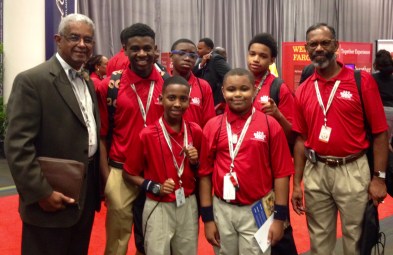
Alfred and another mentor with five of our mentees at national conference
Involvement with our young African American males, has given me the opportunity to pass on the lessons I’ve learned from my parents: lessons of integrity, honesty, perseverance, and self-esteem. Additionally, they taught me the value of developing persistent study habits, understanding that I could accomplish what I wanted if I prepared myself properly, the importance of nurturing spirituality within myself, respecting myself and treating others with respect. Unlike many of our mentees, I came from a two-parent household that instilled aspirations in me and my four siblings. A high premium was placed on education. My father’s words still ring in my head, as I know they do for my four siblings, “You will go to college and you will graduate. What you become is your choice. You may be a garbage man, but you will be an educated garbage man.” And my brothers and sisters will agree that we were fortunate and blessed to have had such loving parents.
Sartorial splendor appears to be de rigueur at these 100 conventions. Among approximately two thousand conferees, hundreds of mentors and mentees are nattily attired in bowties. The first time our chapter brought mentees to the conference, they surprised me by sporting bowties. Since then though, our youngsters attend the conference neatly attired in matching polo shirts with our local chapter’s loco. But what always amazes me at each of these conferences is the attention to decorum with particular emphasis among the young toward civility and politeness. Each conversation or greeting by a youngster is peppered with sir; “Good morning, sir,” or “Where are your from, sir,” or “Yes sir,” or No sir.” And even a chance encounter in the hallway or on the elevator, a younger adult will inevitably address me as sir, as I do with an older gentleman. These conventionalities remind me of my own southern upbringing when adults were always addressed in a respectful manner. I’ve had a hard time adjusting to modern times that permit children to address adults by their first names. Such familiarity was unthinkable during my youth.
But what is most remarkable about these annual conferences, setting aside the camaraderie that spontaneously occurs among total strangers, is the exchange of ideas. Learning from others has proven beneficial in developing our chapter’s programmatic initiatives. Our barbershop hypertension and prostate screenings are outgrowths of what we learned from priorities established by the national organization and work being done by other chapters. In South Bend, with the aid of our two local hospitals, Memorial and Saint Joseph, we send nursing students from Indiana University South Bend and Bethel College to the barbershops to help men monitor their blood pressure. And in partnership with Riverbend Cancer Center, we annually participate in outreach for prostate screening.
Among the numerous workshops and information sessions, the most gratifying event is the youth breakfast. The program, emceed by the young people, is a display of talent and creativity. There are musical presentations, poetry recitations, individual talks, all equally moving and inspiring. Observing and listening to these poised young people effaces, at least during those two hours, feelings of hopelessness when confronted by the problems besieging the black community — the under achievement academically of African American males, the high dropout rate, the lawlessness of the inner cities with black on black crime, gang and drug activity, the over incarceration of black males and high unemployment among minority communities. Rather, these young people, generate positive energy and give a face to “What They See is What They’ll Be.”
In keeping with the 30th anniversary conference theme of “Positive Influence, Powerful Impact,” I am confident that 100 Black Men of Greater South Bend is adding value to the lives of the young men we serve while simultaneously making an impact on our Michiana region. We know this anecdotally from our interactions with and comments received from the broader business, civic and educational community. We’ve developed a strategic plan to guide us in the immediate future and we’re establishing metrics that will measure our success. We’re far from perfect but we’re committed to continuous improvement. We use our annual winter gala of over seven hundred attendees to showcase the work we are doing. As at the national conference, our young charges are the evening’s emcees. They are the best ambassadors of our accomplishments and our aspirations. We, the 100 Black Men of Greater South Bend, have ambitious plans for the future, but we know that with the continuous support of our community, we will succeed in reaching our goal of improving the lives of our African American males.
Sad to Leave, Happy to Return
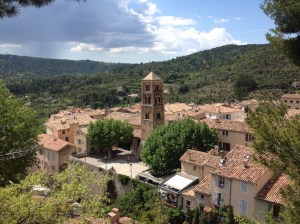
Moustiers-Sainte-Marie
If in our first couple of weeks here we were happy just be-ing, our last two weeks before journeying home have been filled with activity. Friends, and those whom we have met through our friends, have regaled us with dinners and apéros . Around the dining or coffee table, our conversations, helped along with wine and other alcoholic spirits, have lasted late in the evening. By the time we’ve plopped ourselves in bed, it’s after midnight. In the morning, we grudgingly drag ourselves out of bed. Breakfast becomes brunch and my morning walks less frequent. When not being entertained, we’ve managed several small road trips to quaint little villages, walks along stoned winding streets and country paths, and visits to places of interest. We’ve enjoyed the local scenery, sitting in cafés, or reading quietly on the beach.
Our flight from Marseille to Amsterdam, then to Detroit, and on to South Bend is a few days away. It hardly seems that seven weeks have passed since our arrival. We’re totally in sync with the rhythms of life here. Our interactions with the locals are more spontaneous; our French flows more naturally; the habits of daily life have become our own–shopping at the Friday morning open air market, walking each morning to the bakery for bread, enjoying occasionally a croissant or fruit tart. We visit the office of tourism to find out what’s happening locally . Our neighbors greet us with a smile.
Our quiet immersion into French life was never more evident than during last Sunday’s celebration of the Allies’ victory over Germany, VE Day. We joined the crowd marching in unison with the military band.


At the war memorial in the park, there were proclamations and the laying of wreaths by veterans and other citizen groups. The mayor spoke patriotically about the preservation of democracy; he praised those who fought and died for France’s liberation, thanking the allied troops, the resistance fighters, the Africans; he remembered solemnly the sufferings and sacrifices of so many French citizens, reminding us to be forever vigilant in the preservation of democracy, freedom, and the French way of life. School children recited poems and led the crowd in the singing of La Marseillaise, the French national anthem. Standing there in solidarity with the French, Melanie and I joined in the singing. It was an emotional moment not easily forgotten.
Each time we come to Provence, we meet new people through our friends. Through Martine, we’ve met Marie-Jeanne, a charming and fiercely independent, ninety-four year old woman, who invited us for an apéro at her beautiful home filled with antiques and art. From her glass patio, we watched the whitecaps of the rolling waves on the beach and, in the distance, the bolts of lightening in the darkening sky. With her that evening were her nephew, Pierrot, and his wife, Agnès, from northeast France. Agnès loves to cook and has a Facebook page, “Bievenue dans ma cuisine,” dedicated to cooking. Martine also introduced us to Marc and Danièle, who also invited us to their home for an apéro. Their home sits just a few doors from Martine’s. Their backyard, with its well arranged gardens, faces a forested area, through which the sea can be seen.
And at Marie-Hélène’s , who came to IUSB as a visiting Fulbright scholar several years ago, we met another interesting couple, Claude and Claudette. Claudette is a watercolorist who later invited us to see her tableaus, but we could not because of our tight social schedule near the end of our stay. And just last evening, we celebrated, in our little apartment, Laure’s birthday with her mother, Marie-Hélène, and her friends, Chen and Yannick, doctoral students in chemistry and international law, who met in Ontario, Canada. Several days earlier, we dined with friends, Hélène, Olivier and Xavier in a restaurant at the port in Toulon.


And to continue with this theme of celebration and dining, during these past couple of weeks, we’ve dined in Marseille, with Marie and Gaetan, at their home with their beautiful three-year old daughter, Louise, and her doctoral thesis advisor and his wife. We also had a wonderful meal of grilled duck in Karine’s and Laurent’s backyard in Brignolles.


We spent an evening with Jacques and Danièle at their home and a lovely day with them in Moustiers-Ste Marie, walking and climbing stoned steps to the 12th century chapel and driving interminable sinuous roads through the forested tapestry of the Gorge du Verdon. Tonight we will be with our friends, Catherine and Jean-Louis, at one of our favorite restaurants, Le Bard’ô, in Sanary-sur-Mer. And this weekend we’ll be regaled with more dinners.
To the reader of my blog, it may appear that we spend an inordinate amount of time eating. Yes, this is true, but not exclusively. Socializing in France happens around the table, but isn’t that true in many cultures? Spending time outdoors is equally important and Provence has many interesting things to do and sites to visit within a short car ride. One day we drove to Eze, a beautiful village along the coast, but we could not find a parking space; it was our first encounter with busloads of tourists. Instead, we visited a neighboring town, La Turbie. Yes, we had a delicious lunch at Le Café de la Fontaine, before visiting the ancient Roman ruins, La Trophée des Alpes. One afternoon, with Martine,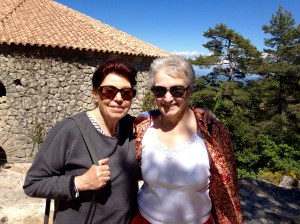 we visited a glacière and learned how ice was made and transported before refrigeration. Later, we hiked up to an isolated spot to visit a monastery, La Chartreuse de Montrieux, where cloistered monks live. We stopped in a little village, Méouines, where we sat and ate lemon tarts.
Alas, all of this is coming to an end. We’ve already begun making a list of the things we need to do when we return to the States. We’ll go through a period of readjustment, recovering from jet lag, recalibrating our emotional highs and lows, before resettling into the pace of life in Michiana. We’ll pine for Provence, nostalgically remembering the wonderful days spent here, and with the space of time, those images will slowly fade. We’re sad to leave; next year we’ll await a visit from our friends, Martine, MariThé and Christian; and the year after, we will be happy to return!


Île de Beauté


For several years we’ve talked about visiting Corsica. Now we have, but not before a two and a half hour late start of our ferry from Toulon and spending the first two days with a stomach virus. Most of the ferry ride was spent lying on a couch or sleeping upright. The next day, I passed on my gift to Melanie. Once we disembarked, and in spite of our weakened state, we managed to visit Île Rousse and Pigna before heading across the mountains to St. Florent. The next day we retraced our journey, crossing once again the fifty-eight kilometer trek across the mountains toward Calvi and stopping for a brief visit at Algajola, a quaint little village along the coast. Since Melanie did the driving the day before, and was still not feeling well, I summoned enough courage to drive to and from Calvi. All the while I thought of my friend, Randy, who knows my fear of driving at high altitudes. Driving in the mountain pass last summer from Victor, Idaho to Jackson Hole, Wyoming, I was so paralyzed with fear that I had to let Randy drive the rest of the way. But this time in Corsica, I succeeded. Admittedly, there were butterflies in my stomach at each hairpin turn.
In Calvi, a beautiful medieval town situated along the Mediterranean, I spent the afternoon walking the narrow streets of the Citadel while Melanie rested with a book in a café at the port. Calvi is one of three cities that claim Christopher Columbus as a native son. A bronze bust of him sits prominently along the ramparts leading to the Citadel. Along the outer walls are spectacular views of the port, the surrounding mountains and the sea.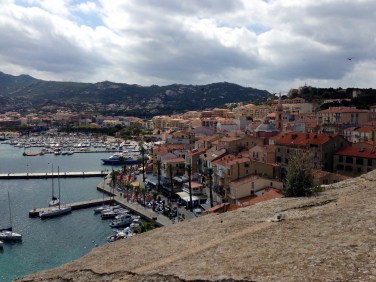 Within this walled fortress, I visited the thirteenth century cathedral, St. Jean-Baptiste, which sits at the summit of this massive stone city. I sat there for several minutes in meditation, as Melanie and I typically do in these ancient holy places, but it was in the oratory of St. Antoine, just a few cobblestoned and winding streets away, where I sat the longest giving thanks for the wonderful gifts in my life.
Upon our return to St. Florent, we had a fabulous meal in a traditional Corsican restaurant, Ind’è Lucia, where I had a superb Corsican vegetable soup. We were the first to arrive at 7:30pm; by 9pm practically every table was occupied with twenty-six patrons, including a couple who had sat at a table next to us the evening before in a different restaurant. The owner of the restaurant was busy with her young daughter when we arrived. As she took our orders, the child quickly joined her grandmother in the kitchen. The décor of the restaurant was warm and homey with an open fireplace on which the woman cooked sausages. We sat beneath the head of a sanglier, the wild boar that we had hoped to see live in the wild.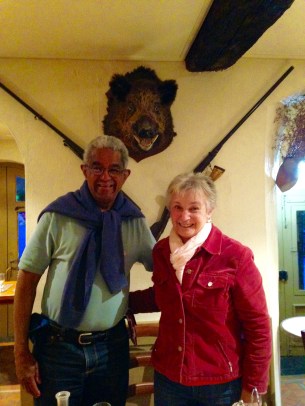
Our only regret with St. Florent was not being able to visit the ancient cathedral of Nebbio, Santa Maria Assunta. Built on an old Roman site, the church represents one of the best examples of Corsican religious architecture. When we arrived, several groups of people between the ages of twenty to forty, all dressed in black, were standing outside. We learned from a couple of young women that a deceased friend of theirs was laying in wake. Out of respect we did not enter. The next morning we left for Cap Corse.
And Melanie did the driving. Cap Corse is a narrow strip of land, a finger, jutting from the island’s northern border. Most of the trip was a continuous zigzag of narrow roads along kilometers-high rock-hewn precipices. Squeezed between the empty space of the sea below on one side – a long drop – and the hard mountain rock on the other side, the drive demanded a heightened vigilance. At a juncture in the road, the sea half had completely fallen, leaving one lane open for traffic in both directions. Meanwhile a crew with heavy equipment was repairing the road. Setting aside the stress, the panoramic, expansive views of the sea and the rustic verdant valleys below were breathtakingly beautiful. We passed through several medieval villages etched in the mountains or perched on precipices overlooking the sea far below. In one of these hamlets, we stopped at a small café for sandwiches and a can of juice. In the dimly lit interior, two elderly men were sitting at a table, one speaking animatedly on his cell phone, the other reading the newspaper. A much younger man, simply gazing, was seated on a stool at the bar on the other side of the tiny room. We inquired of the bartender if sandwiches could be made, and with an affirmative nod, he quickly disappeared in a backroom and returned several minutes later with two charcuterie-filled baguettes. Once on the road, I began to wonder what daily life was like in the Cap Corse villages and how people occupied themselves.
On our way south, we stopped briefly in Bastia, a fairly large urban area. As we walked exploring the old city, we arrived at the church St. Jean Baptiste, on the Place du Marché, just in time to join the procession of Ste Zita, the patroness of gardeners.
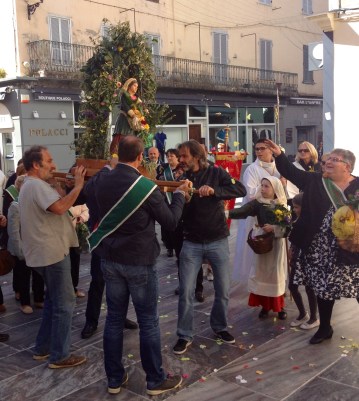
Procession of Ste Zita
Once we reached the southern part of Corsica, we were welcomed warmly by Dominique, at whose home we would spend the next week. Dominique is a charming and gracious gentleman of ninety-four years who is a friend of our friend, Martine, whose apartment we are renting in Le Pradet. Dominique, too, has an independent lower apartment attached to his home in Bocco d’Oro, between Porto Vecchio and Bonifacio. During our stay, we were also invited one evening for an apéro at the home of Dominique’s sister and brother-in-law, Marie-Jeanne and Guy, who live just a few doors away. With them, we enjoyed spirited conversation over Corsican charcuterie and rosé, topped with a fiadone for dessert. Marie-Jeanne also gave us several yeux de Sainte Lucie, distinctive sea shells with a spiral. These are thought to bring luck.
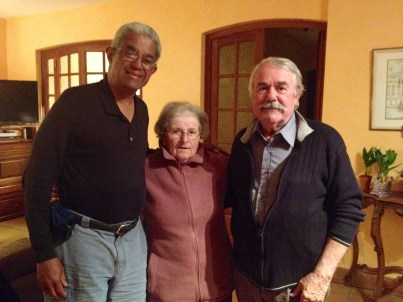
Alfred, Jeanne-Marie, Guy
We spent considerable time in Porto Vecchio, or Porto Vech – the Corsicans have a tendency to leave off the final vowels in conversation. On Sunday morning, we went to Mass at the cathedral where we heard beautiful music and the scripture readings recited in French, Portuguese and Italian. At the end of Mass, the priest asked the congregation to come in great numbers “to celebrate with our Portuguese brothers and sisters” the feast of Our Lady of Fatima at another church later that week, noting that the Portuguese community came to the church to worship with the French/Corsican speakers, so the latter should show the same solidarity with them. Upon leaving Mass, we asked a couple of ladies why the scriptural readings were in three languages. They told us of the large population of Portuguese and Italians (Sardinia can be seen across the Mediterranean on a clear day) residing in the area. And one of the ladies chimed, “There are many languages, but only one Church and one God.” That afternoon, in the center of town, was the annual race of hand-made boxcars and other inventive wheeled contraptions, the Carruleddu. We opted instead to spend that chilly afternoon at Polombaggia, considered to be the most beautiful beach in Corsica because of the large red boulders that frame it.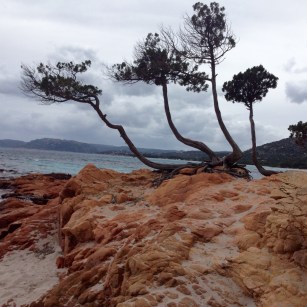
Highlights of our stay in southern Corsica included a concert of Corsican music at one of the churches in the old part of Bonifacio. From the beginning of the polyphonic singing at 9:30 pm until its end at 11:30 pm, goose bumps covered the skin. In Bonifacio, we also walked passed the house where Napoleon once lived. Another day we visited the Èglise Ste-Marie (Santa Maria Assunta) in Sartène, where on Good Friday a member of one the societies of penitents carries the Cross with chains on his feet. 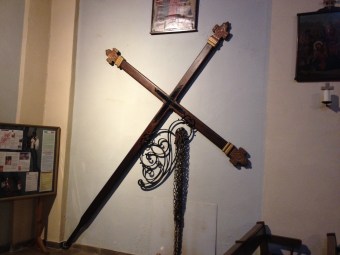 The same day of our visit we happened upon the annual town Carnaval with lots of merrymaking. We managed to escape the crowd and took refuge in a quaint restaurant, Le Jardin de l’Echauguette, where we had a delicious meal in a shady outdoor terrace. Later in the afternoon, on our way home, we stopped by the Plateau de Cauria, a site of prehistoric standing stones, “menhirs” and a “dolmen”. To get there we drove several kilometers on a dusty winding road, and once there, we walked for a half hour before reaching these simple, yet stately, stones, evoking a sacred time eons ago.


Another day we went north to the Bavela forests with its rocky mountainous points and dense pine trees. We stopped several times along the way to gaze at the natural beauty that surrounded us. In our next trip here, we will drive less and do more hiking. As we traveled through the forest, we also stopped at Lake Ospédale, near which we had a picnic lunch. Our full day trip ended by passing through the Zonza forest before our descent to the shore and back home.


On our last day in Porto Vecchio, we had a sumptuous lunch of salmon at U Moulu, a restaurant at the port. The next morning we started our journey back to Toulon driving to Ajaccio via Corte, another beautiful medieval town in the island’s interior. Arguably this central part of Corsica is the most beautiful because of its hidden valleys and snow-capped mountains. In Ajaccio, the native city of Napoleon, we spent the evening at a chambre d’hôte, a bed and breakfast. The morning of our departure, we sat on the terrace of our host’s home overlooking the port and the city and witnessed the arrival of a gréement, an old three-mast ship.
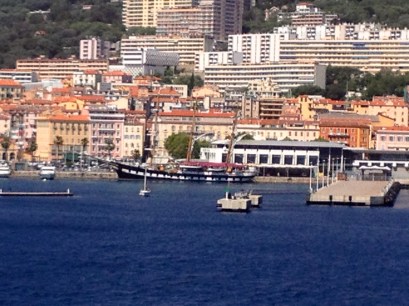 Madame Bartoli was a gracious host with whom we enjoyed chatting. Now a widow and retired, she had spent twenty years teaching in Uganda and regaled us with stories of her time there. At one point in the conversation, she blurted, “I have a passion for Africa.” Our bedroom was decorated in an African theme. As wonderful as she was a conversationalist, she was equally adept as a pastry chef. She had prepared delicious homemade pastries for our breakfast, one of them a moëlleux, made with hazelnut flour, for which she gave us the recipe. We could have spent the entire morning talking with Madame Bartoli, but alas our Corsica trip was coming to an end and we had to embark on the ferry. But once on the ferry, I discovered that I did not have my man-purse with me. I panicked. We called Madame Bartoli who found it on the terrace and since she was only ten minutes away she graciously agreed to bring it to the ferry. Since we were not allowed to walk off the ferry, we had to leave in our car. Luckily, there were no cars impeding our exit. After much trial and error figuring where each of us was located at the port, we finally managed to find each other. Separated by a fence, Madame Bartoli reached through the rails to hand Melanie my man-purse. With bisous (kisses on the cheeks) through the fence and many thanks we said good-bye before re-embarking on the ferry just a few minutes before its departure. Another misadventure of a wayward wallet ending well!
All in all, our nine-day visit to Corsica was memorable. Though it was overcast, rainy and at times windy, our enthusiasm visiting this land of incredible beauty did not wane. Corsica easily charmed us with its welcoming people, spectacular landscapes and limitless panoramic vistas from the ocean to the forested, mountainous interior.


Traveling Corsica has its challenges though. Driving its incessant sinuous and narrow roads at high altitudes is tiresome. It’s nearly impossible to travel from one place to the other without driving over rolling hills or climbing steep mountains. The constant rise and descent of serpentine and dizzying turns is stressing and requires vigilance. A distraction could prove disastrous. And the rapid speed at which the Corsicans drive adds unwelcome tension. At every opportunity we had (and there were few), we moved slightly to the right to allow a parade of cars to pass by. On the road to Corte all traffic was stopped as a herd of goats crossed a country road, where, because of construction, only one lane of traffic served cars in both directions.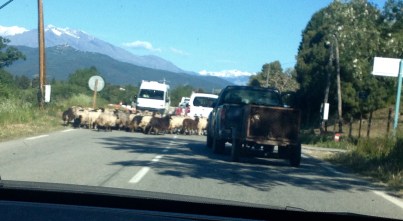
Corsicans are proud of their traditions and way of life. As one of the singers mentioned the night of the concert we attended in Bonifacio, there is a constant tension between being French and being Corsican At the archeological museum in Calvi, we learned more about the rich traditions deeply entrenched in Corsican life. Some Corsicans would like to see an independent Corsica. We saw graffiti, “A Francia Fora” (France Out) in several places. Some street signs that are in both French and Corsican were spray painted over the French. When asked about Corsican’s desire to be independent of France, our hotel receptionist in St. Florent said that it’s not likely but if it did happen, there would be economic disaster quickly in Corsica. Corsicans take great pride in the wide variety of their products: honey, pastries, made with chestnuts, chestnut beer, wine, charcuterie and seafood. We tasted and enjoyed them all. Corsica, the first part of France to be liberated by the allies, and France’s island of beauty, definitely warrants a return trip.


And Life Rolls Along…
We’ve been here in sunny Provence for three weeks now. We’ve settled into the daily rhythms of life. We take walks in the neighborhood and to the beach; we do our shopping at the local supermarket and on Friday mornings, at the open-air market in the public square; we sit at a café en plein air with a pression (draft beer or a pastis(Pernod over ice cubes with splashes of water). We have long conversations with friends over dinner that last until midnight, or casual conversations with strangers we meet as we amble about. We’ve enjoyed just be-ing. Life is good.
Our week began with a trip to Juan-les-Pins to visit our “adopted” French grandchildren, Justine and Louis. Justine spent three weeks with us in South Bend last summer. She and


Louis were spending spring break with their uncle in the warmer Mediterranean sun. It was good to see them because we won’t be visiting Verzenay, a small town near Reims, where their parents own a champagne vineyard. On Saturday, we lunched on our patio for the first time with Laure, the daughter of one of our friends, over a large mixed salad (bread, cheese and wine, de rigueur, of course), followed by a bowl of vanilla ice cream topped with fresh strawberries. Later, we took a bus and then hiked up a fairly steep hill for one and half kilometers for a guided tour of a nineteenth-century mine, Cap Garonne. On the way, we stopped several times to admire the vegetation that lined the road. Melanie was particularly interested in the cork trees, chêne liège, where the bark was cut and sometimes burned. It was also fascinating to see the regrowth of the bark. Now every time I uncork a bottle of wine, I’ll remember this steep climb on the way to the mine.


On Sunday afternoon, we walked down the hill with our friend, Martine, to see a marvelous film, Le Médecin de Campagne, starring François Cluzet and Marianne Denincourt. The film chronicles the harsh realities of life as a country doctor. The acting and cinematography were excellent, though at times, the sound quality coupled with the rapid elocution of the dialogue made the French at times difficult to understand for non-native speakers. Admittedly, I sometimes do not understand everything spoken in English language films.
Dinners with friends have been a common theme in my blogs and this week we have entertained and been fêted in turn. Faculty friends at the university who have been to IUSB as exchange professors treated us to dinner at Le Mayol, a restaurant at the old port in Toulon.

Xavier, Marie, Giles, Emmeline, Alfred, Axelle, Melanie
And the next evening we had a new dining experience, a raclette, at Marie-Hélène’s home with other invitees. In the center of the table was a large pancake shaped cooking device, hollow in the middle where several miniature wrought iron trays were nestled, one for each guest. Charcuterie, topped with cheese, is placed in the middle of the raclette to melt the cheese. The meal reminded me of a seventies fondue party. And the very next evening we invited Martine, our friend and landlady, and Christian and MariThé, for a meal of broiled cauliflower seasoned with zaa’tar as an appetizer, followed by a meal of New Orleans trout amandine and stuffed eggplant. Each evening there was conversation about a sundry of topics, but American politics dominated the discussion.
Eating delicious food was not our only pastime of the week. We went dancing at l’Italienne, a popular dance spot for gray-haired youngsters like us. On Sunday and Tuesday afternoons, there is dancing from 3-7pm. We arrived at 4 and stayed until closing at 7. Two singers, a male and a female, and an accordion player supplemented the canned orchestration. The female singer’s resonant, sultry voice added deeper meaning to the Latin love songs. Most of the music was tangos, Viennese waltzes, Paso Dobles, swing, and lots of rumbas with an occasional cha-cha. We had difficulty finding a rhythm to dance a foxtrot or a slower tempo waltz that the French call the Boston. But that did not hamper us from having a wonderful afternoon of dancing. Unlike the style of dancing at our dance club, Dan O’Day’s, where dancers flow across the room with wide arms and broad steps, the dancers here remain in a close embrace, moving in smaller steps rhythmically across the floor.
As we were leaving, an elderly gentleman spoke to us in a heavy Provençal accent that we did not grasp right away. With a tinge of sadness , he said that all good things must come to an end, to which he followed with a broad smile, “Dancing is great because during these several hours there are no arguments.” We all laughed and nodded in agreement. Once outside the dance hall, another gentleman, perhaps closer to our age, asked me if I was a compatriot from the islands, a question I’m often asked. When I responded that I was from Louisiana, he thought I said Guyana, to which he retorted was not very far away. But once I corrected him, he asked specifically where in Louisiana. That I was from New Orleans prompted him to tell us how much the French love jazz (he mentioned specifically Sidney Bechet) and how the French fought against racism. Sadly, racism continues, he said, even with the election of President Obama.With that last remark, he crossed the street to the bus stop, and we continued on to our car.
Exchanges like these are another way for us integrate into life here. Our apartment on the sloping side of a hill facing the Mediterranean is cozy with adequate space to entertain and receive friends. We have television but we rarely turn it on. Even in the States our tv is silent.

Our “home” in Provence
Thanks to the marvels of technology, we do remain connected to current events. Through the NY Times, the Washington Post and the Chicago Tribune, the Daily Kos and other media, the circus of presidential politics is within reach of our computer’s keyboard.
Yesterday, Martine, MariThé and Christian took us on a lovely drive through the countryside, on ascending winding hills with very sharp turns, to the village of Collobrières where we visited a reconstructed twelfth century monastery, La Chartreuse de la Verne. Today, there are only twenty-eight cloistered nuns who live in the monastery. For a moment, we stood outside and gazed across the forest of chestnut trees and imagined this isolated spot many centuries ago as a haven of prayer for the monks who lived and worked there, and now nuns do the same.


Tomorrow, we leave for Corsica and when we return after a nine-day stay, only three weeks will remain. I could stay here an additional two months. As much as I am thoroughly American, I feel equally connected to the French (a topic that I will explore in another blog).
In the Footsteps of Van Gogh
Birthdays are memorable. I remember celebrating my 23rd in Vietnam, my 27th and 66th in France, and my 49th in Morocco.
I’ve just celebrated my sixty-ninth birthday, April 10, in St. Rémy de Provence, in the footsteps of Van Gogh, with Melanie, Nancy and Jim, Melanie’s cousin and her husband from Taos. Nancy and Jim treated us to lunch at a very nice restaurant in St. Rémy, L’aile ou la Cuisse. We sat in the outside patio, and what a scrumptious meal it was! Pictures of what I ordered follow, a delicious mosaic of salad, fish and dessert.


We spent the night in St. Rémy at a “chambre d’hôte,” a bed and breakfast, in a very small, but neat and comfortable, room attached to the main home a few steps from a swimming pool. Before retiring for the evening we took a walk downtown where we drank a “pression.” a draft beer, at one of the sidewalk cafés that are abundant throughout France. While sipping my beer, I noticed a waiter, sharply attired, exiting from the chic hotel across the street, with a sole drink on a tray. Once the traffic had subsided, allowing him to cross the street , he immediately approached a table near us where several young people were animatedly chatting. He placed the drink, to their surprise, in front of one of them, a young man whom he obviously knew from the laughter that ensued. It was a droll happenstance of life in a small French village.
St. Rémy is a charming village. It’s easy to imagine why Van Gogh would find the town and its environs an inspiration for his painting. In reading the placards disbursed across town that detail Van Gogh’s life, Melanie and I imagined walking with him as he ambled along these same streets.

The soft colors on Provençal houses.
The next morning, we ate the simply prepared French breakfast of bread, cheese, butter, jam, coffee and tea that our hostess had prepared for us. Before leaving, this seventy-eight year old widow, Jacqueline, short in stature with a gracious smile and stately demeanor, chatted with us for half an hour about what life has been for her recently. She had buried her ninety-year old mother just four months ago. The last three years of her mother’s life had not been good. Her mother lived in Champagne and the burden of caring for her was left to her sister who lived in Paris. And for those last three years, she went frequently to Champagne to help her sister care for their mother. As she talked, it become increasingly obvious to us that she was lonely and happy to have someone with whom to talk. She said that living was getting harder. And although she meets interesting people, her work keeping up the “chambre d’hôte” is hard for her. She continued sharing personal stories, mentioning that her sister’s husband was an alcoholic which added to the stress of caring for their mother. Because of her loneliness, she herself thought that life was no longer worth living, until her grandson one day, who had been contemplating suicide, said he did not because of her. So she carries on for him.
Before leaving St. Rémy we visited the asylum where Van Gogh spent his last days. There we visited his room and walked in the gardens where he painted. The place is still a functional mental health facility.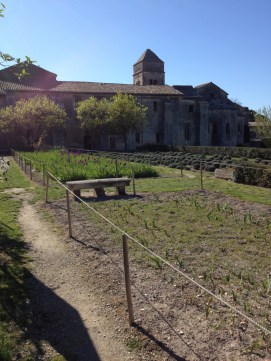 Had twenty-first century treatment of mental illness been available to Van Gogh in late nineteenth-century France, there would have been perhaps a different outcome to his life and many more hundreds of canvases before he eventually died. In the short ten-year span that he did paint, there are over seven hundred canvases in museums and private collections.
The day before my birthday lunch we met Nancy and Jim at another one of their favorite restaurants, Jardin sur le Quai, in L’Isle-sur-la-Sorgue. Jim and Nancy are gourmets; they appreciate what delights food brings to the palate. They know the best places to eat; each spring they caravan in France for two to three months. Amanda, Melanie’s daughter, another fine dining aficionado, joins them them every year for a couple of weeks, but she will arrive a few days later. After lunch, Nancy and Jim returned to their caravan, and Melanie and I strolled along the main street popping in and out of antique shops. In one of them, we saw a beautiful, lavishly ornate, seventeenth century Mazarin desk at the princely sum of $24,000 euros.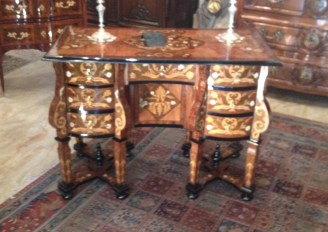 Naw! We were not tempted! It did not suit our tastes, nor did it accommodate our pocket book. However, if I had the resources of Monsieur Trump!
And speaking of the leading Republican candidate, our French friends are horrified and consider him dangerous! They are fearful that Trump may be America’s president, and wonder how such a person could possibly be elected as President Obama’s successor. We have tried to assuage their misgivings, but Trump’s rise mirrors the political climate here in France with the growing popularity of Marine Le Pen’s radical right National Front Party. The disgust for Trump is widespread. The cover of Charlie Hebdo, the satirical newspaper that suffered the terrorist attack in January of last year, has a special edition of the entire front cover depicting the Donald with a toilet bowl refresher hanging from his mouth. I’m saving that edition as a souvenir.
So after two weeks, we have not done as much traveling and exploring as we have in the past. We’ve been content to “just be,” absorbing, as much as possible, Provençal life. And although we like to discover new things, we don’t feel compelled to run hither and thither, as tourists often do.We spent one afternoon at the beach in Giens, a twenty minute car ride from our apartment, where we happily watched the dozens of wind and kite surfers. We were amazed that among the hordes of kites in the sky there were no entanglements. We also marveled at the graceful leaps in the air of the kite surfers. We learned later that surfers who compete train here.


We’re also content to sit quietly with a book. We’ve been reading French translations of novels by Martha Grimes and John Grisham. They are interesting reads because we learn new idioms and slang, expressions used in daily life but not found in the more literary texts that we’re accustomed to reading.
Yesterday, we ventured into downtown Toulon on the bus with our senior passes. We made brief stops at the grocery store and pharmacy for Advil and a balm for the nagging pain in Melanie’s shoulder. From there, we lunched at our favorite outdoor  café, Le Marais, near the Arab Quarter.
It’s under different management now, but the food and ambience were still fabulous. We chatted with the new owner, David, and the chef, Gregory who came out to greet the diners.
As we walked through the Arab Quarter, it struck me how natural and normal life was there. We stumbled upon the Tuesday afternoon market, bustling with Muslim and non-Muslim shoppers, families and other pedestrians passing through. Some women were draped in traditional clothing, others with their heads covered, but many dressed in modern, western clothing. We saw one Muslim family, the husband with his arm around his wife who was covered, a public display of affection not usually seen among Muslim couples. Both of their kids were dressed casually in jeans and sweats. But what was most noticeable to me was the lack of angst and fear that might have been expected due to the recent terrorist attacks in Paris and Bruxelles. The only evidence that we saw of any tension or heightened alertness was at the Marseille airport. When we arrived, there were only two soldiers pacing around that we noticed, and only one with a weapon.
After lunch, on our way to the bus stop, we turned a corner into a deserted street, where a Muslim man with a bottle of Heineken was speaking loudly to himself in French, and obviously very drunk. As we exited the street, another Muslim man with contempt for this scene, pointed a finger to his head and nodded indicating that he thought the other man was crazy. Just another slice of life in Toulon.

Birthday Lunch with Jim, Nancy and Melanie
The Golden Light of Provence, 2016
There is something magical about Provence that keeps drawing me back. Perhaps it’s the golden light of the Provençal sun with its deep rich blue Mediterranean skies. Cézanne, Gauguin and Van Gogh certainly captured it in their canvases.

Melanie in Garden of Notre Dame de Pitié in St. Rémy de Provence. The statue is of Frédéric Mistral, Provençal author.
Like them, I too am enchanted by the early morning light. In the morning, the sun glides gently across rustic, red-tiled roofs; the evening sun cascades over the verdant countryside. When we arrived just over a week ago, the sun was a welcome change from the cold, overcast days we left behind in South Bend. But for the next five days, rain and the blustery winds of the Mistral reminded us that these early days of spring in Provence still bring wintry conditions. Now the sun is back and we are grateful.
Our first days here have been spent setting up household. We’ve gone to the local supermarket, the Casino, and to the Friday morning open market in the town square. We’ve also made trips to our favorite boulangerie and to the boucherie. We’ve gotten our senior bus passes and new SIM cards for our phones. And now we’re slowly settling in to daily Provençal living. Our apartment, the same as we had two years ago, sits on a hill facing the Mediterranean. The sea is not visible, but the glass wall that lines our kitchen and sitting area give us a wonderful view of the garden below, the trees and rooftops of the houses, and in the distance to the west, the mountains.
What has made our visits to Provence even more special are the friends we’ve made over the years, most of them through the exchange program between IUSB and the Université de Toulon-Var. Since our arrival, we’ve been welcomed and feted. On Sunday morning, we went to the flea market with our friends, Christian and MariThé, and returned to their home for a “simple” meal of lentils and sausage with a cauliflower and asparagus salad. There was, of course, wine and cheese. And, bien entendu, the baguette! After our meal, we showed our friends the YouTube video of our latest spotlight dance at our dance studio, a waltz to the music of the Cajun singer, Zachary Richard. Christian, a big fan of international music, introduced us to the jazz of a Brazilian piano player, Eliana Elias, and to the American group, Pink Martini. Ari Shapiro, of NPR (National Public Radio), is an occasional guest artist with the latter group.
On another evening, our landlady, and friend, Martine, brought us a delicious Moroccan soup, chorba, with lamb, chick peas and vegetables. Another time, she surprised us, with a knock on the door and a smile, with chocolate mousse topped with almonds. And yesterday evening, we dined at another friend’s on fish and steamed vegetables with aioli (garlic mayonnaise sauce). We’ve had very little time to prepare a sumptuous meal of our own. But am I concerned?
Today our friend, Martine, invited us to an afternoon drive to the medieval village, Le Castellet. Like many of the Provençal villages from the Middle Ages, Le Castellet sits atop a mountainous hill overlooking large swaths of verdant, neatly sculptured vineyards and fields. As we wound our way through narrow stone streets, we visited several chic boutiques, a sign that this village caters to tourists. I bought a new wallet, Melanie a salmon colored scarf that matched perfectly the sweater she was wearing, and Martine found a scented candle that she says will last her several months. After a stop at Sanary-sur-Mer, where we casually walked along the pier, we started our journey home, during rush hour, squeezed among a slow moving caravan of cars along narrow streets. Later in the evening, at eight to be precise, the usual hour when meals begin here, we dined at Martine’s with Christian and MariThé, over pumpkin soup as a first course followed by mixed fresh vegetables and roasted turkey breast. Dessert was a bowl of fresh fruit. Dining in our friends’ homes is a delight. But our friends are quick to point out that it’s nothing more than a “repas simple,” a simple meal. Whether it is or not is disputable, but what is clear, our palates have not suffered.
Tonight, we’ll eat at home, a simple meal of sautéed spinach and baked cod rubbed in zaa’tar, a Lebanese blend of spices. Melanie wanted to buy it at the Friday market in the downtown square from the vendor selling spices. Since it was unknown to her, she immediately researched it on her iPhone. She then made a sachet for us with the spices she had — sumac, oregano, thyme, sesame seeds, basil, and marjoram. Since it was a particuarly sunny day, there were more people at the market than the previous Friday. We bumped into MariThé, who introduced us to a vendor selling homemade goat cheese. The Friday market is a real treat for us as we meander among the different vendors comparing prices and the quality of the fruit and vegetables. We blend in as local residents. It’s nice to see familiar faces and to know that the vendors we frequent remember us.
Yes, there is much to like here that makes us feel at home. Yesterday in Le Castellet, we were reminded of just how special Provence is when at the candle boutique the saleslady, remarking on the beautiful Provençal day , said, “Les vignes, les collines, la mer, ça, ç’est le paradis!” (The vineyards, the hills, the sea, that is paradise!). In that one phrase, she captured the magical charm of this region in southern France.
Tale of the Wayward Wallet
In grade school we memorized Longfellow’s poem, “Paul Revere’s Ride,” and the verse that still rings in my head is, “Listen, my children, and you shall hear of the midnight ride of Paul Revere.” Well, after many months of anticipating our return trip to Provence, there’s another tale I’d like to relate, that of the wayward wallet. And so it begins.
After deplaning seemingly without any of the expected delays and hassles at Charles de Gaulle airport in Paris, we reached the connecting gate of our flight to Marseille and settled on board on the last leg of our journey to our beloved Provence. Once in Marseille, we learned that our rental car did not have GPS, necessitating a stop to buy one en route to Le Pradet, where we will spend the next two months. At the Carrefour, the French version of a large Wal-Mart or Sam’s Club, just outside of Marseille, our salesman politely explained to us the differences between a Garmin and a Tom-Tom. Once he learned that we were having an extended visit in France and that we planned a trip to Corsica, he suddenly became a tour guide, urging us to discover “la Corsica profonde” and regaled us with stories about Corsica’s beauty and what we should do there. Apparently, he was not pressed for time as he spent almost an hour with us while marveling at our correct and precise French.
The Tom-Tom was on sale, so we bought it. At the checkout counter, I reached for my wallet in my man-purse and discovered it was missing. Many men in France carry leather purses; it’s more convenient than having over-stuffed pockets. Mine was bought in Taos where cowboys too walk around with leather accessories. Excuse the slight digression; now back to my tale.
When I discovered my wallet missing, I panicked, certain that I had been pick-pocketed in the Paris airport. With Melanie’s credit card, we completed our purchase. Without my credit cards, cash, medical cards, and driver’s license, I felt naked and vulnerable. But that did not stop me from driving to Toulon and then on to Le Pradet. And since I did not install the GPS right away and relied on memory, we got sidetracked on our journey by taking several wrong turns. A one hour drive quickly stretched into over two hours, making us slightly late for lunch at our friends’ home. But before eating lunch our friends suggested that I immediately report my stolen wallet to our credit card companies, which I dutifully did. After lunch, we all went to the National Police in a neighboring town so that I could report the theft of my wallet. There we rang a bell and entered a courtyard before entering into a nondescript building whose nearly blank walls and sparse furnishings reminded me of an asylum. A friendly policeman greeted us at the reception desk, took my information and jotted it down in a ledger, then asked us to take a seat. A few minutes later we were greeted by yet another open and friendly policeman who led us through a series of hallways and upstairs to an office whose walls were decorated with French movie posters –– La French and MR73, starring one of our favorite French actors, Daniel Auteil — odd names, but apparently popular in France. Bemused by the tale of my stolen wallet, the friendly policeman gave me the expected warning to guard closely against pickpockets in France and seemed apologetic about my loss. I assured him that these things happened in the States as well. He asked me a series of questions that he typed into a computer as he continued to chat animately with us. During this time, my jet-lag was catching up with me as I repeatedly yawned, fighting hard to keep my droopy eyelids open. The policeman seemed amused by this making several comments about my drowsiness. Just as he was wrapping up his questioning, I unzipped a pocket in my man-purse that I had not opened before, and lo and behold, there was my wayward wallet. The policeman, astonished by my find, quickly smiled and said that was the quickest rediscovery of a lost item that he had ever witnessed. We all had a good laugh — at my expense of course. This banter continued a few moments longer and then he offered me a present, a patch of the National Police so I could be his “adjoint” (assistant). Our friends told us later that a gift of a patch from the National Police to a stranger never happens. I can only surmise that this was the first time this policeman ever encountered a situation like mine.
So what have I learned from this episode? First, never assume the worse until all options are explored. Second, remain calm before panicking. And really, as seasoned an international traveler as I think I am, I should have been aware of where my money and important documents were. Happily, yesterday’s panic is now over. Today, I am blessed to be here in southern France, where in the rain and the accompanying Mistral winds, the vendor at the fish market remembered us with a cheery greeting. I feel at home. Stay tuned!
 Alfred Guillaume
Recent Comments