For the Love of Art

Crater Lake by Anthony Droege
“Art enables us to find ourselves and lose ourselves at the same time.”
Thomas Merton
Art and the creative imagination of those who create it fascinate me. It was in the early sixties when I first became enthralled by art. As a thirteen-year old Josephite seminarian in Newburgh, New York, I routinely roamed the narrow library stacks, browsing art books. Then, I was particularly attracted to religious themes and natural landscapes. The grim images of the suffering Jesus or the facial expressions of devout men and women in angelic ecstasy enveloped me spiritually. I longed to imitate their unrestrained piety. Among the many religious depictions I most admired were those of the baby Jesus with his mother, Mary. But it was the dark and brooding landscape pantings that impressed me most. Their seductive allure beckoned me to discover hidden secrets within nature’s thick foliage. Beyond the fascination of landscapes, the female body intrigued me. I leafed through those pages, furtively glancing at nudes, my budding puberty awakened.


(Images from the National Galleries in Washington, D.C.)
Now in my seventh decade, I find less appealing the religious artwork of the Grand Old Masters. The posed frozen facial features of their subjects staring blandly from the canvasses are less enticing. Yet there are moments when their stares meet mine that I feel the eerie crawl of goosebumps. Are we subtly communicating with each other? Landscapes, particularly those of the Impressionists, still enthuse me. The artists’ artificial rendering of the natural world makes nature’s bounty and grace alive and tangible. And as for those nudes, I admire the artists’ dexterous and graceful portrayal of the human body.
In my travels, I never pass an opportunity to visit a museum. Even in the smallest village or town, I’ve found magnificent art. A few years ago in the Portland Museum of Art, I stumbled across a Picasso, clearly not a major piece, but nonetheless a Picasso. In the local museum in the small city of Utica, New York, there was a lovely Georgia O’Keeffe equal to any of her works on display at the Art Institute of Chicago, or so it appeared to my novice eyes. Many years ago, I remember being pleasantly surprised by an El Greco in the St. Louis Museum of Art. There are several paintings by John Singer Sargent, one of my most admired portraitists, at the Isabella Stewart Gardner Museum in Boston that are amazingly photographic. Happily, since I spend extended periods in France, there is an abundance of museums for me to indulge my passion for art.
Within the last few weeks in visits first to Chicago and then D.C., Melanie and I spent afternoons at the Art Institute and the National Galleries. In Chicago, we met Melanie’s grand-niece who, taking a respite from her missionary duties in Costa Rica, was spending a few a days in Chicago with friends. Naturally, as we visited with her we strolled through the Impressionist wing, lingering long enough to observe with new eyes the canvasses we’ve seen dozens of time. Particularly interesting, and a singular reason why we all met at the Institute, was the special Rodin exhibit. Ultimately, we wound our way to the Modern Wing. Admittedly, I favor realism over abstraction, but there are many Modern Art canvasses that I find strikingly beautiful in their complexity. A Picasso or Matisse, even a Dali or Braque, can transport me. I have more difficulty though appreciating Rothko or Jackson Pollock. In each of the museums, we observed artists standing or sitting in front of unfinished canvasses imitating one of the masterpieces on display. Apparently, this is an important learning exercise for both neophytes and mature artists. In his book, The Greater Journey: Americans in Paris, David McCulough makes note that artists like John Singer Sargent and Mary Cassatt did likewise in the Louvre.


(Images from the Art Institute in Chicago)
Primitive art also fascinates me. It is equally as important in my view, as the more sophisticated forms of art. Though it is deceptively simple, it still depicts deep common truths and perspectives. Great artists like Picasso and Gauguin have included primitive themes in their work. Being a native Louisianan, it is not surprising that I like Clementine Hunter’s art. Her work is highly copied and dishonestly promoted as originals. Haitian art with its vibrant colors, also appeals to me. Walking the streets of old San Juan, Puerto Rico, I stumbled across a gathering of Haitian artists in a dilapidated studio. Hearing a soft lyrical French sounding dialect — it was actually Creole — I entered a dimly lit room and began speaking French to them. Before leaving I had purchased a small painting. Many years later, I discovered that Haitian art can be purchased through the Vassar Haiti Project.
My tastes in art have been further nurtured by my university career. I’ve been fortunate to work at universities with first-rate faculty artists. At Xavier, I admired the work of John T. Scott, a sculptor now deceased, whose work is found in many public spaces in New Orleans. Scott’s tortured body of Jesus, twisted pieces of metal suspended on a wooden cross, hangs in our bedroom. There were fine artists on the faculty at Saint Louis and Humboldt universities, but none, in my estimation, equal to the remarkably gifted artists at Indiana University South Bend — Harold Zisla (now deceased), Anthony Droege, Alan Larkin, Ron Monsma, Tuck Langland and Dora Natella, the latter two sculptors. The work of each of these highly lauded artists is in museums and private collections regionally and nationally, and in my view, is of the quality that could be included among the world’s finest museum collections. The impact and importance of their work are chronicled in the book, Fine Arts of the South Bend Region: 1840-2000, by the Wolfson Press of Indiana University South Bend, 2014.
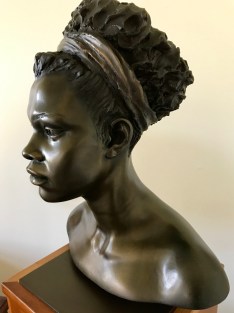
Angel by Dora Natella
Through my son and daughter-in-law, both MFA graduates in photography from the Museum of Fine Arts, Boston, I’ve learned to appreciate photography as a high form of artistic endeavor. When I visit museums, I now search for the photography collection. Because of them, I now look at photos and imagine seeing the subjects through the photographer’s eyes wondering what he or she wants the viewer to observe and know. Texture, light and tone have meaning. They are purposeful and not random abstractions. When Paul speaks about his creative process, I listen attentively, intrigued by his explanations of how he approaches photography. I may not fully grasp the complexities of his thought process or his technique, something he calls light chamber exposure, but what I am certain about is my admiration of his creative mind and the way he thinks about art. Found objects and memory play heavily in his manipulation of reality.

Sunday Morning 1986 by Paul Jude Guillaume
Sometimes I dream of what it would be like to have unlimited funds to purchase art. From time to time, I read a newspaper article about a collector who had an eye for a certain kind of art, or of a relatively unknown artist whose collection becomes valuable after several decades. I imagine what it would be like to be such a person. But for the moment, I am content to roam from room to room in our home, admiring the modest collection of art that Melanie and I have been fortunate to acquire.
What I enjoy most about art is discerning the artist’s intent, then surreptitiously harboring sentiments that are mine alone. Such an exercise is akin to an explication de texte of a poem or literary passage. No one can share the same interpretation of and reaction to Monet’s waterlilies or to Van Gogh’s myriad renditions of his bedroom. In that way, the power that art holds over the individual is uniquely personal.
So that I could better know what to look for in a painting, I audited a survey class of Western Art taught by the inimitable Professor Andrea Rusnock in the semester after my retirement. What a joy! In her class, I learned how to look intimately at a canvass, exploring its subtle details. In that regard, I now examine a Vermeer painting, looking for features that may amplify and elucidate the entire composition. And frankly, being a student without fear of a grade made the learning experience that much more enjoyable. I amused Andrea by chiming in occasionally with a comment or two!
Although I’ve written principally about painting and sculpture, the aesthetic appeal of architecture captivates me. I’m fortunate to live near Chicago, one of the most interesting cities architecturally. One of our favorite things to do is the architectural boat tour with visitors. I sense that my curiosity in art will never be satiated. Each viewing of a canvass, a sculpture, or ceramic brings new sentiments, new sensorial experiences. My journey to satisfy my artistic thirst continues. At the Art Institute in Chicago this summer, there are two exhibits I am eager to see, Charles White, and John Singer Sargent. Both of these artists had ties to Chicago. White, an African American born in Chicago, drew inspiration from his time in the city, and Sargent from his Chicago patrons and creative circle. Artistic discoveries await me every day!
Burying the Past – 2017
“Gonna Lay Down My Burdens” (Traditional Negro Spiritual)

Panorama Jazz Band
New Orleans is a land of many surprises. She never fails to amaze. Such was the case Sunday morning, January 7th during services at the First Unitarian Universalist Church on Claiborne Avenue. Congregants from the three area Unitarian churches gathered for the annual enactment of a New Orleans-style jazz funeral to bury regrets from the previous year wth resolve to begin anew in the coming year. The host minister opened the service with an explanation of the traditions of a jazz funeral with alternating recitations by the visiting ministers. After the lighting of the Unitarian chalice, the wake service began with the brass band playing Negro spirituals as the congregation sang along: “Gonna Lay My Burden Down,” “What a Friend We Have in Jesus,” “Glory, Glory Hallelujah,” ” Precious Lord Take My Hand,” “Nearer My God to Thee. ” The singing and the doleful brass sounds that enveloped the entire church emitted an emotionally charged feeling mixed with both sorrow and joy. The hymn that gave me goosebumps, and always does, was “Precious Lord Take My Hand,” a favorite of the Rev. Dr. King that was sung by Mahalia Jackson at the march on Washington in 1963. Although it was a Unitarian service, it had the feeling of being both a revival and a celebratory musical ode to life. The order of service with historical context of the meaning and purpose of jazz funerals is at this link.
At the minister’s invitation, we wrote our 2017 regrets on paper, and as the band played a soulful dirge, we marched in procession toward the sanctuary to place them in a coffin. My regrets were about the social and political angst endangering our country: President Trump’s tweets; the spewing of white supremacy hate; anti-immigration anger; racism; religious intolerance; gay bashing; congressional partisan stalemate and bickering. Melanie’s regrets were of a personal nature.
After the wake, the band played a mournful dirge as the coffin was wheeled out of the church by the pallbearers, a young mother and father and their four-year old son. The mourners followed solemnly behind. In the symbolic burial, the minister burned the regrets in the church’s courtyard. Then, as is the custom, the band led the departing mourners in a spirited Second Line dance in a celebration of life. Umbrellas opened and handkerchiefs waved as the mourners danced to the syncopated beat of the brass sounds: “Oh! When the Saints go Marching In, I want to be in that number!”


A jazz brunch followed the services, where we had the pleasure of meeting and dining with an ex-patriot from La Rochelle, France, a refugee from Honduras who told a horrifying story of his journey on foot to the United States in the early nineties, and a generations-old Louisiana French Creole. It was the latter who invited us to join him the next day for the monthly meeting of the Causeries du lundi, a French speaking group of ex-pats and local Francophones that sponsors activities to promote French language and culture. There, we heard an interesting lecture in French on Cajun culture by the cinematographer, Glen Pitre. And, not surprisedly, the lecture was followed by a light luncheon of wine and finger food.
The other grand surprise of the morning was the shock of seeing at the service Michele Lankford of Thyme of Grace, the owner and proprietor of one of our favorite restaurants in South Bend. We were dumbfounded to see her so far from home. There is obviously truth in the adage that the world is a small place, and a reminder that one must always be on one’s best behavior. Michele was in New Orleans with friends from South Bend and Houston to celebrate the Houstonian friend’s birthday. Unfortunately, they could not stay for the entire service because of lunch reservations. From their telling, Michele and her friends were having a grand time in my native city. As we natives say, “Love New Orleans and she’ll love you right back.”


While Michele and her friends are here to savor the city’s charm, we’re here to celebrate my mom’s 92nd birthday, January 11. The following Sunday my four siblings, nieces, nephews, and several friends celebrated the grand birthday with a New Orleans feast of pot roast, grilled salmon, jambalaya, sweet potatoes and pumpkin (topped with Louisiana pecans), mac and cheese, potato salad, green beans, yellow and green squash, and many diferent salads. Surely, I must be missing something. I stuffed myself and had little room for the ice cream and cake that followed. Home cooking is almost always an epicurean treat as any New Orleanian can attest. In every New Orleans home, family stories abound of gourmet cooking by a favorite aunt or grandmother.
The “pièce de résistance” was watching the Saints and Vikings football game. The first half was a disappointment, but the Saints came roaring back only to lose 29-24 in the waning seconds. Imagine the noisy elation in my mother’s house when the Saints took the lead and then the mournful woes of despair when they lost. If only that third and one running play had been successful! Oh well! We can follow the script of a jazz funeral by burying this game and keeping hope alive for next year.


Sunday family visits are long New Orleans traditions. Each Sunday, my siblings gather at my Mom’s home. Below are pictures of my brother and me with his grandsons and my niece with her three boys.


Whenever, I am in New Orleans I try to eat at least one po-boy and this visit was no exception. With friends, Tom and Judith Bonner, we lunched at the famous Rib Room of the Royal Orleans where I enjoyed a delicious turtle soup. After lunch we visited the Historic New Orleans Collection, a repository and museum of New Orleans historical artifacts, where Judith is a curator of art. Since I will be teaching a one-hour graduate seminar on Southern Louisiana Culture at IUSB this spring, I wanted to visit the museum. Tom is a scholar of Southern literature and he and Judith suggested resources that would be helpful for my course. While touring the museum, we unexpectedly came across a large painted portrait in one of the halls of the Rev. Theodore Clapp, the founder of the First Unitarian Church in New Orleans in 1833. What is significant about him he welcomed people of color as members of his congregation, something uncommon during that time in antebellum Louisiana.
Later in the week, we dined with friends Johnny and Anne Barron at a very popular neighborhood uptown café, Superior Seafood, There I enjoyed one of New Orleans’ traditional drinks, a Sazerac, rye bourbon with absinthe and bitters, followed by a flavorful crab and crawfish bisque.
After a week and half here in the Crescent City, we originally planned to leave today, but icy road conditions from a wintry storm across the Midwest delayed our return. Hopefully, road conditions will improve by tomorrow morning. We’ll be back in April for my nephew’s wedding, another occasion to “Let the good times roll.”
Grand-parenting Lore
As we welcome in the New Year, there is much to celebrate. To many, including me, our national politics seems chaotic. Thankfully, there are the smiles and laughter of little children that remind us that life is full of joy and that people of goodwill still abound. Those little ones keep us anchored; their simple gestures bring light to the world and hope for the future.
The old adage that it is more fun to be a grandparent than a parent rings true on so many levels. First, we don’t have the primary responsibility of rearing and educating our precious little darlings. Second, when they are upset or moody, we are more than happy to hand them over to their parents. Having raised children of our own, we are wise in the ways of childrearing, at least we deceive ourselves in thinking so. As we observe our progeny in parenting their own, the temptation to offer advice lingers on the tip of our tongues, but we wisely refrain. However, if asked, we’ll gladly oblige.


Our wisdom, such as it is, is the product of raising four children, two each from separate marriages. All of our children are doing well in their chosen careers living in exciting places, Boston, Washington, DC, Portland, OR and Las Vegas. We love them dearly. But our heartstrings are pulled by four beautiful grandkids, Eliot a month shy of 5, Michelle 3, Theron and Juliette both 1. Unluckily, vast distances separate us as they live on both coasts. Two grandsons are in Portland, and two granddaughters in Washington, DC. Happily, FaceTime, Skype and Google Chat keep us connected. During the autumn and winter months, we had the happy occasion to see them in the flesh, a car trip to D.C. and a lovely train ride to Portland. Whenever we visit, we marvel at the parenting skills of our sons and daugthers-in-law. As parents, they are sensitive, caring, thoughtful, seemingly perfectly in tune with their children. They listen attentively, comfort them calmly in their distress, and assure them of their love. Melanie and I are amazed at their calm demeanor, even when everything appears in turmoil. As a young parent, I can recall my frustrations when little tempers flared or stubbornness surfaced. Sometimes we think our own children are handling parenthood more skillfully than we did. Or are they? Reflecting on our time as parents, we readily admit the mistakes we made. We shudder thinking back on some of them. In spite of our parenting errors, our kids have grown up to be responsible adults, pursuing interesting careers. We’d like to believe that they acquired the art of parenting totally from us. But obviously, that is not the case. We’re certain that as they reflect on their own upbringing they do not want to emulate all of our parenting techniques.


I remember as a new dad that I wanted to parent differently from my parents. I know now that my obstinacy blinded me from learning helpful parenting tips. In parenting, my dad was what you might call “old school.” He believed firmly that sparing the rod, spoiled the child and that there was a proper time when children should be heard. Once when I refused to spank my firstborn toddler, he and I became embroiled in a heated argument about the “proper” way to raise a child. I felt that his arcane ways were no longer relevant. Truthfully, I could have been a more receptive listener. At times when I tried to discipline, I overly compensated between being too harsh and too lenient resulting in total ineffectiveness. When I did not achieve the behaviors I expected of my children, frustration and anger gnawed within for not being the controlled disciplinarian my father was. Overall, I muddled through and like to think that my sons have forgiven my parenting shortcomings. And even as I have grown older, and wiser, I appreciate my dad’s disciplined parenting, understanding now his earnestness in protecting my siblings and me from lurking dangers in New Orleans’ segregated society. A misstep could be consequential. As “Negroes,” he did not want us to be labeled in stereotypical images falsely held by the majority.
Melanie and I reached adulthood in the sixties, she in the Northeast and I in the deep South. Those were turbulent and troubling times–the fight for Civil Rights, the war on poverty, the Women’s Movement, protests against the Vietnam War. Our grandkids live in a different world, full of opportunities, but the incidents of the last year from the Charlottesville protests to the #MeToo Movement teach us that the challenges of equality, fairness, and justice remain in their future. Because of the way our grandchildren are being raised, we, as grandparents are optimistic that they will prevail in overcoming these obstacles and be part of the solution for a more equitable and just society. Our children are already moving in that direction, and our grandchildren will build on that progress.


For the moment, we pause in the present and bathe in the happiness these four little ones give us. Their smiles and laughter and their cheerful playfulness in fanciful imaginings lighten our hearts. The beauty of grand-parenting is the thrill of rolling on the floor with them, running around the room as they chase us, or we them, in gleeful mirth, taking walks with them to the park or around the neighborhood. On the swings or slides their energy seems limitless. When they shout “Push me higher Papi” or “Read to me Mamie,” we gladly respond to these angelic voices. Grand-parenting gives new meaning to our lives, a supreme joy we treasure deep within our souls. We enjoy too watching our own children interact with theirs. They embrace their children with love and tenderness. It’s moving to see a little one give a spontaneous big hug to his/her mom or dad, to listen to the cooing sound of a baby nursing, to appreciate the calm voice of a parent comforting a child in distress. And there is unparalleled joy in watching comedy unfold as a little one struggles to put on his/her sock, or one of their younger siblings eating messily. And yes, there is the inevitable drama when a hungry one distressfully cries to be fed, or a scraped knee demands immediate attention, or pouting and shrill voices require a disciplined response. At such times, grand-parenting skills yield to the parent’s deft and appropriate handling. In grand-parenting lore, it’s called “time for the parent” to takeover.”


When we are home, our conversation often drifts toward the memory of those special moments of a sweet phrase uttered, a happy song cheerfully sung in play, a meaningless, but somehow magical, babble of repetitive sounds. Some of our favorites are: Eliot’s response as a two year old watching a train go by, “Train, heart boom-boom,” or when he placed a toy football on my legs in shorts, “Ball brown, Papi brown, what color is me?” And one of our gems is his response to Melanie calling him her sweetie pie, “I’m not your sweetie pie.” Then there is Michelle who used to attend a Spanish language daycare and now attends a bi-lingual pre-school, seeking help shouts out to Melanie, “Ayudame (Help me) Mamie. And Theron’s and Juliette’s singsong babbling are delightful treats, Theron’s chanting of ba-ba-ba-ba and Juliette’s dit-dit-dit-dit.
At the birth of our firstborns we imagined no greater happiness, that is until the birth of our second-borns. That immense joy and excitement has been repeated fourfold in the births of our four grandchildren. We are proud and grateful grandparents. A collage of photos follows.


Southwest Redux

The ground on which we stand is sacred ground. It is the blood of our ancestors. Chief Plenty Coups, Crow
We don’t inherit the earth from our ancestors, we borrow it from our children. Native American Proverb
Several months have passed since our five-week-southwest journey with friends from southern France. Embedded in my nostalgic reveries are images of unparalleled beauty, lush ascending and descending valleys, graceful rolling mountains, and gigantic rock formations of multitudinous colors and shapes. We and our friends were in perpetual awe of Nature’s grandeur. In all my travels across the globe, this trip will remain as one of the most memorable. As a complement to our euphoria, we listened to the evocative western frontier American masterpieces of Antonin Dvorak and Aaron Copland. The sonorous strings of Dvorak’s String Quartet in F Major,Op. 96 and the blaring horns of Copland’s Music of America (Rodeo and Fanfare for the Common Man) echoed the spiritual tranquility of these incredibly majestic landscapes.
Mesmerized, I imagined this rustic scenery as the backdrop of the galloping cowboys of my 1950s youth when shooting marbles and playing cowboys and Indians were king. In our fanciful play we imitated the wild west frontier on the silver screens of our family’s black and white Philco. Roy Rogers, the Lone Ranger, Gene Autry and the Cisco Kid were our heroes. Like them, we chased the bad guys, cattle rustlers and Indians. But that was a distant time of innocent youth. That innocence quickly faded when I considered the Native Americans’ painful loss of this land to westward expansion. I imagined this territory inhabited by millions of Native tribal communities. Then, buffalo and other wildlife roamed freely on the range. Today, the buffalo, once nearly extinct, are contained on land preserves; Native homelands are isolated, barren flatlands. Our country’s historical treatment of Native populations has caused generational problems and suffering. A further examination of why is beyond the scope of this brief blog.
Prior to our trip, a friend visiting from Wisconsin suggested that I read Timothy Eagan’s book, Short Nights of the Spirit Catcher, about the famed early twentieth century photographer, Edward S. Curtis, who worked tirelessly and industriously to capture in photographs the rapidly fading culture of Native Americans. His images are haunting.

Princess Angeline, Kikiblosu, daughter of Chief Seattle
In posed profiles, he captured the sadness and suffering of vanishing Native American tribes. Other photographs depicted the daily activities of Indian life. Thanks to his interest in the new technologies of the camera and the recorder, he preserved in photographs and recordings disintegrating cultures and dying languages. Even today, the Native way of living struggles mightily against the tide of assimilation.
This became starkly evident when one afternoon during a refueling stop, I picked up a copy of the May 11, Navajo Times. Reading it was akin to peering into life on the reservation. Within its pages were a full-page congratulatory ad listing the names of all the graduates of Navajo Technical University, articles about family services on the reservation, the construction of a new high school, racial profiling, a heartfelt Happy Mother’s Day tribute to a deceased mother, a column on the Navajo Blessingway ceremony and other general interest stories pertinent to the local Indian community. Interestingly, there was a front page article about scientists and students from Notre Dame working with the local community to clean up an abandoned uranium mine site that had been an environmental hazard to the residents of the reservation. But the most intriguing story, a guest column, was written by a young Navajo woman about her tenacity to hold onto her Navajo heritage amidst the overwhelming majority American culture. I resonated with her struggle to maintain her Native identity. I, too, struggle to seek balance among the tensions among my multiple ethnic, cultural, racial and linguistic identities. I wrote about it in an article that was re-published in an intercultural textbook (Among Us: Essays on Identity, Belonging, and Intercultural Competence).
When we returned from our trip, I vowed to learn more about the Native American experience in the United States. My desire to know more flows from my own cultural background. My paternal great-grandmother, known as Papoose, and deceased before my birth, was from a little known Louisiana tribe, the Houma Indians. I know her only from a family photograph in which she is dressed in tribal garb. I’ve always taken great pride in sharing this kinship with Native Americans.
My other, perhaps more intimate contact, dates to my time as provost and vice president for academic affairs at Humboldt State University. The campus, nestled among the redwoods and overlooking Humboldt Bay, was home to the Center for Indian Community Development. Several tribes reside in this northern, remote section of California – Hupa, Wiyot (HSU was once the land of the Wiyots), Karok, and Yurok. The Center’s director, a Hupa Indian woman, personally took me to meet with many tribal communities to discover how best the university and the respective tribes could align in partnership. During my time at HSU, I learned about the peculiar status of these tribal communities as sovereign and independent nations within the United States.
But it was through the reading of Benjamin Madley’s book, American Genocide: The United States and the California Indian Catastrophe that I learned in more detail of the horrifying state and government sponsored slaughter of Native American tribal communities. Wanton killing of women, children and the elderly, enslavement of surviving men, total destruction of homes, livestock and agricultural fields. All of these were part of institutionalized annihilation of the Indian. Madley’s book details these gruesome killing campaigns in California from roughly 1846-1873. The Indian was defined by Anglo-Americans as sub-human and an enemy to western expansion. This demonization was sufficient justification for genocide. In 1845, the native populations of California stood at roughly 150,000. By 1880, they had shrunk to less than 20,000. Despite the constant onslaught of killing raids and death by disease, the resilience of Native Americans in this country is remarkable. America is soaked in blood, and even more so when the mutilation of black bodies in slavery and the needless spillage of blood during the Civil War are added. There has been talk nationally about reparations to the ancestors of enslaved African Americans. I would argue, too, that an equally strong case can be made for reparations to Native Americans. Their continued suffering is our nation’s shame.
Forever Fair and High and Strong

Vassar College Song c 1929 “Alma Mater”
“Hark, Alma Mater, through the world is ringing the praise thy grateful daughters bring to thee. O thou who dost hold the torch of truth before us, across thy lawns we hear the magic song. ‘Tis Vassar, Our beloved Alma Mater, that stands forever fair and high and strong.”
Our trek across the Southwest with our southern French friends barely two weeks gone, we hit the road again, this time eastward toward Poughkeepsie, New York en route to Vassar, but not before stopping to see our dear friend, Frances Wolfson in Utica (see previous blog). The occasion was Melanie’s 50th college reunion. The last time we set foot on campus was ten year’s ago for the 40th reunion. Then, as now, it was a glorious and festive weekend. Classes from as far back as 1942 were in attendance. Forever fair and high and strong, Vassar, founded in 1861 by Matthew Vassar, was the first degree-granting institution for women. It began admitting men in 1969, two years after Melanie graduated.
Over the years, Melanie has shared with me fond memories of her undergraduate days — the friends she made (a few with whom she has maintained contact), her professors, her dorm days, her junior year abroad in France.


But most of all she’s talked about the rigorous liberal arts education she received there, an education whose foundational values of looking at the world broadly and openly with an inquisitive mind has shaped her into being the person she is today. From my own exhilarating conversations I’ve had with her classmates, I’ve observed that Vassar education in bright, dynamic, intelligent and confident women. Like many women’s colleges, Vassar was a place for women to feel empowered. These graduates have reached the pinnacle of professionalism in their desire and determination to excel. They are impressive in what they have accomplished as scholars, engineers, researchers, scientists, doctors, lawyers, educators, and as leaders in business, government and healthcare policy and practice.
When these women were in college, it was a tumultuous time for our nation. In their freshman year, President Kennedy was assassinated. Civil Rights workers were beaten and murdered. The Vietnam war was raging. Racial unrest led to rioting in disadvantaged neighborhoods. The fight for the right to vote, for fair housing, for equal education, for fair and equal wages was still ongoing. The Women’s Movement sought gender equality. The role of women in the professions and in society was still being debated. I remember a conversation with a graduate at the 40th reunion whose mother discouraged her from pursuing a career as a doctor. She instead became a nurse and married a doctor. I’m sure she excelled as a nurse, but if her dreams to become a doctor had not been stymied by the prejudices of the day, what heights she might have ascended? In spite of many historical and social barriers prevalent at that time, these women persevered, persisted and achieved.
As typical of alumni gatherings, activities were planned for each of the classes. There were dinners and socials for the classes to bond. For the Class of 1967, a highlight was the tour of Val-Kill, the residence of Eleanor Roosevelt. To situate us to the importance of Mrs. Roosevelt and her historical impact, we saw a brief film of her life before visiting her modest get-away that eventually became her home.

Living room at Val-Kill
There, tucked among the trees, on the vast grounds of the Roosevelt estate, she entertained heads of state and other dignitaries, nationally and internationally. Senator John Kennedy visited her there seeking her endorsement of his presidency. She said she would, but only if he took a stronger stand on civil rights. I knew of some of that history from my reading of Doris Kearns Goodwin’s No Ordinary Time: Franklin and Eleanor Roosevelt: The Home Front in World War II. In my view, she was as grand in stature as her husband. After that visit to Val-Kill, I feel compelled to read more about her.
Saturday morning was the traditional grand marches by all the classes, beginning with the earliest classes present. This year the Class of 1942 lead the parade in a golf cart amidst the blare of music and cheering classes that lined the parade route. As the Class of 1967 followed in step, led by the New Orleans-style band, the Saints of Swing, Melanie and I noticed the increased diversity in gender and ethnicity among the classes cheering us on as they waited in turn to join the parade. Several women in the Class of ’67 wore pussy hats, evocative of the Women’s March on January 21, the day after President Trump’s inauguration.


The parade ended with raucous cheering as the last class entered the huge campus arena. Seated in the middle just in front the stage was the celebrated 50th Reunion Class of 1967. After the usual greeting formalities from the interim president and others, the alumni president delivered a roll call of class gifts. Over fifteen million dollars was raised and the largest gift came from the Class of 1967, $5.4 million. Included in that amount was a Jean-Francois Millet painting presented by an alumna the evening before to the Vassar Museum. This family treasure initially belonged to her great-grandfather, an avid art collector in the nineteenth-century.
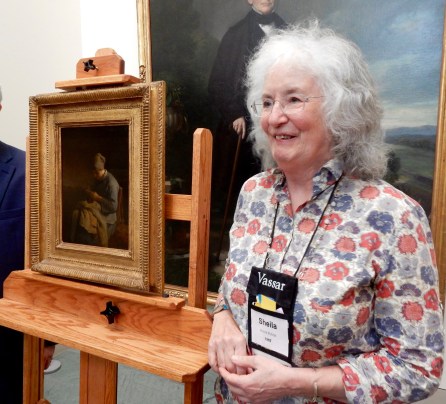
Alumna presenting family heirloom to Vassar Museum of Art
Later that evening, we dined at the Wallace Center of the Franklin D. Roosevelt Library and Museum. During the cocktail hour, Melanie and I strolled along the gardens and patio where we sat on a bench with Franklin and Eleanor for a casual chat. They were pleasant enough, even smiled!


For the Class of 1967, that weekend was a joyous time to reminisce, to celebrate, to renew old friendships and to begin new ones. At the 40th reunion, we vowed to stay in touch with several alumnae we met. In spite of our good intentions, we did not. But now after the 50th, perhaps because of advancing age, there is a renewed commitment to reach out in the remaining years to appreciate those whose lives have intersected ours
From Poughkeepsie, we motored to Boston to spend a marvelous weekend wth our politically engaged daughter, Amanda. There we ate well as usual (she’s a fabulous cook) and we ventured out to eat delicious fried clams.
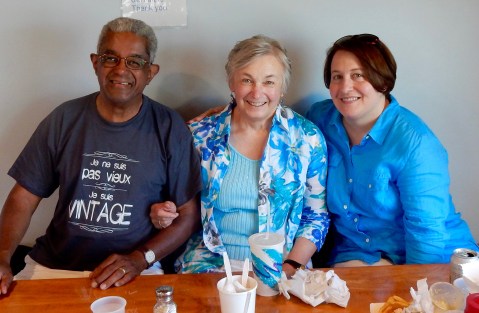
Smiling faces after consuming mounds of fried clams (T-shirt, brought from France by Amanda: I am not old; I’m vintage)
Frances and Georgia
Our travels began anew for Melanie’s 50th college reunion at Vassar. En route, we stopped in Utica, New York for a two-day visit with Frances Wolfson, the widow of Chancellor Emeritus Lester Wolfson of Indiana University South Bend. And what a splendid visit it was! Frances was waiting for our arrival with grand cheer. At ninety-three, she is still an elegant and gracious lady. A few days earlier, she had telephoned to warn us that she was not her usual self. Obviously, still mourning her recently deceased husband and dear friend, she was feeling listless and out of sorts. She thought perhaps we might want to reconsider our visit. Not a chance! From the beginning of our Vassar planning, we had been looking forward to spending time with her.
Frances characterized our two-day visit as good medicine for her. After an afternoon of good conversation and hors d’oeuvres in the afternoon in her lovely Acacia Village apartment, we went out to dinner at a neighborhood Italian restaurant, Dominique’s Chesterfield. The large clientele on a Tuesday evening was a sure sign that this restaurant is a local favorite. And we were not disappointed; the food was delicious.
The next day we had a late breakfast before getting a veritable historical tour of Utica from Frances as we made our way to the local shopping center to buy a pair of white pants for Melanie and an all-weather jacket for me as a buffer to the unexpected chilly weather. We skipped lunch and made our way to the local museum, the Munson William Proctor Art Institute, for the opening of their summer film series to see Norman with Richard Gere. The movie’s complicated plot of a wheeling and dealing fixer, expertly played by Richard Gere, has a bounty of intrigue and surprises. It definitely merits a second viewing. I missed key components of the plot. And even with my hearing aids, some of dialogue escaped me.
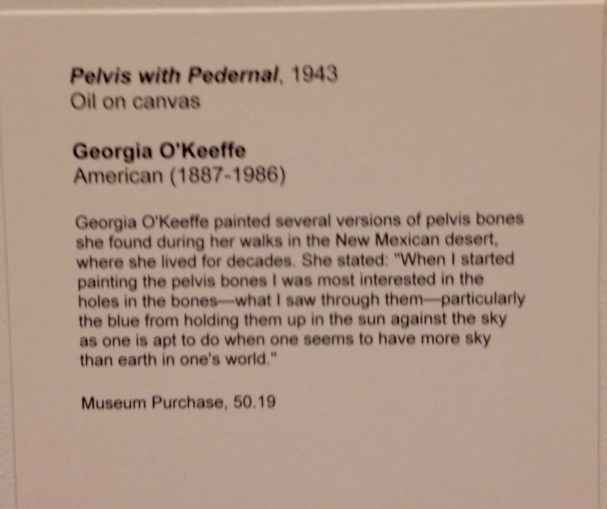
But what is most remarkable about this little museum are the artistic treasures we discovered – tableaux by O’Keefe, Picasso, Feininger, Dali, Glackens, Leger, Mondrian and sculptures by Arp and Barlach. Granted these pieces may not be as important and as numerous as you might find at the Art Institute of Chicago, the Metropolitan Museum of Art or the Louvre, but to the novice art lover that I am, I was amazed to find such artists in this local museum.

Pelvis with Pedernal (1943) Georgia O’Keefe
Although we did not have time to explore extensively (and learn more about) the collection, I believe I assume correctly that many of these works came from the estates of generations of Alfred Munson’s families, Helen Elizabeth Munson Williams and Thomas Proctor. Certainly, we will re-visit the museum on our return trip to see Frances.
Before dinner, we took time in the cool afternoon for a pleasant nap. Later, choosing where to dine required discussion among us. Apparently, Utica is a gourmand’s dream as it is home to several good restaurants. We narrowed our choices to a Bosnian and Italian restaurant, and finally settled on Ventura’s, a highly respected restaurant among the locals, and one of Frances’ favorites, specializing in Old World Italian cuisine. As if anticipating our arrival, one of the waiters was already at the door to greet us and helped Frances mount the three stairs into the restaurant. The dinner, impeccably presented and prepared, was delicious. Prior to our leaving, Mr. Ventura, came to our table to greet us and to chat with Frances. The intimate exchange between him and Frances was a sure sign that she is a frequent patron, well-known by the wait staff. Our meal finished, Mr. Ventura escorted Frances to the door, helping her descend the stairs and making sure that she was settled safely in the car that we parked, at his request, on the sidewalk just in front of the steps.
On our way to her apartment, Frances once again thanked us for our visit and repeated what good medicine we were for her. Whatever anxieties or trepidations she may have had about her health, about aging or being alone without a spouse, she now felt revitalized physically and emotionally renewed. That may be so! But she gave us a wonderful gift in return, two happy days in her company.
Now back to the subject of this blog. On our recent road trip to the Southwest, we visited the Georgia O’Keefe museum in Santa Fe, walked in O’Keefe’s footsteps at Ghost Ranch, toured her home in Abiquiu and saw breathtaking views of landscape depicted in her paintings. We learned about her strength, her resilience, her independence, her love of nature, her views of humanity. And perhaps, what was more striking for us was Georgia’s exuberance about life — the simplicity of being in the moment. Georgia’s studio and her home extended into exterior spaces; from her window she had expansive views of nature, She lived simply; when not painting she tended her ample gardens. Simplicity in living was her modus operandi. Her home was neat and modest with sparse but functional furnishings.


Similarly, Frances has a depth of character and regal demeanor that reveal an interior strength, resilience and grace. Her telling of Utica’s historical trivia gave us glimpses into her former civic and social engagement with the city. And like Georgia’s, her apartment overlooks a picturesque panorama. Adding to its charm, are works of art by artist friends and her talented artistic children. These two women, whose lives overlapped for a number of years, shared/share an uncommon love of the aesthetic and a joy of the human spirit. Each was/is a grand lady!
Enchanted Landscapes II

Humans are not the only species on earth, we just act like it.
Chief Joseph, Nez Percé Tribe
C’est beau! C’est magnifique! C’est grandiose! C’est immense! These exclamations by MariThé mirror the expressive joys of children opening presents on Christmas Day. As we traversed the Southwest, our friends, MariThé and Christian, marveled at the varied scenery, from the lush green terrains east of the Mississippi to the parched earth of the desert. Their appreciation heightened our enjoyment of the breathtaking beauty of the Southwest landscapes. Until their arrival, their images of the Southwest had been gleaned through Westerns. As we rode along the vast plains, we could envision the cowboys on their broncos, bandanas in the wind, rounding up herds in a cloud of dust, the cries of giddy-up and yippy-yi-yay echoing in the distance.
For them, and for us I suppose, the Grand Canyon was the definitive marker of this vast and distinctive region, the likes of which cannot be found east of the Mississippi. Like many tourists getting their first close-up glimpse of the Grand Canyon, we took a two-hour train ride to the South Rim. Before boarding, we were entertained by a Wild West show that was an amusing caricature of the rough cowboy life. Aboard the train, were tourists from England, Germany, France , India and, of course, Americans from across the States. En route to the Grand Canyon, we were entertained by a cowboy violinist; on the return by a humorous singer of folk music from the sixties.


The South Rim offered expansive views of the Canyon and I had trepidations about looking over the barriers. But I did and glimpsed the magnitude of the Canyon’s grandeur. Unlike some, I did not venture out to stand on any of the boulders. There are limits to my new courage! On my next visit to the Grand Canyon, I would like to be more adventuresome and hike in the valley below, perhaps even climbing to the rim.


That would give me a different perspective of the Canyon’s unparalleled grandeur. I got a taste of it back in the late eighties, as a Kellogg Fellow, during a rafting trip along the Colorado River with my other Class VIII Fellows.
Before visiting the national parks in Utah, we stopped at the Hoover Dam on our way for an overnight visit with our son, Paul, and daughter-in-law, Katie. Paul, who has developed an interest in cooking, grilled a sumptuous feast of steak, chicken, vegetables along with a green salad and a rich, cheesy pasta dish. Earlier that day, on the Strip, MariThé and Christian were thrilled to see the Eiffel Tower, a bit of the Strip’s tacky character. We were all disappointed that we did not get an Elvis sighting, but there were the occasional scantily clad young women who lured tourists for group pictures. After a short walk, we sat on the veranda of one of the bars lining the Strip and had an expensive Happy Hour beer at $7.00.
The next day, we headed to St. George, Utah, where we spent two lovely days at the home of our friends, Bob and Pat Kill, who had already left for their summer and fall stay in South Bend. St. George was our base for visits to Zion and Bryce. From the extraordinary beauty of these imposing landscapes, and the others we were yet to see, Utah rivals New Mexico as a land of enchantment. Even the rainy day at Zion did not dampen our enthusiasm. Strangely, the walk in a steady rain between majestic rock formations along a fast moving river seemed to heighten our sense of wonderment. Interestingly, we were greeted by a squirrel perched on a long boulder who did not seem to mind the attention from passersby.


From Zion we went on to Bryce, and as Bob Kill alerted us, Bryce was unusual. Called “Poetry in Stone,” Bryce opens up to wide panoramic vistas. Its geologic formations create interesting shapes and soft pink tones. What Bob referred to as unusual were the plethora of sculpted statuesque rock shapes, commonly named hoodoos. They owe their peculiar shape to erosion caused by melting snow and ice that seeps into the rock, and once the water re-freezes, expands forming cracks. The name itself evokes something eerie, but as we stood at seven thousand feet of altitude peering in the distance, these shapes captured strength and grace.


In all we spent five days touring Utah’s national parks. At Zion and Bryce we used the shuttle, stopping at interesting places for short hikes. At the other parks, particularly at Capitol Reef, Canyonlands and Arches, we were able to explore the environs more easily on foot. When I asked MariThé what was her favorite park, she refused to choose, opting instead to embrace each one equally. My favorite was Capitol Reef because of its deep rich reddish hues that seem to envelop the entire landscape. Light seemed to gently caress the stately rock formations, changing in intensity as the day progressed from morning to mid-afternoon.


What is remarkable about Utah’s national parks is their distinctive character. No one is alike; each has its charm. Canyonlands is as different from Capitol Reef as Bryce is to Arches. Canyonlands is broad and immense, Arches more contained atop a grand mesa. And it is Arches, with its many arched openings in rocks, that is the most marketed and ubiquitous image of Utah’s national parks. Our only disappointment there was the road construction that prevented us from seeing some of the spectacular sites we’ve read about or seen pictures of.


Although there is diversity of landscapes and geologic formations in the national parks we visited, there is one constant, the admonition not to veer off the defined paths for fear of destroying the natural vegetation and soil sediments. Yet, often we saw footprints on forbidden terrain. So shameful that these sacred spaces were violated! As we traveled through the parks, placards strategically placed gave us insights into the scenery we were observing and educated us about the interconnectedness of the global ecosystem. Air pollution across the oceans can cause harm to the fragile ecosystems in the parks. What happens in Peoria affects the fragile environs of the parks.
Another indication of the broad reach of the global community was our encounters of people from all over the world. Besides meeting many European and Asian travelers like ourselves, Melanie happened upon a woman in Capitol Reef about twenty years younger than she, who was born in the same Massachusetts town and who graduated from the same high school in Auburn. Now that’s serendipity!
From Arches, we began our trek back to the Midwest, but not before visiting Indiana-transplanted-to-Wyoming-friends, Bob and Carol Mathia, who have a cottage in Estes Park, Colorado. There we spent two relaxing days. Melanie and Carol played Scrabble. MariThé was enthralled by the elk on the golf course behind their home. And we all took a leisurely stroll in the Rockies. We would have loved to explore more but several paths and roads were closed from a recent snowstorm. The chilly temperature and snow at the high altitudes were startling contrasts to the warmer clime and earth tone colors of the Southwest.


For MariThé and Christian, this journey is one that they will long remember – 5,900 miles total. It may not be the complete travels of Toqueville, but it was nevertheless, amazing! And it was for us as well!
Enchanted Landscapes

When I got to New Mexico, that was mine. As soon as I saw it, that was my country. Georgia O’Keeffe
There is a sacredness of eternal space and time in the landscapes of New Mexico. Its broad blue sky, vast terrain, rugged mountains of reddish tints mixed with layers of grey and white are awe-inspiring. No wonder Georgia O’Keeffe was so enamored of this seductive landscape! We spent two magnificent days walking in her steps at Ghost Ranch. The massive open spaces around it provided unlimited subjects for her paintings. Walking as she did, admiring the landscape awash in color, we observed the scenery she so deftly interpreted on her canvases.


She was not a realist, nor did she want to be. Rather her paintings are personal interpretations of the images before her. She wanted to paint as no one had before. In that sense, her style is typically American.
We also visited O’Keeffe’s home and studio in Abiquiu, an old Spanish adobe a few miles southwest of Ghost Ranch. There we got a glimpse into the simplicity and order of her life. Atop a hill that offered expansive views of the natural surroundings, the old home with its seven thousand square feet took three years to renovate. Like Georgia O’Keeffe, we too were seduced by the beauty of the limitless panorama. Although,our visit was short, we got a good feeling of why this place was so special to her. We’d like to come back and stay a week, basking in the tranquility and grander of Ghost Ranch and its environs.

Plaza Blanca (painted several times by O’Keeffe
Once our visit to Abiquiu was done, we headed to Mesa Verde in Arizona. About a mile and a half north of Ghost Ranch, the passenger rear tire of our minivan blew to shreds. Melanie was driving and safely steered the vehicle to the shoulder. We immediately called AAA. We learned that we did not have a spare when a tow truck stopped to help us before AAA arrived. Imagine our surprise and dismay! Here we are on a two lane highway, far away from any town, stuck on a desert road with no spare tire. We called AAA again and informed them that we did not have a spare as earlier reported. When the truck arrived, he was willing to tow us to a garage in a town forty-seven miles away, except he could only take two passengers with him. By then it was pouring rain. We finally persuaded him to take Melanie and MariThé back to Ghost Ranch and then return for Christian and me. We bought a tire, returned to Ghost Ranch to pick up MariThé and Melanie and began anew our journey to Mesa Verde.
About an hour before reaching Mesa Verde, we ran into a tremendous hail storm that made visibility difficult and driving through the accumulation of two inches of hail on the ground treacherous. We almost stopped but decided not to because we wanted to reach Mesa Verde before the restaurant closed at 9:30 pm. But that was not the end of our driving difficulties. When we reached Mesa Verde, there was a heavy fog as we climbed in altitude along the remote and tortuous hairpin turns in the dark. We were so happy to arrive safely, we treated ourselves to cocktails before dinner and a good bottle of wine to accompany our meal. We were giddy at dinner, laughing about our day’s misfortunes.
The next day we visited the pre-historic Indian cliff dwelling sites on the Mesa Verde. At the Balcony House, we had to first descend a staircase along the cliff and then after a few yards climb a thirty-foot ladder to reach the dwelling. With my fear of heights, descending the staircase was difficult enough, but I was hesitant to climb the ladder. I also learned that this would be the first of three ladders to climb. So with Melanie’s encouragement, I faced my fears and climbed the ladder. It was an agonizingly slow climb. Thankfully, Melanie climbed beside me, reminding me to keep my eyes forward and not to look down. When I made it to the top ledge, I was overwhelmed with pride. It’s something I thought I could never do. Several people in our group, including the Park Ranger, applauded my success in facing my fear. So this side note is for my friend, Randy Isaacson, who knows my fear of heights — I did it ! If I hadn’t, I would have missed getting a glimpse of how these pre-historic people lived.


Once we left Mesa Verde, we headed to Gallup, New Mexico. Throughout the day there were episodes of pounding rain which made driving difficult. What struck me most as we traversed the large territory that the United States Government ceded to the Indians as the Navajo reservation was the starkness of the parched landscape. The dominant color of the dry land was a dusky red. Along the remote highway we saw strings of trailer settlements and shanty towns. I kept wondering how do these Native People survive in such a desolate place? How are they employed and by whom? From what source does their water and electricity come? What, if any, modern day amenities are available to them? One of the most enduring images I have of our traverse across the Navajo reservation is of the trains of the Santa Fe railroad speeding rapidly across the barren desert, its cars filled with the commercial and industrial advances of the modern world in stark contrast to the poverty of the communities it was passing through. What was most remarkable about this barren, flat, dusky landscape were the massive rock formations that appear to erupt suddenly. They stood majestically tall and broad, isolated and alone every few miles, bearing names like Shiprock and Window Rock depending upon their formations.
As we sped across the reservation, my thoughts were centered on the injustices perpetrated on the Native People since the first European settlers. My mind raced through the events of the forced migration of the Native People and the Trail of Tears. And even today the sacred land of the Dakotas will be besmirched by an oil pipeline. When we stopped for gas, a copy of the Navajo Times caught my attention. In it was an article written by a young Navajo college student about her Navajo identity and her journey to full acceptance of self that deeply moved me. Her story is one that resonates with many minorities living in America.
Once we reached Gallup, New Mexico, we took a one day jaunt to discover Canyon de Chelly with its magnificent scenery. The majestic formations of the rocks swathed in a reddish color, blazed from every direction and held us captive in awe and admiration. We saw the canyon from above at several points in the road.


We would have loved to have taken a jeep tour within the bowels of the canyon. Perhaps, the next time. Imagine the powerful and turbulent forces of nature that shaped these rocks into their current tranquil state. Even the most hardened disbeliever can be moved into a meditative state.
We continued our journey along the Petrified Forest, a reminder of nature’s destructive force millennia ago. What remains now are clusters of petrified wood spread across a vast landscape. The archeologist, John Muir, is one of the pioneering researchers to help preserve this area. The landscape, empty of color, still had a mesmerizing effect, particularly at the thought of what had been.


From the Petrified Forest and the Painted Desert, we were to visit friends from South Bend who now live in Wickenburg, Arizona before heading to visit Paul, my son, and daughter-in-law, Katie in Las Vegas. Unfortunately, a few days before our scheduled visit we received a phone call from Mary indicating that her oldest son had just passed away suddenly with a heart attack. Our prayers are with the Filberts during this sad period in their lives. At Mary’s suggestion we called other friends from South Bend, John and Martha Borkowski who allowed us to stay in their timeshare in Sedona. So here we are in this beautiful settting, an oasis in the mountains encased by the desert clime of Arizona. Our first night here was a simple meal of salad, wine and cheese. The next day, Christian and MariThé went off to explore the natural surroundings while Melanie and I profited from a tranquil afternoon and morning on the patio that extends into a shaded garden with fragrant aromas of the flowering bushes . Adding to the charm was a fresh, gentle breeze. After two weeks of traveling by car, this was a welcome respite. The evening before we departed we had a delicious meal at Judi’s, a restaurant recommended by the Borkowskis.
From Sedona, we traveled to the Grand Cayon, the mother of all the great National Parks. For our friends from France, the Grand Canyon, was the pièce de résistance, and the primary reason for their southwest tour. Their reactions will be detailed in the next blog, Enchanted Landscapes II.
Getting Kicks on Route 66
Last spring in southern France, over wine and conversation with our French friends , we all decided to do a road trip together to the American southwest. For them it would be a new way to discover America outside of the big cities like New York, Chicago or Miami. In the months that followed, we began our planning, and with the help of our AAA travel agent we had a well-organized trip that would take us through St. Louis toward Utah and the national monuments. Along the way, we would visit friends and family in Missouri, Arizona, Nevada, Utah and Colorado. Initially, we were to be five, but,unfortunately, because of health issues, one of our friends, Martine, from whom we rent when we stay in southern France, could not make the trip. But Christian and MariThé did, and after spending a couple of days in Chicago, they joined us at our home for a week exploring Michiana. Of course, one of the places we took them was to Shipshewana to see the Amish. They were fascinated, as I continue to be, by the Amish way of living. Their adherence to a life unencumbered by materialism and technological advances of the modern world is laudable.
Our southwest journey began with a visit to the Cahokia Mounds, a pre-historic Native American site that began to fade well before Columbus’ exploration of the “New World.” We explored St. Louis, but heavy rains limited exploring the city on foot. We had to bypass the botanical gardens, but a break in the weather did allow us to walk through Laclede’s Landing and the park at the Arch. The swollen Mississippi and the debris caused by the storm prevented us from traveling on paddleboat down the river. Looking at the Arch in front of the court house, we thought that the Dred Scott Street sign was an eerie reminder of a dark chapter in American history. In 1857, the Supreme Court denied citizenship to blacks. The street with the Arch as a backdrop hung in stark contrast to the hope of future generations that the Arch and its magnificent splendor symbolized.
Every time I am in St. Louis, I visit my old neighborhood in the Central West End. I don’t know what draws me there. Happy memories are overshadowed by personal pain. Perhaps, it’s the seduction of its quiet, shaded streets of stately three-story brick homes. I lived at 4728 Westminster Street, just off Euclid Street with its array of shops, restaurants, art galleries and antique stores. The neighborhood has a uniquely European flavor. When I moved there in the summer of 1989, the area had already begun gentrification; my home built in 1904, had recently been refurbished. The rain that was threatening at Cahokia Mounds met us with a vengeance in St. Louis. Visibility was so low that for a few minutes I had to pull off the road. Later in the evening, when the rain subsided, we had dinner at Llewelyn’s, the Irish pub on McPherson Street just around the corner from my old house. Their sweet potato fries were always a big hit with my sons, AJ and Paul.
The next evening we had a tri-lingual dinner in English, Spanish and French with our dear friends, Pablo and Patricia at their beautiful home. Pablo was the World Languages Chair at Saint Louis University when I was the Academic Vice President. As it is whenever we are with Pablo, his colorful stories kept us laughing.
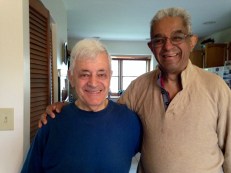
Pablo y Yo
On Sunday I attended Mass in Hyde Park at Holy Trinity, a gothic style church with tall stone pillars reminiscent of European churches. It was perhaps the smallest Sunday service I’ve ever attended in a Catholic church. All of the thirty congregants including the priest were over fifty. But what the church lacked in attendance was overshadowed by its abundance of friendliness. Stranger that I was, several people greeted me merrily, welcoming me to the service. Just before Mass ended I was asked to introduce myself. I could not leave easily after Mass as several people, including the celebrant, wanted to know more about me. The celebrant, a man who appeared to be in his late 70s , was the most talkative , revealing his enthusiasm for biking and giving a detailed accounting of how at 1 am in Breaux Bridge, LA as he was biking he encountered a priest walking. He expressed his surprise at seeing him walking so late at night only to receive the priest’s retort that he too was amazed to see another priest biking so late at night.
The next morning, bidding farewell to Pablo and Patricia, we headed to the Southwest. Finally, after many years of listening to the velvet voice of Nat King Cole singing about the iconic Route 66, there I was on May 1, 2017, rolling along Route 66 in a rented mini-van with Melanie and our friends from Southern France, MariThé and Christian. As Cole sang the litany of cities and towns along the route from Chicago to L. A., we breezed past small and large farms, and cruised slowly through worn, forgotten towns. On one stretch of the two-lane Route 66 highway in Missouri, a parade of vintage Corvettes zoomed toward us. I imagined days of a by-gone era when caravans of cars rolled along long stretches of Route 66, its occupants dreaming of a better future in the West and others, whom fate blessed with more fortune, seeking lazy days on the beaches of Santa Monica. As we made our way through Joplin, MO on Langston Hughes Avenue, a mural on the side of a brick building caught our attention. We stopped for a closer look and marveled at the bright colors depicting contrasting images of pastoral scenes juxtaposed with an image of the Harlem Renaissance poet, Gwendolyn Brooks.


The thrill of being on Route 66 was so great that I now have it listed in my Happiness File (Bucket List) to drive the entire length from Chicago to L. A., all 2,448 miles of it. But before I do, I must read John Steinbeck’s epic novel, The Grapes of Wrath, about the mass exodus to the west of Oklahoma farmers escaping the dust bowl. Though it was the major hub for travelers to California in its heyday, it is now a chain of disconnected highway that at large intervals overlaps with Interstates 44 and 40. But for those unadulterated remaining fragments, the open road coupled with slow drives through mall towns would be a wonderful way to experience slices of an American past .


Until then, I am content to have this opportunity to experience what it was then like stopping at the original, but non-functioning, Lucile’s gas station, and eating in a replica of a 1950s diner. In Elk City, Oklahoma, the National Museum of Route 66 gave us further insights into life along this iconic highway.
Now that we’re in Santa Fe, one of our favorite places to visit, we’re enjoying our time in a beautiful and spacious Adobe-style house about twenty minutes from Santa Fe’s center.
 As we arrived, a road runner darted across the property. During the next three days we were hoping to see him again, but to no avail. This elegant home was a welcome retreat from the window shopping along the plaza and gallery hopping. Highlights included introducing our friends to Georgia O’Keeffe’s art at the small museum dedicated to her early work and to the Basilica of St. Francis. We had scrumptious Mexican food at Tune-Up Café, a simple, rugged local place that we’ve enjoyed on previous visits, and at La Choza, new to us and recommended by a friend from South Bend, and at Café Pasqual, where we’ve also dined before. But mostly we’ve enjoyed the evenings sitting on the terrace over cheese and wine, watching the colorful sunsets of red, yellow and orange descend behind the distant mountains.


Before beginning our trek northward to Taos, we visited the student exhibition of seniors from the New Mexico School for the Arts in the Santa Fe Community Center. Initially, we had thought we were going to an exhibition of painting by senior citizens, but to our surprise we saw a display of art that, in my view, was equal, or superior, to any student art exhibition at a university.
When we first arrived in Santa Fe, we saw several posters around town promoting what we thought would be an exhibition at the International Museum of Folk Art. So, as we proceeded out of town, we stopped there only to find out it was a sale of folk art. By the time we arrived, there were hundreds of cars in the parking lots. The event opened at 10:00 am and we arrived at 10:30 am. What we did not realize until then is that this is an annual event that draws people from all over the country. Needless to say, by 10:30 am many of the best pieces had already been sold, but we did manage to buy a beautiful beaded belt and an Indian ceremonial mask. We learned that much of the art that is sold is bequeathed to the museum by collectors and that the museum then sells the pieces that are not kept in its permanent collection. The quality of pieces for sale warrants a return trip, but in the future we’ll arrive before 10:00 am.
From the moment we began to see the changing landscape west of Elk City, OK, from a verdant green to the more dusty ruggedness typical of the Southwest, we began to see spectacular panoramic vistas. Each landscape being the most beautiful until we saw the next eye-catching scenery. Seeing this southwestern terrain through the eyes of our French friends was a totally new experience. Their exclamations of awe and wonderment gave us a deeper appreciation for the beauty of this land. Their connections to this territory is through the western movies with cowboys galloping across the plain. As we rolled along, my mind was centered on the Native People who roamed this land, and who almost came to extinction.
The rich culture of the indigenous people is as apparent in the Taos Pueblo as at Cahokia Mounds. 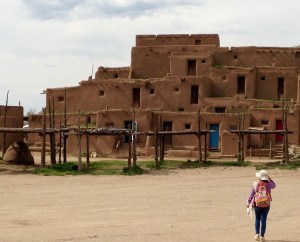 Unlike at Cahokia, there are still Native People living the traditional ways in this UNESCO designated historic site. Our guide was a young tribal woman who related the tribe’s history. She told of the conquest by the Spanish who brought the Catholic faith to the tribe using force to make the Indians build the church. Today the tribe practices both the Catholic faith and its indigenous religion. A nursing student, our guide expressed her intention to return to the tribe and work among her people. Once the tour was finished, we were free to visit the pueblo and the small shops where the Naive People sold their crafts. MariThé bought jewelry, and Alfred bought Melanie a leather pouch with beading signifying the stepped architecture of the pueblo and the colors of the rainbow representing good luck. What we enjoyed most was talking to the vendors. One young potter talked to us about his horse hair pottery; and another elderly gentlemen with beautiful dark tones to his skin, and an expressive face bemoaned how he missed President Obama. At another shop, the vendor told Melanie that he joined the Navy because he wanted to see the world, and he related to her the different places he had been. There is a genuine warmth and kindness among the Pueblo people. For Melanie and me, this was our second visit to the Taos Pueblo. Each time we feel intensely the sacredness of place and the unwavering spirituality of the Pueblo Indians that has continued throughout generations from pre-historic time to the present.
70! How Did That Happen?

With Mother and siblings on my 70th birthday – Cynthia, Warmoth, Rhaoul, Alfred (Me) and Teresita
I gave no special thought to my 70th birthday, but as it neared, Melanie asked if I wanted to do something special. That question caught me off guard because I did not think that entering my eight decade warranted any special consideration. But the more it crossed my mind, the more I thought about doing something out of the ordinary like going to Martinique or to Quebec. It’s been many years since I visited either place, Martinique as a young assistant professor on a scholarship from the French government and Quebec as an undergraduate student in an intensive summer language program at McGill University in Montreal. So the time seemed ripe to return. Paralysis and indifference prevented me from looking into travel details. But Melanie persisted in her inquiries about what I wanted to do. Frankly, I had no answer. My elder son, AJ also thought the day warranted special attention. Finally, it occurred to me that spending my 70th birthday with my 91 year old mother would be ideal. She would be happy to see me as would my siblings. Luckily, I found two airline tickets at half the cost of what they were two days earlier. So off we went to New Orleans. My two sons and their families came from D. C. and Las Vegas to be with us, a very special treat indeed.
And what a happy occasion it was! On Palm Sunday, the day before my actual birthday (April 10), my siblings and Melanie arranged a huge party of about forty people – sons, grandchildren, nieces, nephews, grand nieces and nephews, cousins and friends. As typical of any New Orleans festivity, where the good times roll, there was plenty to eat — delicious crawfish bisque and gumbo prepared by my younger cousin Sherrie whose cooking rivals that of her mother, and sundry other dishes of baked macaroni and cheese, ham, turkey, jambalaya, mixed vegetables. green and potato salads. The tasty birthday cake from Haydel’s Bakery decorated in Mardi Gras colors of purple, green and gold, had my name in the middle and Rhaoul’s and KT’s in each of the top corners. Rhaoul, who falls short by four days of being one year younger than I, celebrated his birthday on April 6 and KT’s, my daughter-in-law, on April 8. Call it a family affair! By the end of the day I was full of mirth, merriment, and a very full stomach.
On this Bacchanal note, a visit to New Orleans would not be complete without dining in a city known for its culinary pleasures. During our week-long visit we ate po-boys at the iconic Parkway Bakery and Tavern with my son, Paul, and, daughter-in-law, Katie, had dinner at Cava’s with brother, Warmoth and sister-in-law, Laurie, and dinner at Muriel’s, just off Jackson Square with good friends and former Xavier colleagues, Tom and Judith Bonner and Ann and Johnny Barron. And at my mother’s, Teresita and I enjoyed a mound of crawfish.
As I get older, I realize more and more the importance of family and friends. I’ve not always kept in touch as often as I should or would have liked. It’s not out of neglect or even laziness, it’s just that life has many detours that lead to new adventures. Because time is fleeting, it’s more important for me now to maintain those relationships with family and dear ole friends. I was particularly gratified to spend time with my mother, who at ninety-one is in relatively good health, but showing signs of aging. As I sat on the sofa near her we laughed at tales of my youth repeated many times, and in the telling of them new twists and embellishments were added. I imagine it is this way in many families.
God only knows how much longer my mother will be with us. My siblings and I are fortunate to still have her involved in our lives. Our mother is a deeply religious woman whose morning and night prayers are pleas to heaven to watch over her family. As my mother says, she begins with Alfred, his wife, his children and grandchildren, repeating this pattern down the birth order of siblings. In my estimation, she is a saint. She is and has been a blessing. To be with her, to hold her hand and to give her hugs and kisses was the best present a seventy-year old could ever want. Thank you Teresita for the loving care you provide for our mother.
 Alfred Guillaume
Recent Comments