Mangoes and Flowers in Flora-Bama
For the past few days we’ve had the pleasure of visiting our friends, Gordon and Linda Wilson, in their rented condo in Peridido Key, Florida, just two miles from Orange Beach, Alabama. Since our arrival, we’ve been stuffing our bellies with the local fare of fresh seafood – not your ordinary frozen shrimp and limited fish choices available in our local Martin’s supermarket in Granger, Indiana. Naw! This is seafood heaven – shrimp and oyster po-boys, pecan-crusted catfish, stuffed shrimp, and the specially prepared catch of the day. Appetizers of popcorn shrimp dipped into a spicy remoulade sauce or a dozen (or two) raw oysters on the half shell, dipped in a mixture of horseradish and Tabasco sauce seduce the palate.
Any trip to the Gulf Coast is an occasion for a bacchanalian food orgy with an abundance of spicy and tangy seafood guaranteed to satisfy the most ardent carnivore. Restaurants galore dot the coast. One of the most memorable, and highly recommended, is Shipps Harbour Grill. There I had a scrumptious Grouper Pontchartrain covered in lemon butter and topped with shrimp and crawfish, served over mashed potatoes and green beans. On another day we lunched at McGuire’s Irish Pub in Pensacola, a must on one’s bucket list. The extensive menu offered many mouth-watering choices. Our friends recommended the pork chops. Melanie and I wisely chose to share this large meal of two large, thick pork cutlets, enough food for lunch at the condo the next day. But what is most extraordinary about McGuire’s are the over two million dollar bills tacked on the walls. To be sure that no one is tempted, each dollar is marked and easily traced.
Although we did not dine, nor imbibe, there, the Flora-Bama Lounge and Oyster Bar, so named due to its proximity to the Florida/Alabama border, is a singular cultural experience. It is a maze of several rooms, staggered at different levels but loosely connected as one unit, each with worn floorboards and outside walls of heavy clear plastic. Bandstands are scattered throughout, and in one room where bingo is held Monday through Friday from 1-4, brassieres hang from lines that crisscross the room. I leave it to the reader’s imagination how that came to be!
This land of perpetual sunshine and endless beaches is a haven to the cold weather wearied snowbird traveler and an escape from the dreary, bitter cold days. Relaxation and lazy quiet days are in the offing. Early morning walks or a round of golf, reading over coffee, lunch, a nap, or playing bingo or bridge, an early bird dinner special at one of he local restaurants from 4-6pm, and an evening cocktail before retiring for the evening is the snowbird schedule scripted during our brief stay. The chilly winds of our morning walks along the beach did not dampen our enthusiasm of gathering colorful seashells or watching the birds, pelicans, sanderlings or the footprints of the heron we never saw. His or her footprints led to a wildlife refuge that bordered the beach.
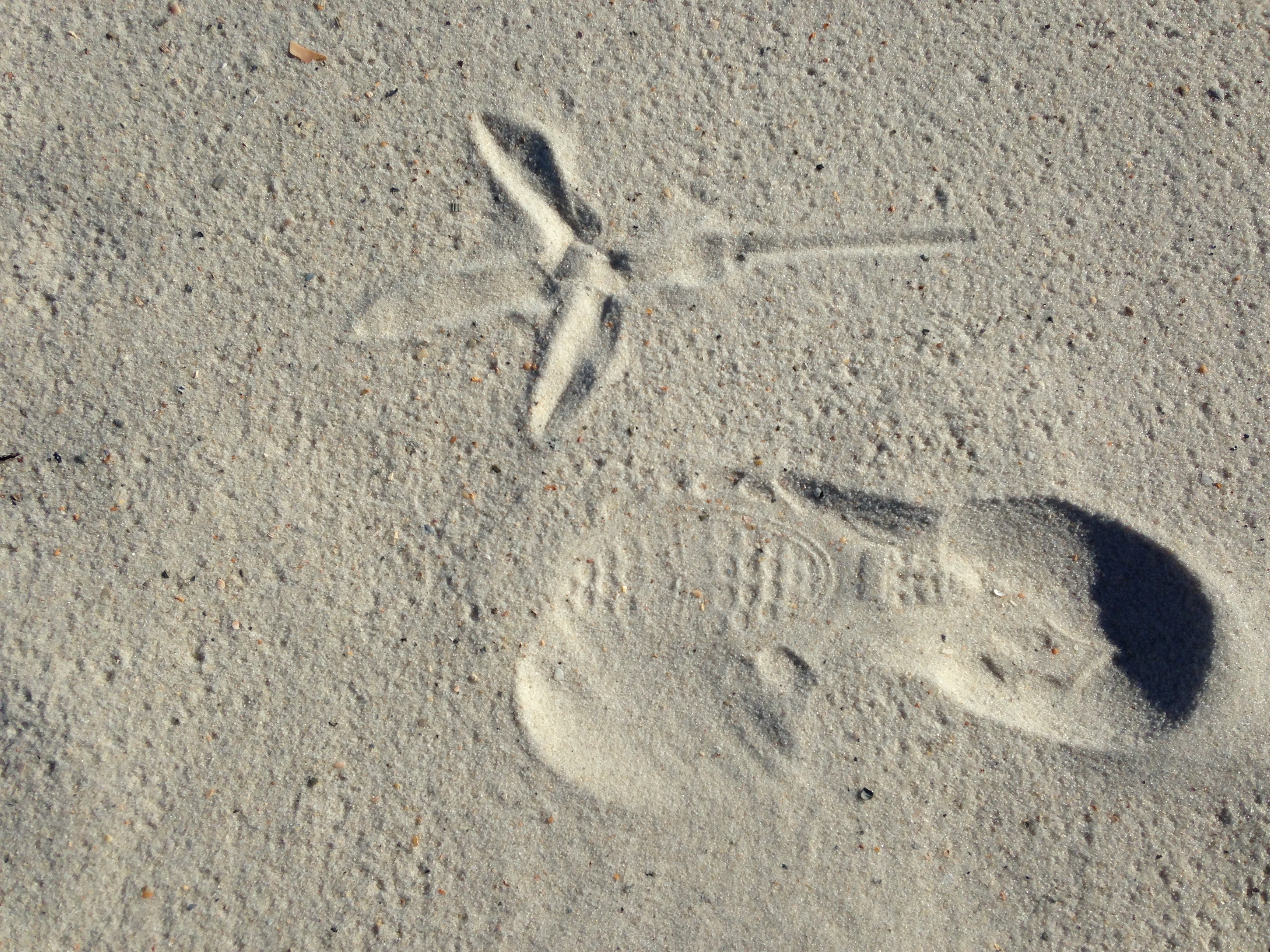
My footprint next to the Blue Heron’s
Our walk along the beach was replaced one morning with a walk in the backcountry at a local park in Orange Beach, AL. Along the paths were benches with inscriptions in memory of a loved one. Several were dedicated to Snowbirds of Missouri, of Minnesota, or of Illinois. License plates verify the presence of snowbirds from these areas and other northern states. There were several from Indiana, but we did not bump into anyone we know.
From Florida, we returned to New Orleans for mom’s grand 90th birthday celebration. And what a happy occasion it was. Approximately fifty immediate and extended family and longtime friends of my parents gathered at Dooky Chase, the famous black Creole restaurant in the Tremé district. For my mom, it was the perfect gift.
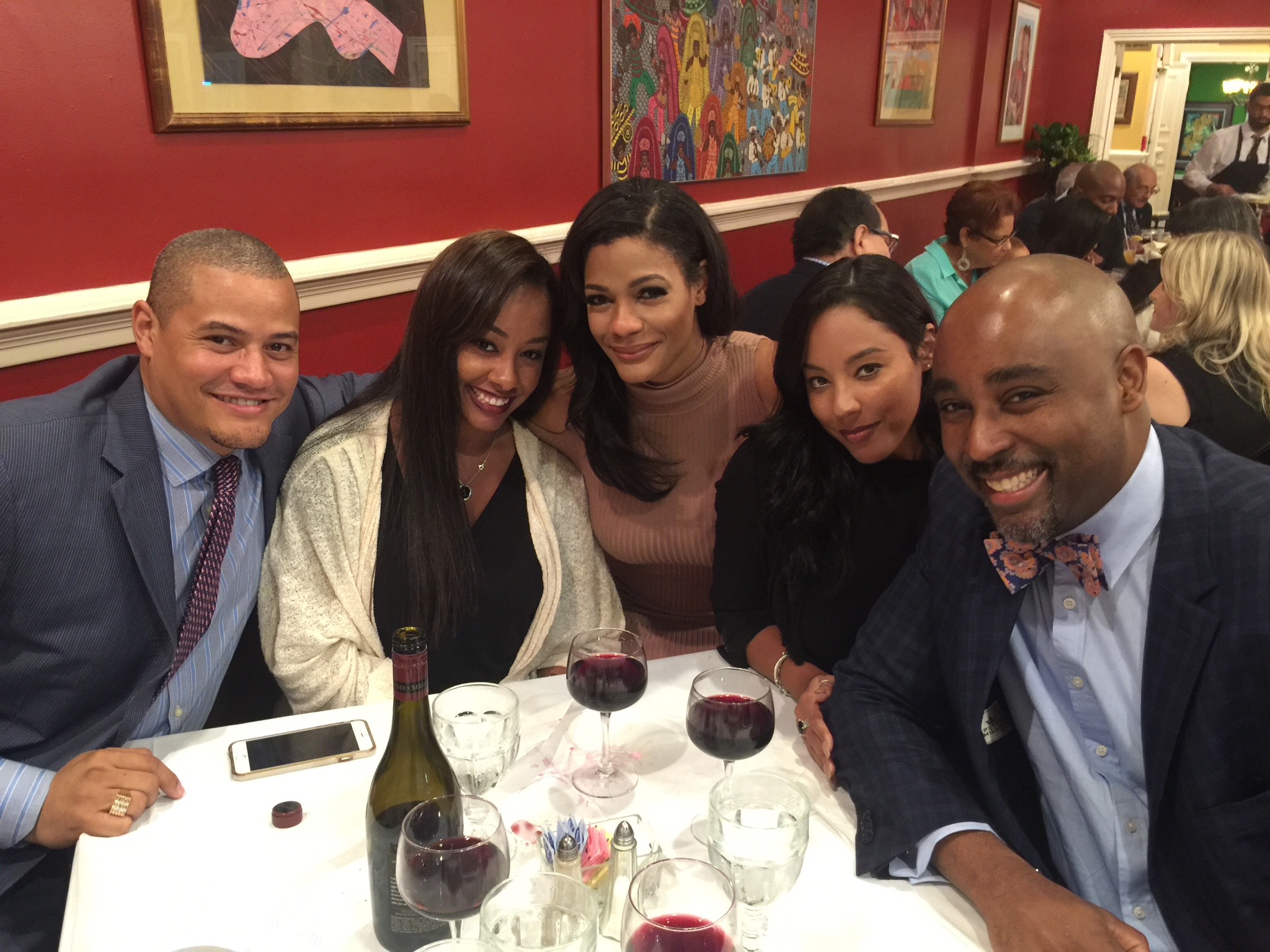
Five of Mom’s Grandchildren
She delighted in having her five children, nine of ten grandchildren and six great grandchildren with her. My son, Paul ,and his wife, Katie, spent the Christmas holidays with her. Speeches from me and my brother, Rhaoul, extolled her virtues. Not to be outdone, she in turn spoke glowingly of her love for her family.
Leah Chase, the owner and chef, just a few days earlier, had celebrated her 93rd birthday. To celebrate her and her legendary restaurant, the Times-Picayune, published a front page story of Mrs. Chase. Presidents George W. Bush and Barack Obama dined there. The evening of my mom’s dinner party, I visited with Mrs. Chase in the kitchen. I had not seen her in several years. She was a bit more diminutive than I remember, but that same beautiful, serene face with a broad smile, all framed with curly white hair, has never changed. 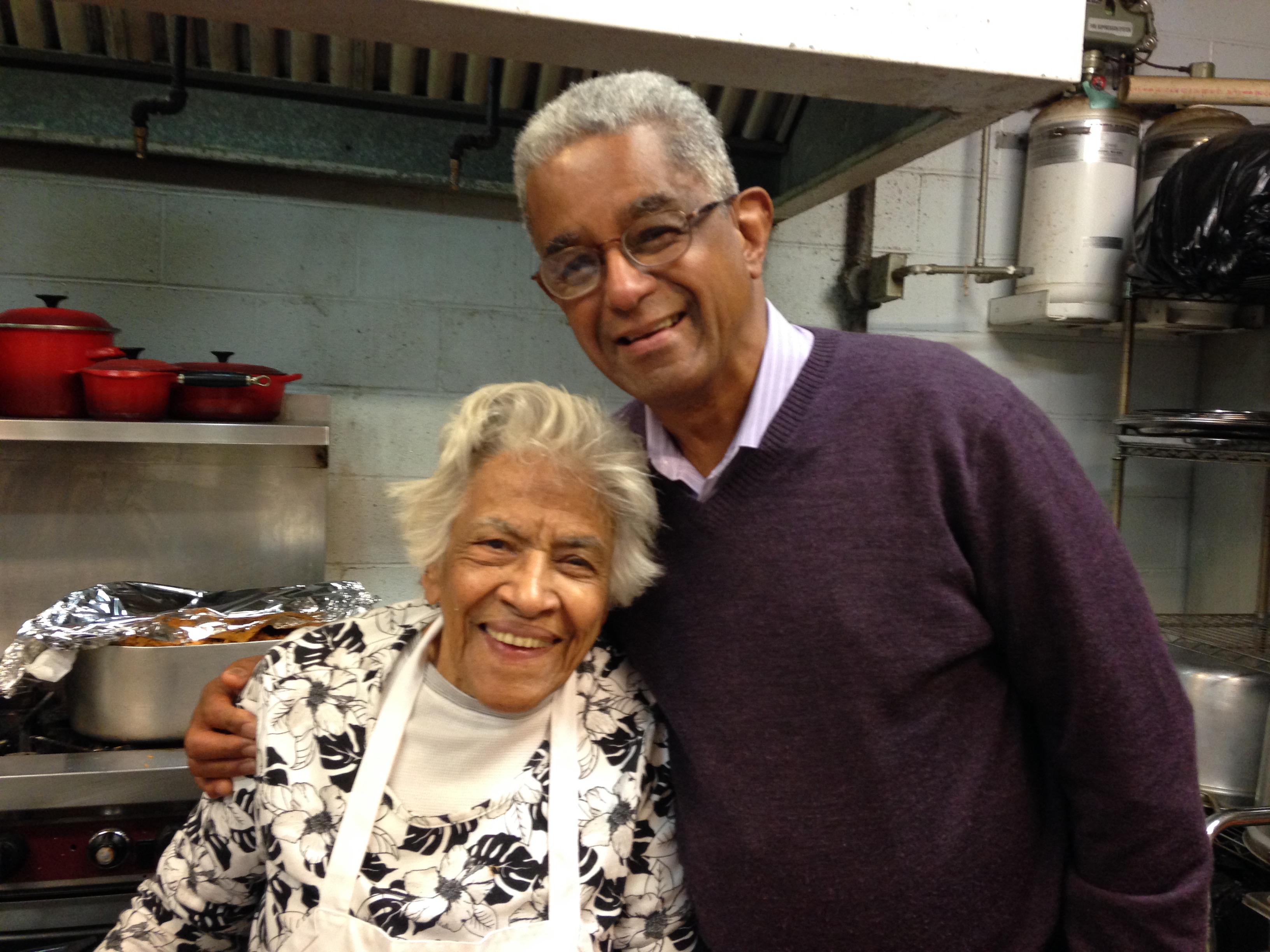 In the kitchen she was preparing vats of gumbo for the governor’s ball to be held a few days later. As she chopped sausages, we spoke of the time when Dooky’s was the only fine restaurant where blacks were able to dine elegantly. We laughed at the remembrance of the Shirley Temples she served to the hordes of young prom goers. Parents were comforted in knowing that Leah Chase kept a watchful eye over us. And she made sure that we had the proper dining decorum.
Katrina: Recovery and Renewal
This essay was initially broadcast on August 27th, on the NPR affiliate, WVPE Elkhart/South Bend.
Ten years ago on August 29th, the pounding winds and rains of Hurricane Katrina weakened and then collapsed the levees protecting New Orleans, and soon eighty percent of my beloved city was under water. Like many Americans, I watched incredulously the news of a city in distress, its houses inundated and citizens stranded, others drowned in the wake of flooding waters, survivors distraught and afraid. Their hopeless and dispirited faces drained me emotionally and spiritually. The destruction was unfathomable.
My own close relatives managed to leave before the levees broke, but as I watched Louisiana’s interminable bayous and waterways swallow the city, I feared for the safety of others left behind. Miraculously, I reached my undergraduate mentor by phone. He was unaware of the enormity of the storm’s damage in other parts of the city. He was low on critical medication and had no car; he needed to be evacuated. On his behalf, I tried but could not reach the Louisiana Coast Guard. In the chaos of those days I lost contact with him, but I learned later that a neighbor helped him evacuate.
Then we all became aware of the great and perhaps lasting exodus from the city. I feared the irretrievable loss of intimate, generations-old neighborhoods like Tremé and the Irish Channel, the tidy Creole cottages and shotgun houses shaded by massive live oaks and flowering magnolias. I feared that as residents scattered across America, much of the soul of New Orleans would never return. New Orleans is its people, and without them the enrichment and cross-fertilization, the gumbo of Creole, Cajun, and African cultures, would be forever altered.
In the ten years since Katrina, I’ve made many trips to New Orleans. With each visit I see progress. My mother who initially vowed never to return is happily settled into a new home not far from her former neighborhood. The ubiquitous blue tarps on rooftops are now gone. Homes have been rebuilt elevated above the ground as required by new building codes; in some neighborhoods the houses retain the façade of traditional Creole cottages. Other homes reflect an architectural style foreign to the region. In many areas streets with gaping potholes and bulging concrete suggest an underdeveloped country. Massive rebuilding of the drainage system is creating annoyances for motorists and pedestrians alike.
On the surface New Orleans today is a bustling city. Tourism is flourishing. In the French Quarter jazz blows hotly from street corners to Preservation Hall. Steamboats roll merrily along the Mississippi. Streetcars clatter down St. Charles Avenue. Everything seems normal. The mayor speaks of a stronger more resilient city since Katrina. He cites rapid business expansion with a retail and restaurant boom. He touts the academic achievement of the charter schools. He proclaims a city on the mend with a budget surplus, reduced murder rate, and reduced homelessness, and above all, racial reconciliation. a cornerstone of his administration. New Orleans, he says, is “unbowed and unbroken.”
The Big Easy is back, but deep wounds remain. Black on black violence is an almost daily news item. Many streets still show deep potholes and buckling concrete. The predominantly black lower ninth ward is pockmarked with concrete slabs where houses once stood; weeds overtake abandoned lots. Approximately one hundred fifty thousand displaced residents, disproportionately African-American, may never return. Latino workers who came to rebuild have stayed, doubling their population in the last decade. Other young and enterprising adventurers and opportunity seekers are establishing roots.
New Orleans fifty years from now will be different. Culturally, the new immigrants will add new spice to the Creole, Cajun and African cultures that already define the city. Regional accents and neighborhood dialects will change. New tastes in food and new forms of music will emerge. In time, New Orleans will once again be a thriving city at the mouth of the Mississippi; still laid-back, still charming. I trust, as progress continues, New Orleans will be a model of resilience and redemption.
Gratitude and Acceptance
Whenever I am stressed or needlessly fretting over an inconsequential thing, Melanie has always encouraged me to breathe in gratitude and breathe out acceptance. And miraculously like a balm that soothes and quiets my worries, I feel better and suddenly I see everything in a more positive way. I’ve called upon this resource recently to cope with sorrow.
This morning (August 19th) we learned of the death of a very dear friend, and a former colleague of mine, Elizabeth Scarborough. Cognizant of approaching death, she remained cheerful throughout, never losing her humor and sharp wit. Even as cancer slowly destroyed her body, her spirits were lofty. She had been preparing for death for the last two plus years and left this life full of vigor, active in her church and fully engaged in life. We last saw her a couple of days before we left town on July 26th. The way she faced death was a lesson in how to live. She never complained about her illness and the pain and discomfort she endured. She greeted everyone with a smile, rarely speaking of her suffering. She was more interested in a lively conversation with others or offering her thoughts about the current political debacles. We had many good conversations over the years about growing up in Louisiana, she from the Protestant north, and I from the Catholic south. We laughed about how those two disparate worlds intersected yet remained totally different, each in the same state, but culturally apart.
Until her death, she was an eager learner and a voracious reader. Besides talking about growing up in the South, we shared what each was reading. A die-hard Unitarian Universalist, she retained a keen interest in the world’s shared humanity. She read about and reflected sincerely on all religious faiths believing that each had truths upon which to base our lives. She and I had an amicable repartee about Protestantism and Catholicism. She read many books about dying. One of those books she shared with me, Atul Gawande’s Being Mortal: Medicine and What Matters in the End. For those of us who shared the last few years with Elizabeth, we learned in the face of death how to live gracefully. And we all share in gratitude for having had her in our lives. She will be missed, no doubt, but she lives in the hearts of her fellow UU’s and friends.
As Elizabeth’s death is a transition, so is the recent wedding of my son, Paul, and new daughter-in-law, Katie, as they enter into a new and shared life together. But they too are facing sorrow as they accept the imminent death of a fellow MFA graduate, now in hospice care with a tumor in the brain. They share in gratitude the lovely person they’ve come to love and appreciate. Life will soon end for their friend, and theirs begin anew through their wedding vows by which they expressed gratitude for each other. As they begin that journey colored with joy and pain, their mutual love will be a constant source of comfort.
The older I become, the more conscious I am of life’s fragility. Tomorrow is not guaranteed. Therefore, I’ve come to appreciate more and more the family and friends I cherish, and for them, I breathe in gratitude. I have a sister and a dear friend who suffer from multiple sclerosis. If I could, I would heal them at a snap of the fingers. But I can’t. But as I’ve watched this debilitating disease slowly sap their energy and limit their motor abilities, I’ve learned from them acceptance, humility and the power of positive thinking. Neither dwells on the limitations imposed by their illness. Rather each lives life happily and fully, using their talents as they are able. I am the beneficiary of the joy that they export, and for this I am grateful.
Melanie and I are grateful for our children and grandchildren. Our blessings extend particularly to Paul and Katie as they begin their new life together. And, of course, we are grateful for each other. We’ve been enjoying our extended seven week road trip out west, first to attend Paul’s and Katie’s wedding in the redwoods of Northern California. Before arriving in Portland, we spent a few days in redwood country, with friends in Crescent City and Eureka, where Melanie and I met during my time as provost and vice chancellor at Humboldt State University. Not much has changed since we left seventeen years ago; Humboldt County still retains that gritty, hippie-looking throwback to the sixties. Leaving Northern California, we stopped in Ashland to visit friends and watched the Oregon Shakespeare Theater’s production of Guys and Dolls. For the last two weeks we’ve been with two and a half year old Eliot who has boundless energy. We’ve been thrilled by his play antics, jumping from the sofa into a pile of pillows on the floor. As he says, “This is really very fun for me.”
Since retirement two years ago, I’ve welcomed the freedom to explore more of my inner self, to do the things that I enjoy and to contribute to my community in meaningful ways without the burden of formal employment. When I’m in town, I’m busy attending board meetings, working with the 100 Black Men of Greater South Bend, meeting with others in the community and doing other volunteer tasks. Carving out time for reading or spending more time in the garden gets squeezed into whatever free time I can muster. That my life in retirement is jammed with activity is a blessing for which I am grateful. And for the moment I accept that more leisure time is wanting.
Soon, we’ll begin our eastern trek home. On the way we’ll see friends in Victor, ID and Estes Park, CO. The final leg will be over Labor Day weekend with Tim and Pat Size attending plays by the American Theater Company. We’ll be home for a few days and then on the road again to Maine for a week-long celebration of Melanie’s and four of her high school girlfriends’ seventieth birthday. We’ll visit Amanda in Boston and Melanie’s brother and his wife in Cape Cod before going to New Orleans for my brother, Warmoth’s, wedding.
Yes, I’m beginning to feel like a rolling stone, a wayfarer traveling across America. And although, I’d welcome a respite at home, I am grateful for the family and friends I’ve seen on this journey. There is nothing wanting in my life. For this I breathe in gratitude and breathe out acceptance.
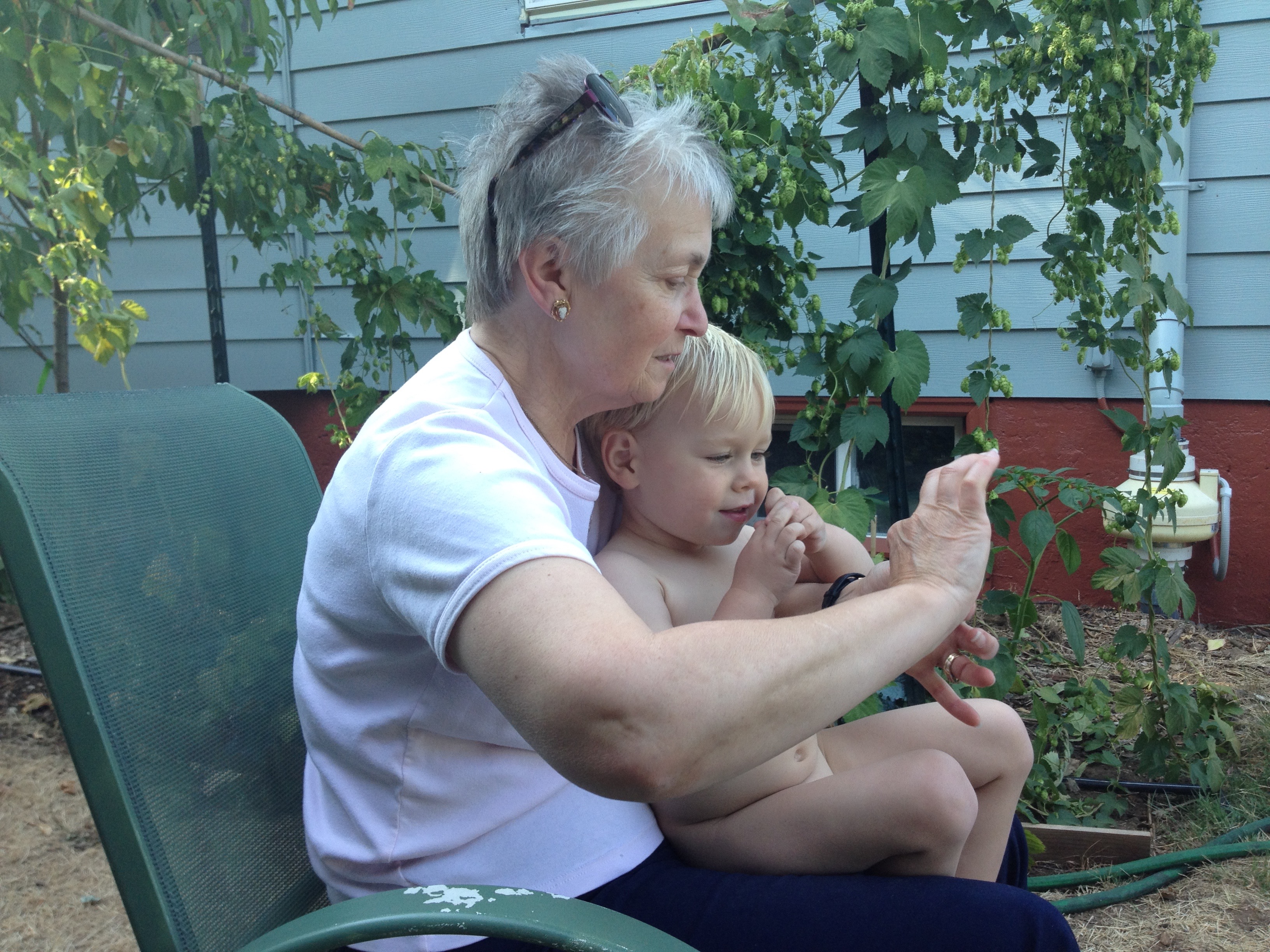
Mamie and Eliot playing Itsy Bitsy Spider
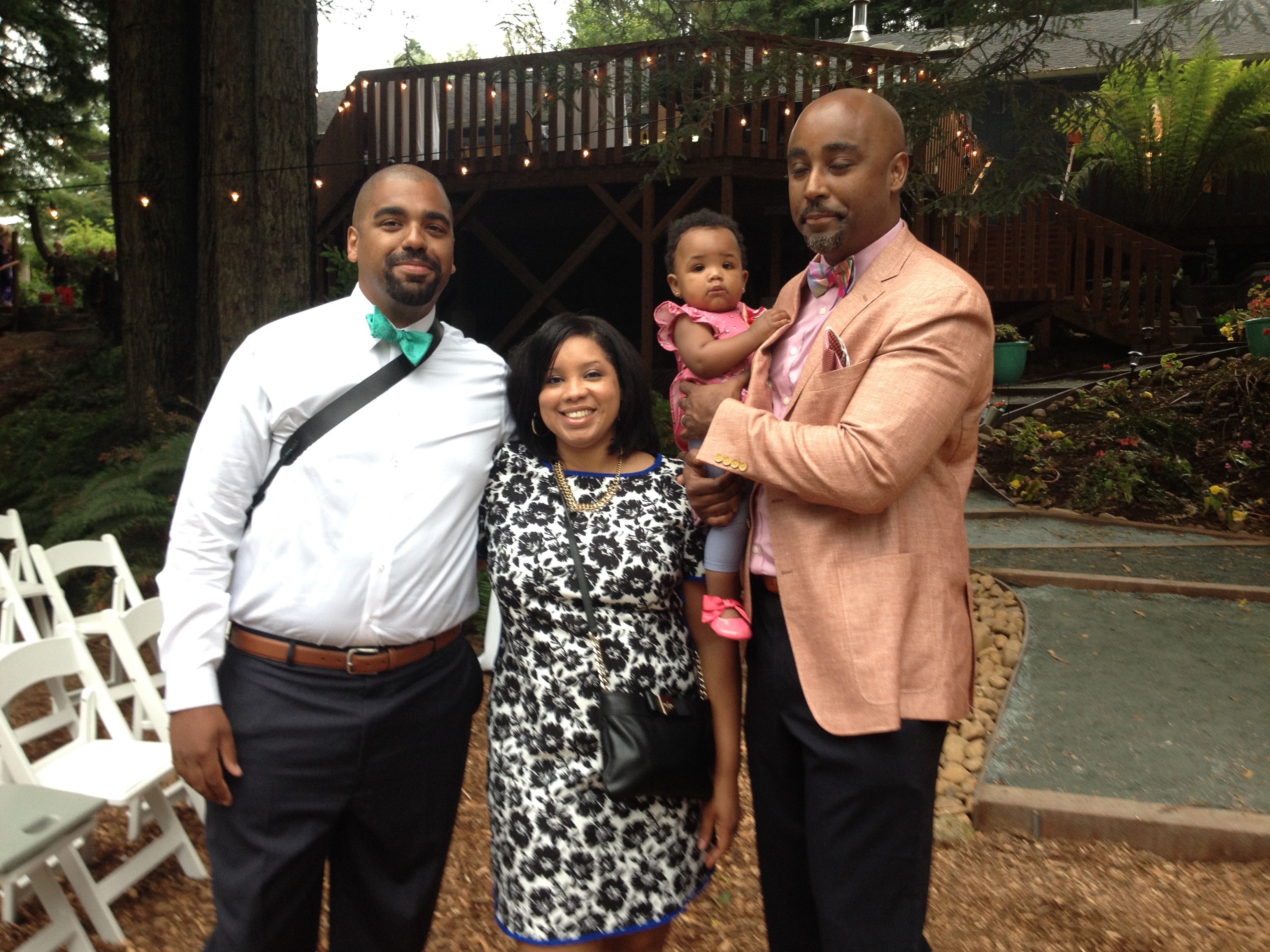
Paul with Nashida, Michelle and AJ
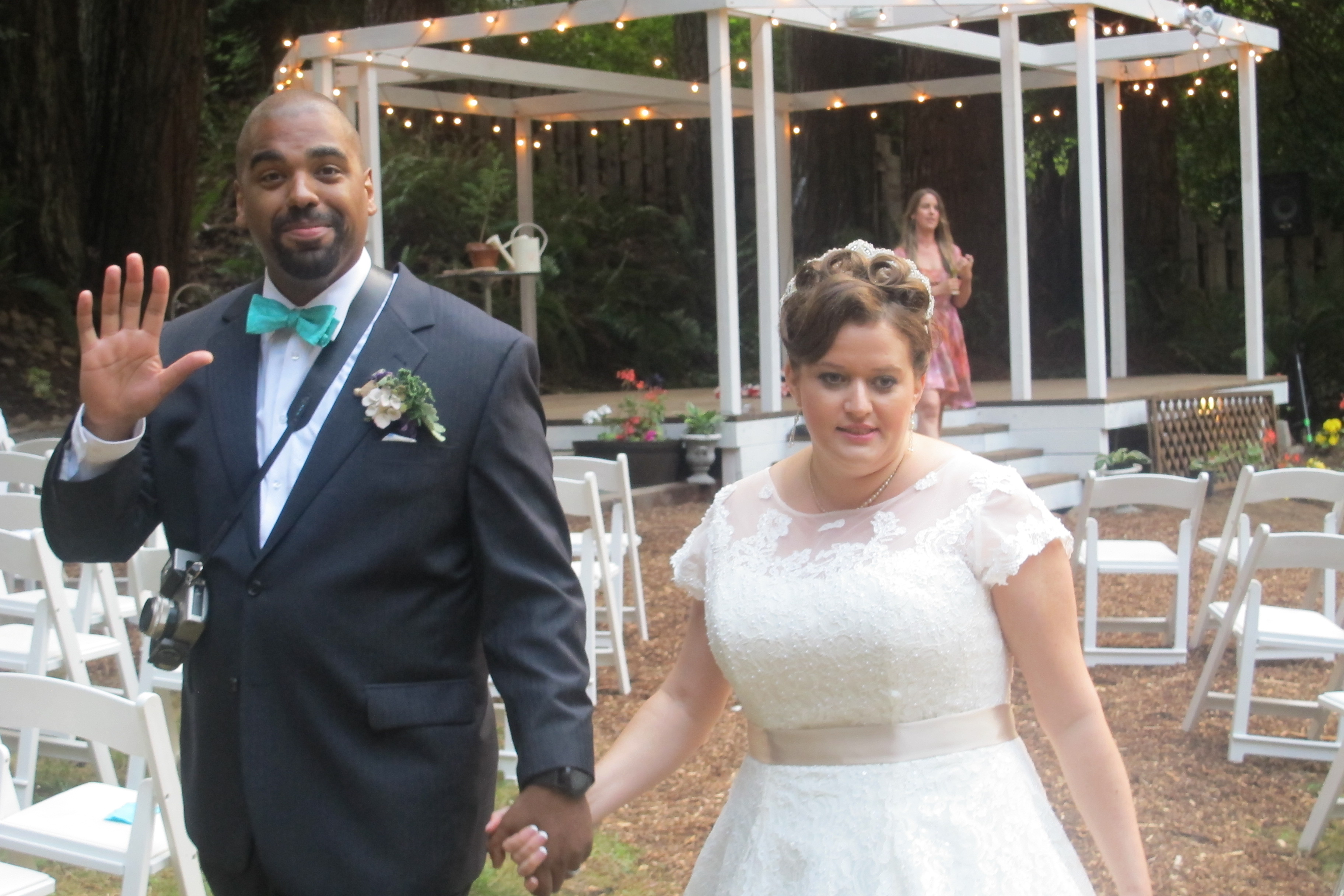
Paul and Katie, happily married.
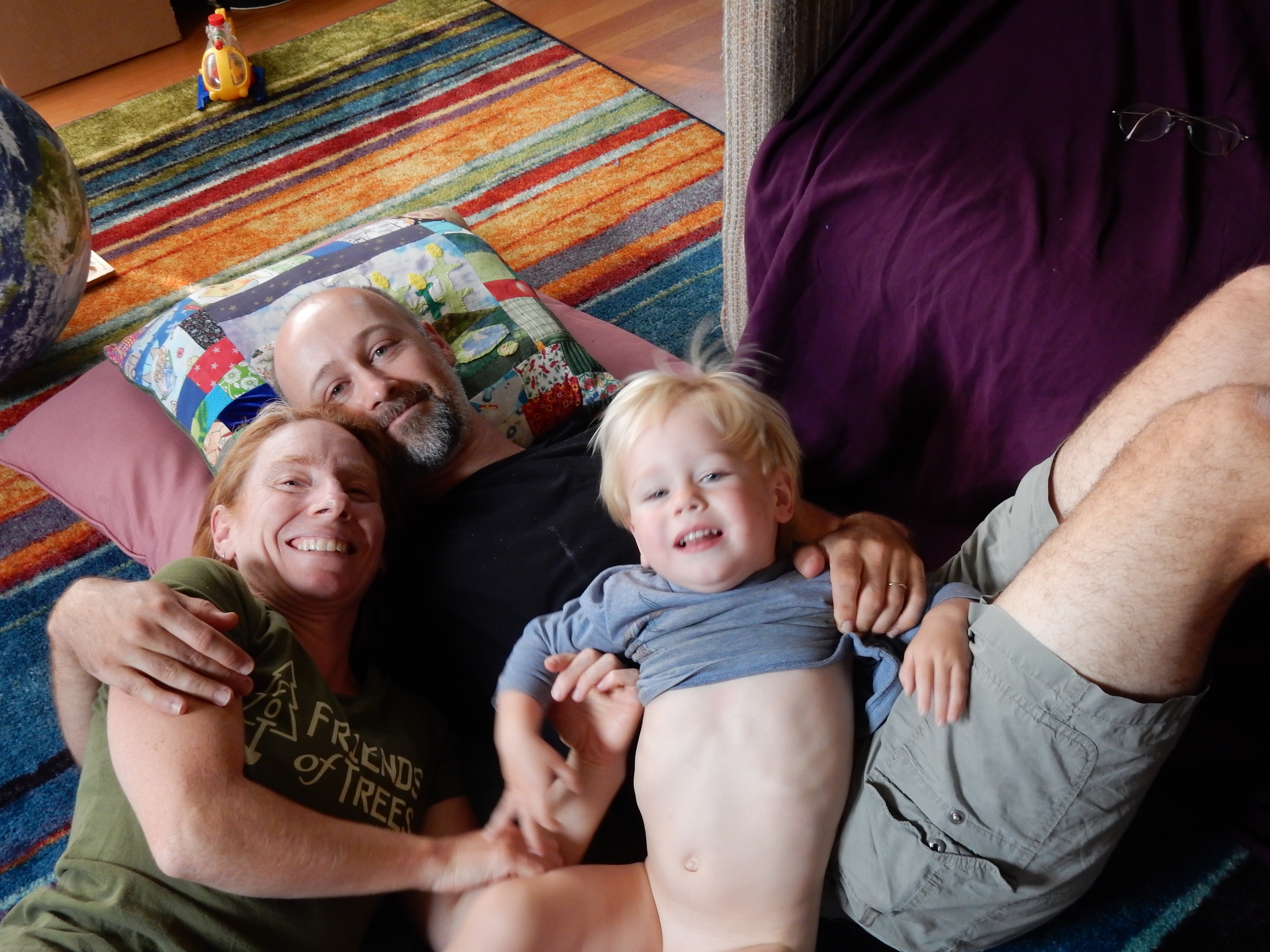
Nicole, Ethan and Eliot
Eye on Louisiana’s Slave History
My roots run deep in Louisiana soil. Born and raised here, I’ll be buried here. Its cultural and ethnic history colors who I am – Black, Catholic, American and Creole. This melding of Africa, Europe, the Caribbean, and native peoples indisputably defines southern Louisiana. Culturally, it is unlike any other region in the States with its Creole and Cajun cuisine, its music of jazz and zydeco and its festive Mardi Gras when the good times roll prior to the forty days of Lenten fasting and penance.
Yes, there is much to celebrate about Louisiana. But like other southern states, it has a dark and shameful past anchored in slavery. Melanie and I were reminded of that past with a visit to the Whitney Plantation along the famed River Road, 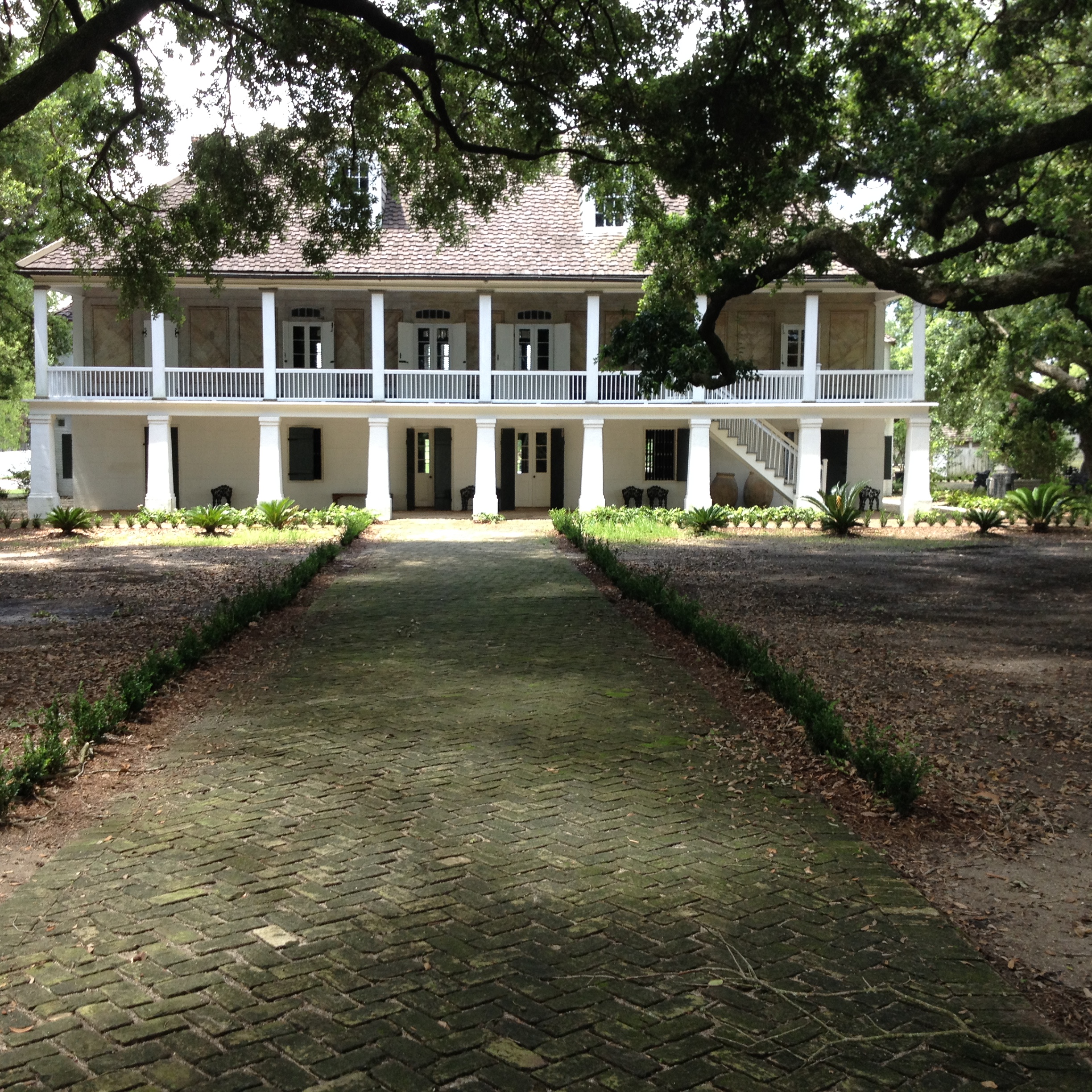 where there is a string of plantations just a few miles from New Orleans. Unlike other plantations, this one is a museum that documents slavery through the slave children’s eyes. Bought and restored a few years ago by a prominent white lawyer, John Cummings, the museum’s main purpose is to educate the public about slave life. To paraphrase Mr. Cummings, he created the museum to help people of all ethnic and racial groups to understand their common humanity and to demonstrate to those who share his skin color how horribly they treated others of a darker hue.
Throughout the grounds of the museum are statues of children whose faces were cast from actual photographs from this or surrounding plantations. Melanie and I were both moved by their blank and vapid facial expressions and bending submissive postures.  Their simple clothing, hung loosely on their frames, encrusted with soot and dirt, told of hard labor in the fields, cutting sugarcane and then boiling the cane in vast sugar kettles. As I stood in the walled memorial garden with the names of over two thousand slave children engraved in the stones, I felt a piercing pain, imagining my own sons and granddaughter as slaves. And as I continued to walk the grounds, I saw images of them and myself, reliving the lives these children endured. How would I have comported myself with the overseer? Would I have been sufficiently submissive? Would I have cast my eyes downward, appropriately bowing to authority? Or would I have been insolent and arrogant warranting the whip? As we entered one of the slave houses, I felt the discomfort of slave families jammed into wood framed dwellings, in summer suffering from the smothering Louisiana heat, and in winter exposed to the winter air seeping through the cracks in the boards.
 After a long day of labor from sunrise to sunset, I imagined weary bodies sprawled on straw beds under bed coverings of potato sacks.
The museum exists so that these slaves and the suffering they endured are not forgotten. Their names are engraved on black granite walls — those shipped from Africa with their country of origin and original name and those born in this country with their Christian names. Some names tell personal stories, collected during the WPA project during the Great Depression. Mary Harris, age 86 at the time, tells her story: Sure I remember slavery times. I was a big girl, turned eleven. I used to pull the fan that kep’ off the flies while the white folks was eatin’. It wasn’t hard work, but my arms used to get tired – ‘specially at dinner when they set so long at the table. I made the fires and brought in kinlin’ wood and carried out the hashes.
As we learned from our guide, there was a rank of commercial importance on the plantation – the blacksmith, the mule, the cook, and then the rest of the slaves. Undoubtedly, Mary Harris as a child was being groomed for work in the big house. Unfortunately, we did not get to see the big house. Torrential rains ended our visit abruptly. Happily, we were given a rain check and today we visited the kitchen where slaves prepared the food for their master as well as the big house itself. As plantations go, this one is modest in size and splendor compared to others along the river like Oak Alley. And like Oak Alley the walking path leading to the entrance of the home is lined on both sides with huge oak trees that provided a canopy of shade and served as a funnel through which air traversed to cool the house.
I’ve visited other Louisiana plantations but none equals the educational value of the Whitney. Nor did I realize I had a personal connection to the Whitney until I saw news coverage of the plantation’s opening. To my surprise I learned that Sybil Haydel Morial, the wife of the first black mayor of New Orleans, and with whom I worked at Xavier University of Louisiana, traces her roots to the plantation. Her ancestor, Victor Haydel, was the son of the plantation owner’s brother and an enslaved woman, Anna. Sybil’s son, also a former mayor of New Orleans, now heads the national Urban League.
Like many others who’ve read about slavery, I felt largely untouched by it. As a black person privileged to have been born in a strong family unit with equally strong attachments to the Catholic Church, slavery was distant and kept at bay. My two visits at the Whitney changed all that. I felt the pain and suffering of those whose stories were etched in stone. I heard their cries of anguish within my soul. I mourned with the child forcibly separated from her mother. I winced at the thought of being somebody’s property. I shuddered at the wheezing sound of the whip on a bloody back. I pitied the slave woman selected solely for the purpose of breeding. And lest I forget the price of insolence and resistance, there atop poles standing in the swampy waters of the plantation rested sculpted heads of slaves who revolted against their masters, a vivid reminder of the fate of those who dared to do the same.
As a Catholic, I am ashamed of the Church’s legacy in the legitimization of slavery through the papal bull of Nicholas V that granted the Portuguese the apostolic authority “to invade and subjugate the Saracens and pagans and any other non-believers and enemies of Christ wherever they may be, as well as their kingdoms…. and reduce their persons to perpetual slavery.”
Away from the plantation, revulsion best describes how I feel. I’m repulsed by the treatment and living conditions of slaves. Like Sybil Morial, my ancestral lineage traces back to slavery. And I wonder who among the names etched on the memorial walls might possibly be one of my ancestors. That our family has a lineage among the free people of color in Louisiana does not obfuscate our slave ancestry. Guillaume, Saizon, Darensbourg and St. Amant clearly legitimize our French heritage. But I am pained that some of my extended family do not embrace their African lineage. In honor and memory of enslaved men, women and children, I strive to live my life respectful of all people and cultures. Ferguson and Baltimore remind us that Lincoln’s vision for an emancipated people is not yet fully realized. We all have much more work to do. Yet, there is reason for optimism. In the museum store there is a wall of posted notes left by visitors. One of them, left by six-year old Julie, is particularly moving: Thank you. I am six. I wish I could save them.”
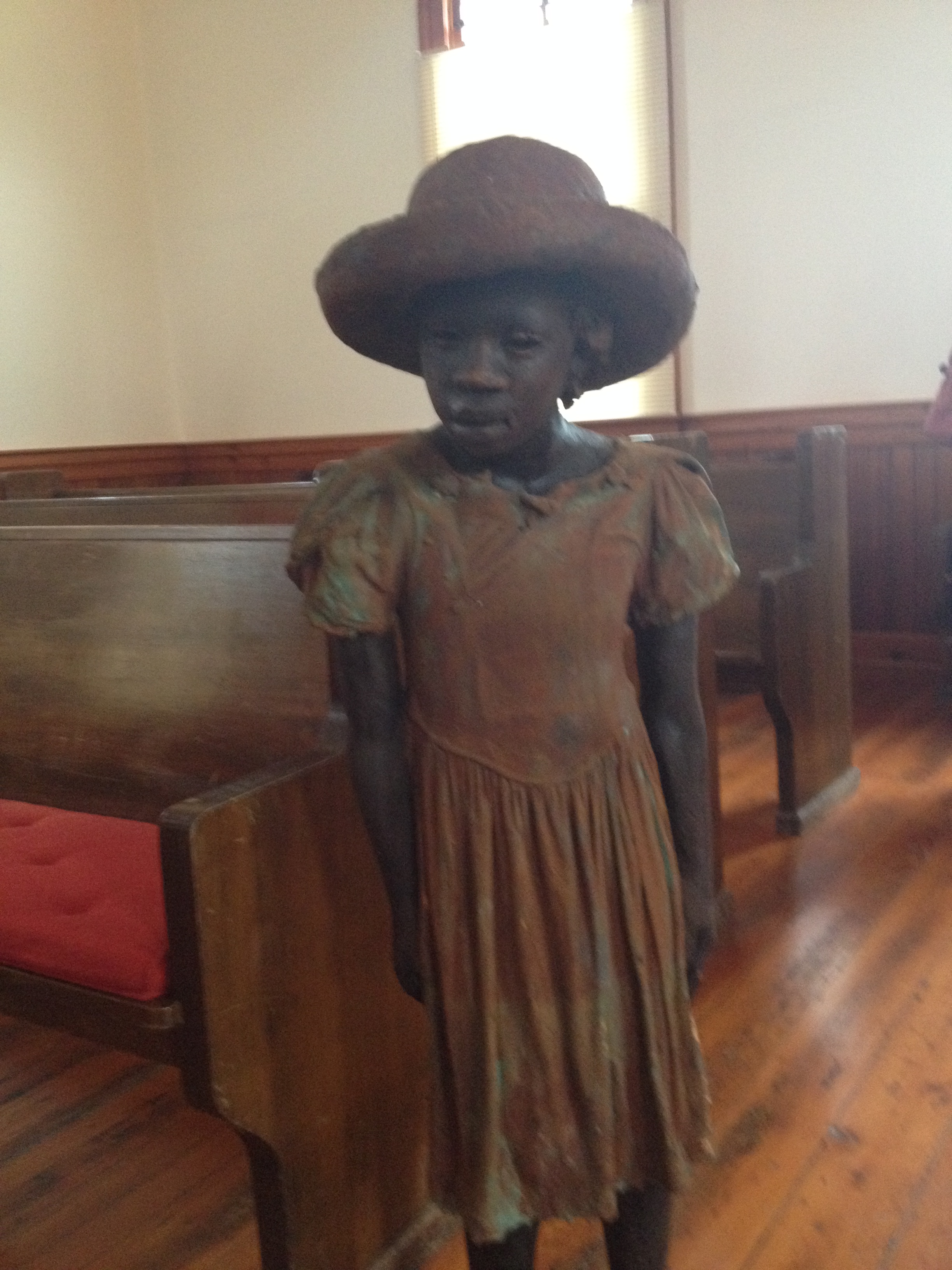

“When children used to get a whipping, they was taught to turn ’round and say, ‘Thank you, ma’am, for whipping me’ and bow. That was mighty hard to do, but we were never allowed to pout. If we did we got another. And if we just needed being punished, we were put behind a door and had to stand on one foot until we were ready to say we were sorry and promised not to do it again. If we told a story, our mouths were washed out with a soaped rag.” Francis Lewis – Louisiana Slave
Not All Cathedrals Have Stained Glass
On the morning of our flight to Las Vegas, the temperature in South Bend was a chilly twenty-seven degrees with accumulating snow. By the time we reached the airport, approximately two inches had already fallen. Our plane, initially diverted to Grand Rapids because of low visibility, had to be de-iced before taking off. What an unlucky start to our Las Vegas and St. George trip! When we finally arrived in Las Vegas we were greeted with temperatures in the high eighties. What a difference four hours can make from icy cold to broiling hot, a blanketed white landscape transformed into a dry dusty desert. From now through October, our travels will take us across the country from the nation’s capital, where we will grand-baby sit, to the redwoods of Northern California for our son’s wedding.
In a few short days, the blending of two families will begin when we meet our son’s future in-laws who are also traveling to Las Vegas. We’ll spend a few days together getting to know each other before the August wedding. As Paul’s life unfolds, and as he and his future bride are embarking on new adventures, so will two families, now strangers, but soon to be joined by marriage.
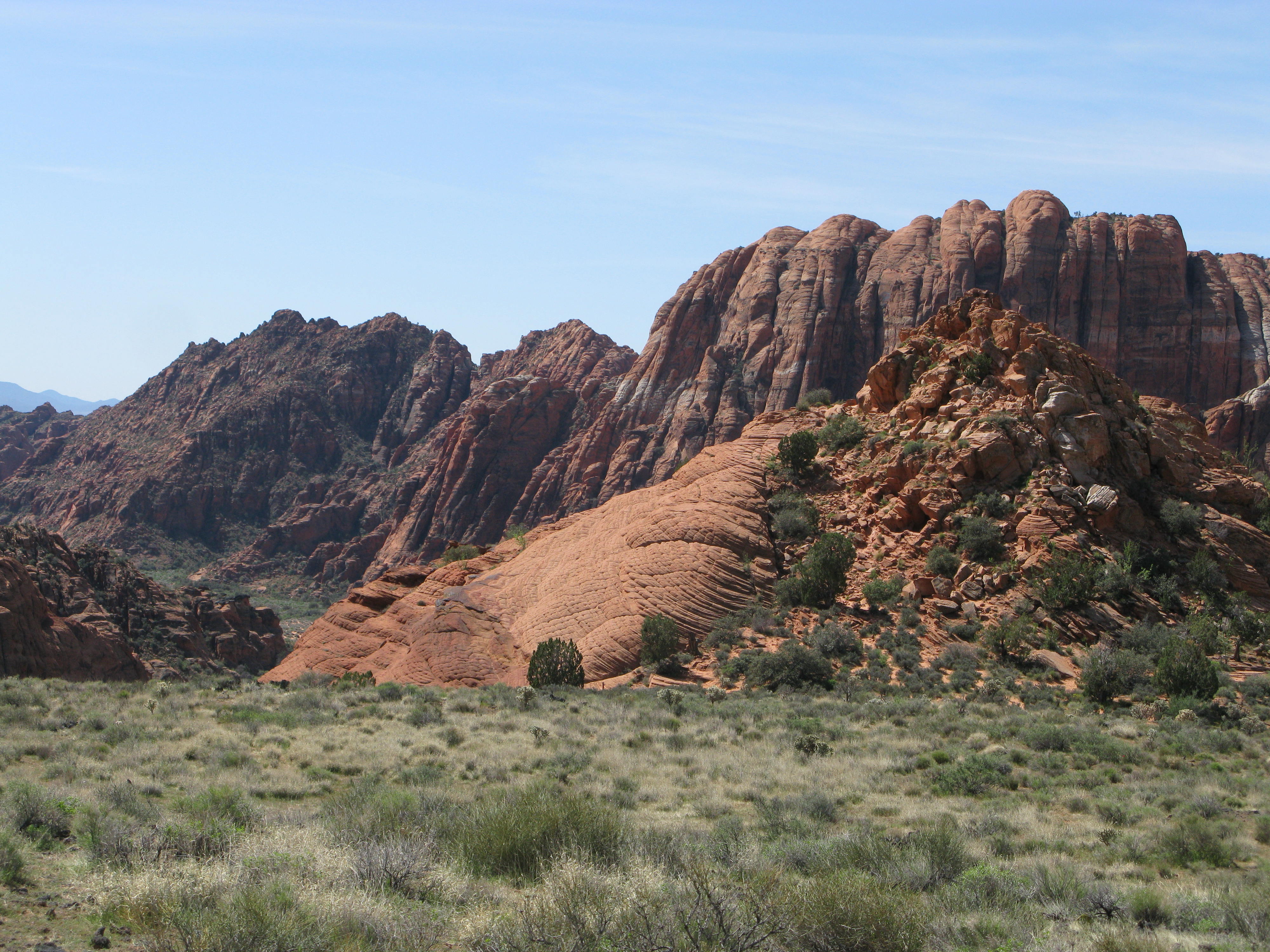
After spending our first evening in Las Vegas with Paul and Katie, we left the next morning to spend a few days with the Kills, our friends from South Bend, at their St. George home. We now know why they retreat here for the winter months — Utah is breathtakingly beautiful. Beauty is everywhere. 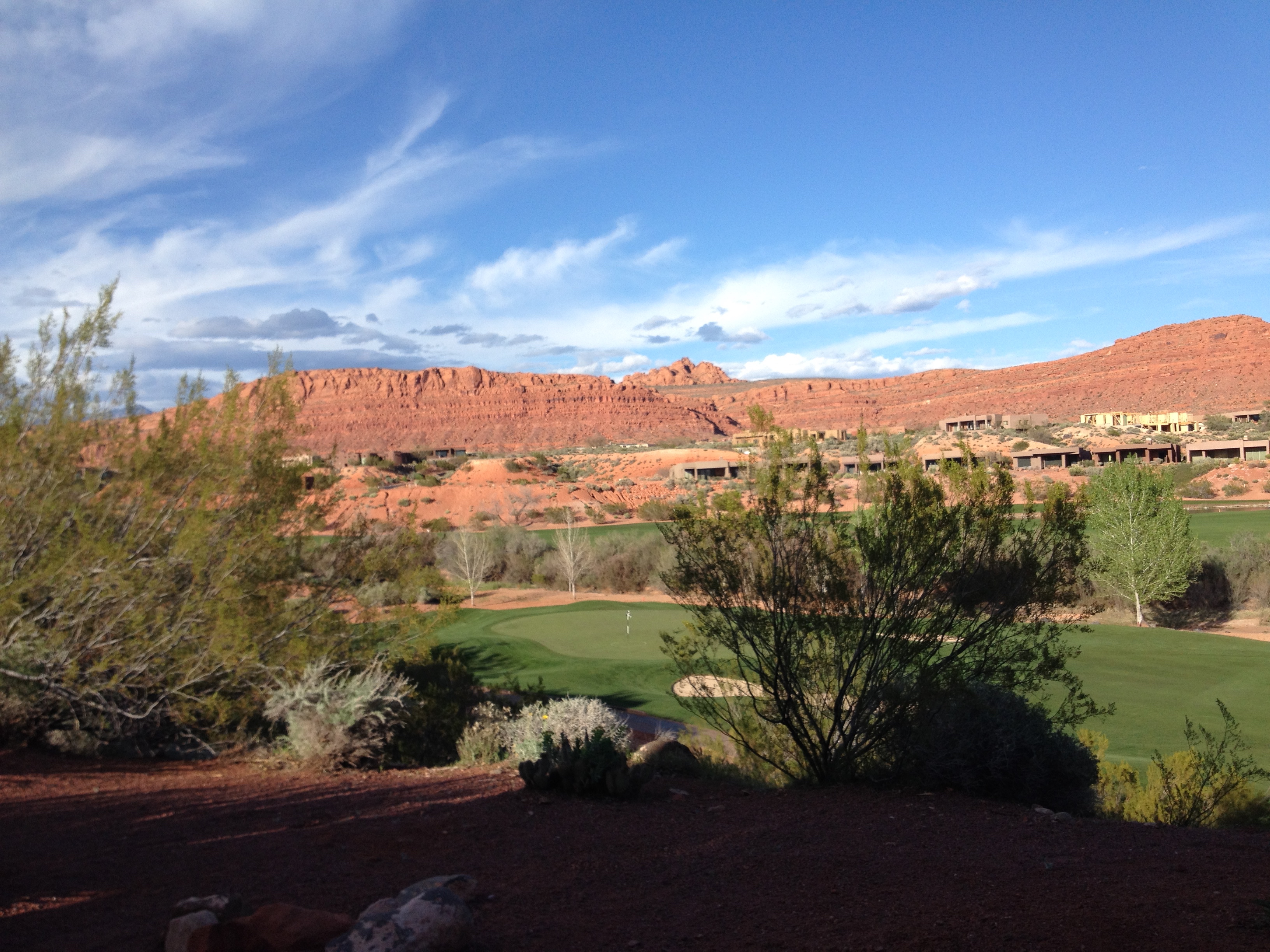 From their patio high above a golf course in the gulch, we focus on the expanse of reddish-toned mountains and splotches of black lava rock, then gaze appreciatively on the dusty green of flowering cacti and myriad colors of other desert plants. Accented by blue sky and wisps of white clouds, this natural panorama is captivating.
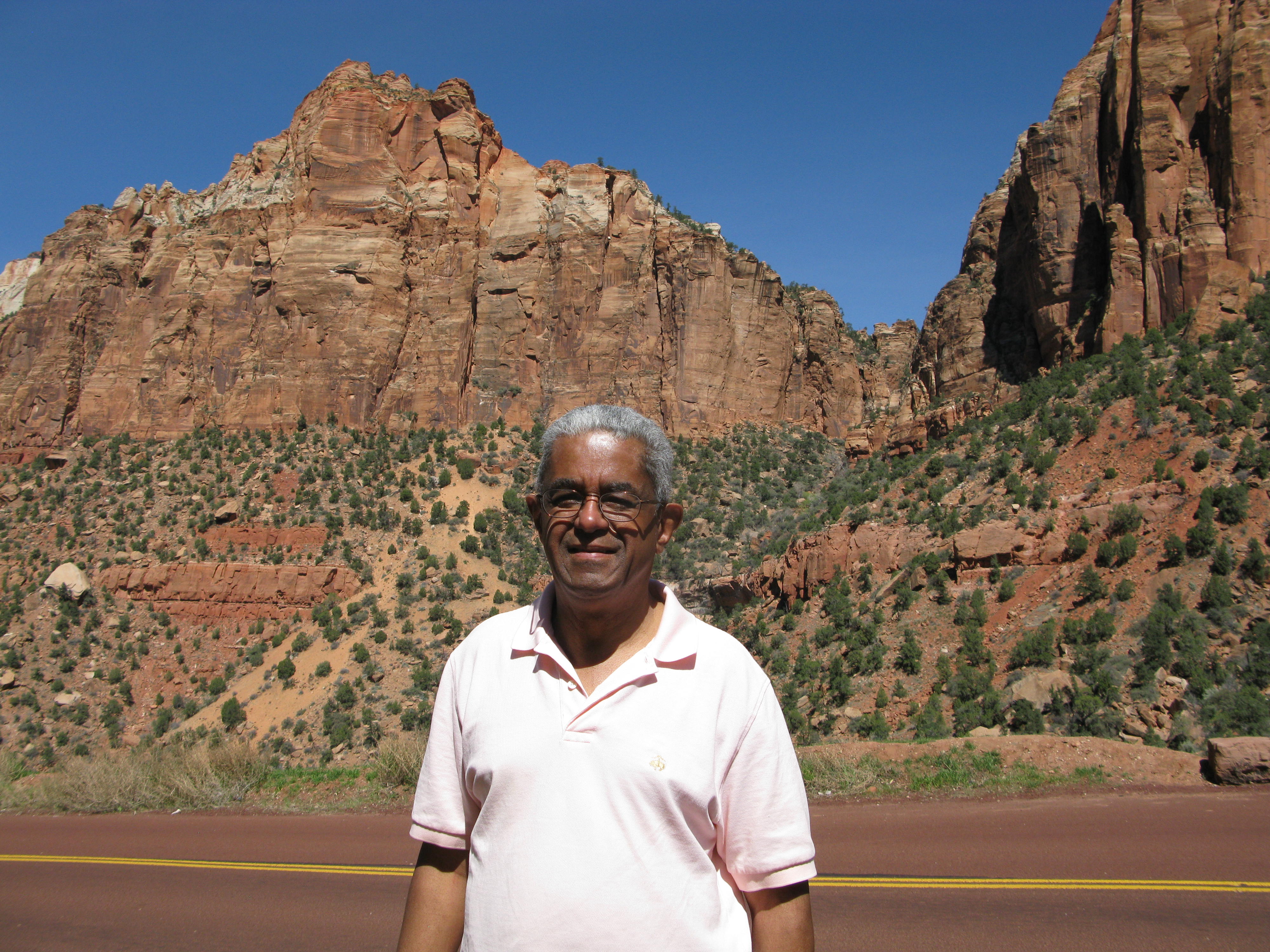
The looming mountains of Zion National Park with its resplendent canvas of color, shape, and layered patterns of swirling strata, elicit a religious stirring within the soul. As we take in this expansive edifice of nature, the phrase “not all cathedrals have stained glass” resonates. One can only imagine the extraordinary ecological disruptions that produced such magnificent splendor.  The long ago thunderous crashing of stone that gave birth to these graceful structures now offers serenity and tranquility to even the most blasé of observers.
The following day we hiked in Snow Canyon for two and half hours through sandy paths, rocky terrain, and lava fields. Though not as grand as Zion, Snow Canyon with its sloping hills seemed more accessible. Except for a few other hikers, we were left alone to explore. Here we were able to examine more closely the graceful contours of the mountains, their beauty enhanced by the intricate patterns of swirls and alternating long tunnels etched along their slopes. Strewn along the desert floor were colorful patches of flowering cacti of yellow or rose blooms. Occasionally we happened upon a lone flowering stem tinged in purple, yellow or fuchsia. A salamander perched upon a rock caught our eye or a startled jack-rabbit would dart across our path.
  The orchestration of color and form of white rock, red clay and black lava beds was clear evidence of divine handiwork.
Utah’s beauty is irrefutable. And although there is not much cultural and ethnic diversity, the people here are among the friendliest we’ve ever encountered. Everyone greets you with a smiling hello. Perhaps, the root of this openness is the Mormon faith professed by many in the state. Neighborhoods are closely knit. I learned that there is a Mormon Temple for every four hundred households. There is much more to learn about this fascinating place. This was our first extended visit to Utah, but certainly not our last!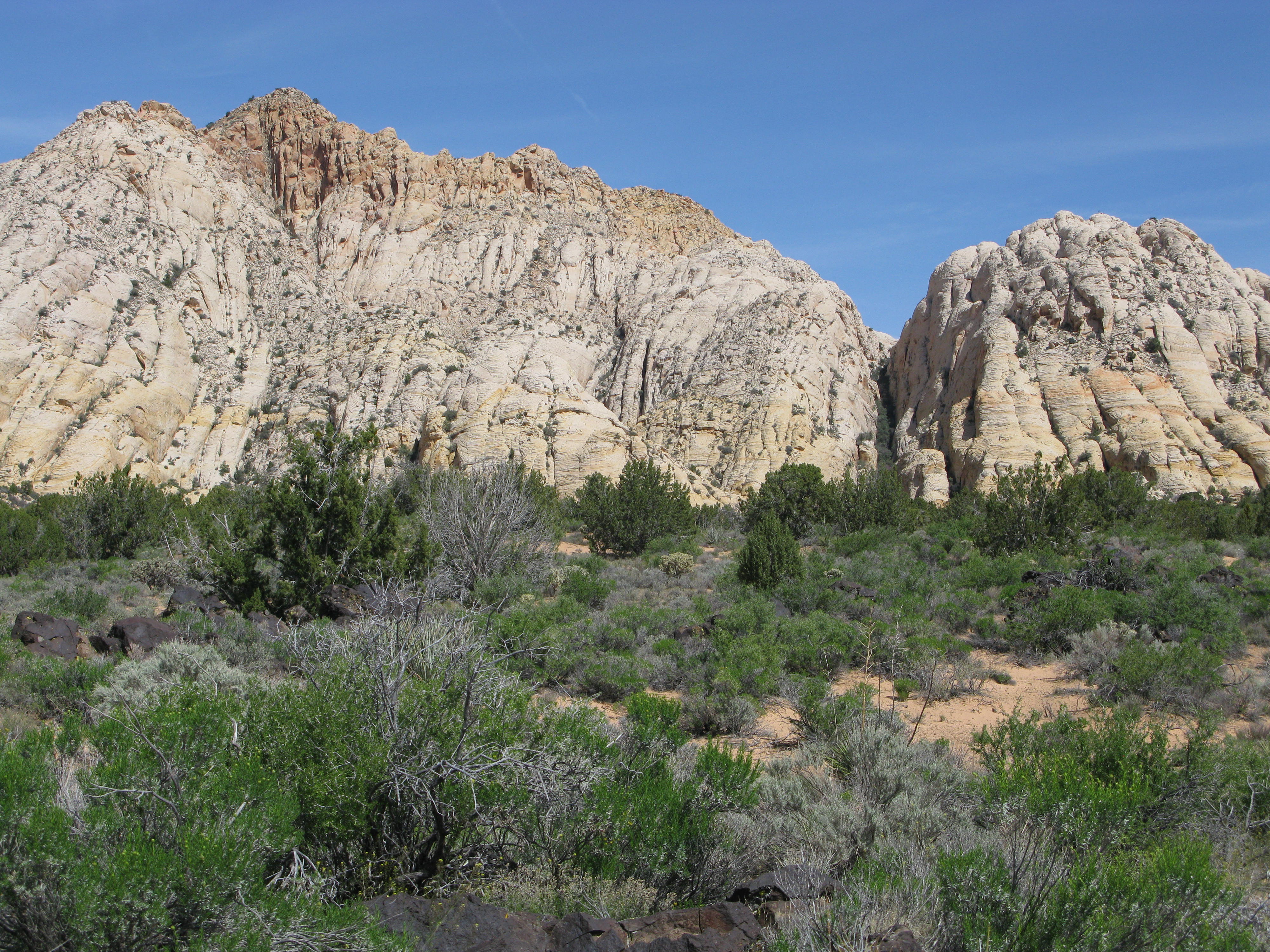



Champagne Country
We spent the last three days of our stay in the company of friends saying good-bye and celebrating life in the inimitable French way – animated conversations around the table with food, wine and cheeses. With friends Hélène and Xavier we walked along the cliffs of the littoral.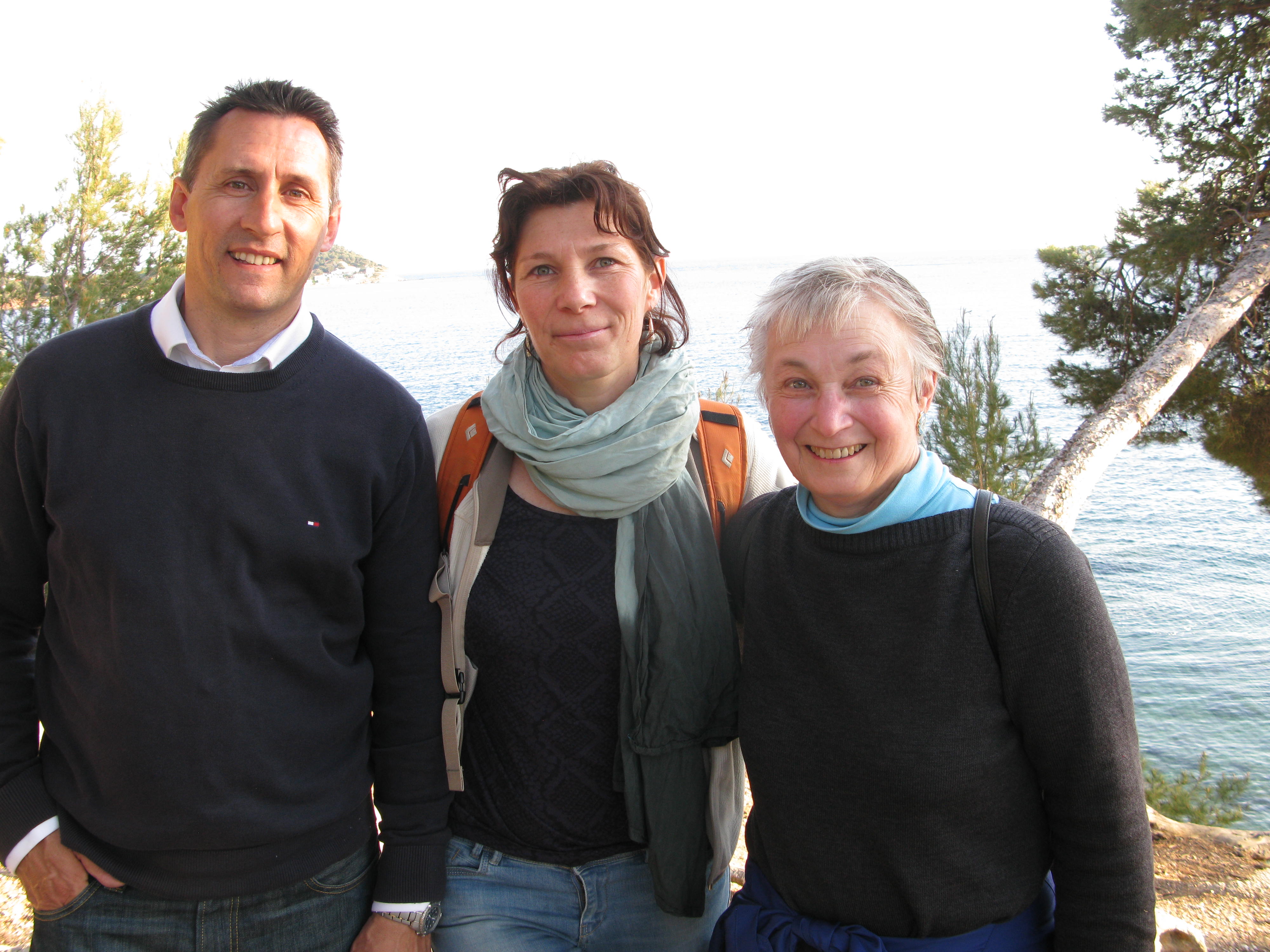 Later at Hélène’s apartment, we were joined by her friend, Asti, a delightful fellow. We all sat on her balcony, with the cool evening breeze and the soft glow of the setting sun. Delicious apéro, cold Belgian beer and refreshing Alsatian white wine added to the relaxing ambience. Leaving Provence is not easy. After seven weeks immersed in Provençal culture, we became French in our daily activities, our American identity submerged. Boarding the train in Marseille meant that soon we would be transformed once again into the Americans we really are. With ten days remaining before returning home, we would be making slight detours to Champagne, Paris and Amsterdam. As the fast-moving train (TGV, train à grande vitesse) en route to Paris zoomed through flat expansive terrain, the sloping rocky Provençal countryside in its wake, movie frame images of the last several weeks sped rapidly in my mind. Each frame pulled at the edges of a saddened heart, consoled only by the certitude that we would be returning. But for the moment, we were heading to Champagne country to visit friends we had not seen in thirteen years. It was Easter weekend and each train car was packed with travelers like us, en route to visit family and friends. When we last visited our friends, Jean-Luc and Alexandra, they had one son, Victor. Now two additional children, Justine and Louis, and a cute mixed Spanish terrier, Ficelle, add to the brood.
 We were eager to see them all. Alexandra was one of Melanie’s ESL (English as a Second Language students) in California in the eighties; Jean-Luc owns a champagne vineyard in the village of Verzenay. Since our last visit their production and export of champagne have grown. One of the by-products of visiting the Lallement family is that we get to drink extraordinarily high quality champagne (91 rating by Spectator) as an apéro (apéritif) each evening. To those reading this blog, we recommend highly Lallement champagne; distributors are in the New York and San Francisco markets. Being with the Lallements is like being with our own family. Their children are like grandchildren to us. In our few days with them, we taught the kids a new card game, Kings’ Corners, and we all watched a feature movie, La Guerre des boutons, which included Victor in several scenes. We took walks and spent time with them individually, listening and laughing. And oh, we enjoyed the parents as well. Alexandra prepared delicious meals; Jean-Luc was happy to prepare some of his favorite delicacies — escargots prepared with wild mushrooms and cream, a separate serving of black mushrooms called trompettes de la mort, and large sautéed white asparagus which is very popular this time of year. He obviously took great delight in seeing me delve hungrily into each dish. Easter Sunday afternoon, after Mass and a delicious dinner, Justine and Louis took us for a walk in the village and surrounding vineyards. They were actually on their trottinettes, (scooters) and we sauntered along.Verzenay is a small village of about one thousand inhabitants but there are over thirty separate champagne vineyards.
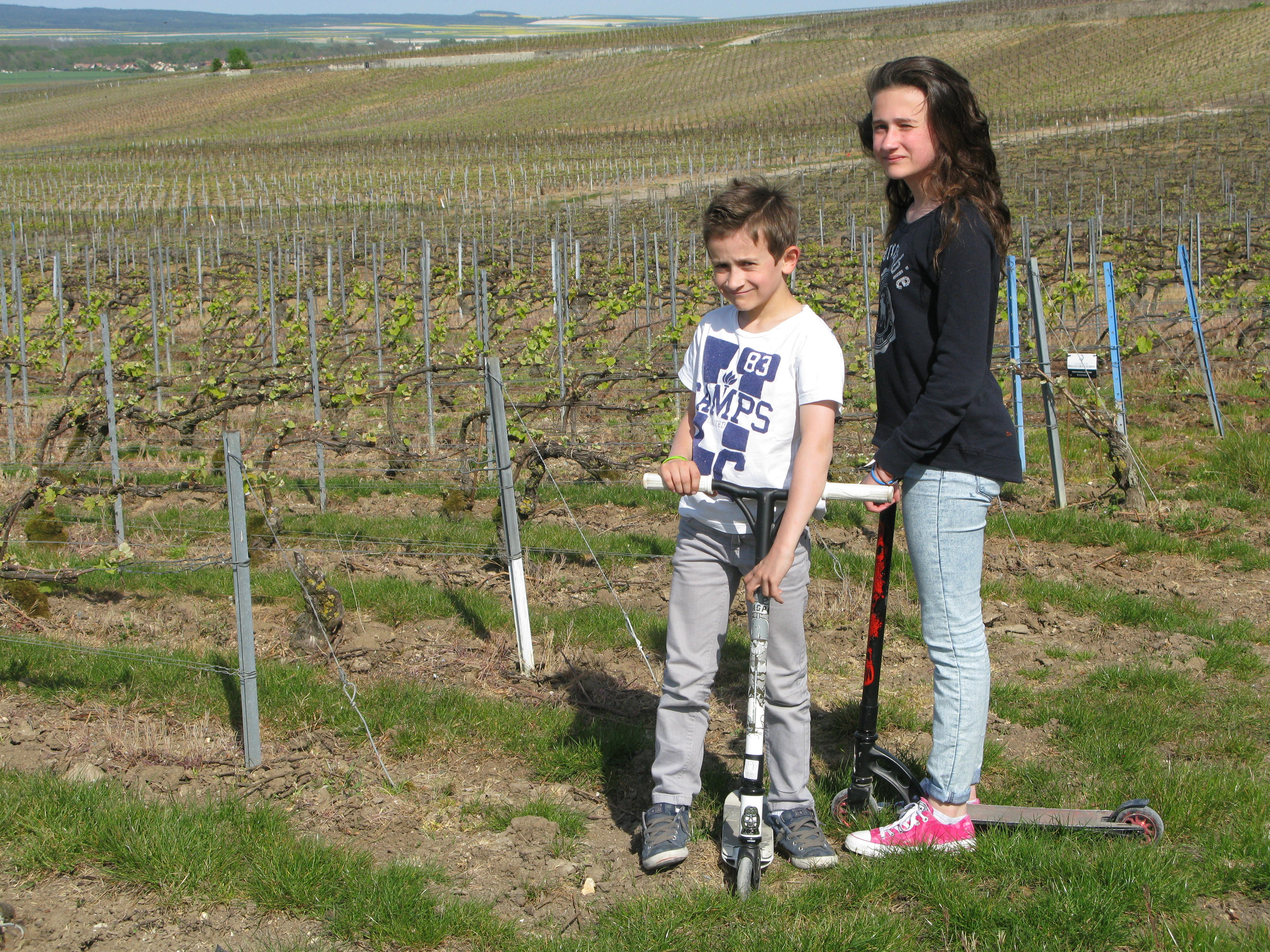 The town, about forty minutes from Reims, dates from the Medieval period in a pastoral setting amidst acres (hectares) of vineyards and yellow Colza(canola) fields. This part of France with expansive, flat open-spaces is a stark contrast to hilly and rocky Provence. But like Provence, its neatly arranged rows of vines strike an unparalleled beauty. After sauntering among the vineyards, the children took us to the cemetery to see the Lallement gravesites dating back several generations. The only shortcoming of this weekend en famille was its short duration. Our bond with the family became stronger. We were honored and privileged listening to the parents speak about parenting. In that respect they are part of that universal parenting club and have concerns in raising children as every parent across the globe shares. My only regret about that weekend is that we didn’t stay longer. And I’m confident that the children feel the same way. I’ve already received an email from my copain, Louis, as he referred to himself, and from Justine. A highlight of our brief visit with the Lallements was an afternoon visit at the Cathedral of Reims. In this Gothic masterpiece the Kings of France were crowned.
 Built over three centuries, the cathedral remains incomplete, lacking spires on the towers. We did not have enough time to visit the impressive canonical section adjacent to the cathedral with its extensive sculpture collection nor the city itself. Those activities are already high on the list for our next visit.
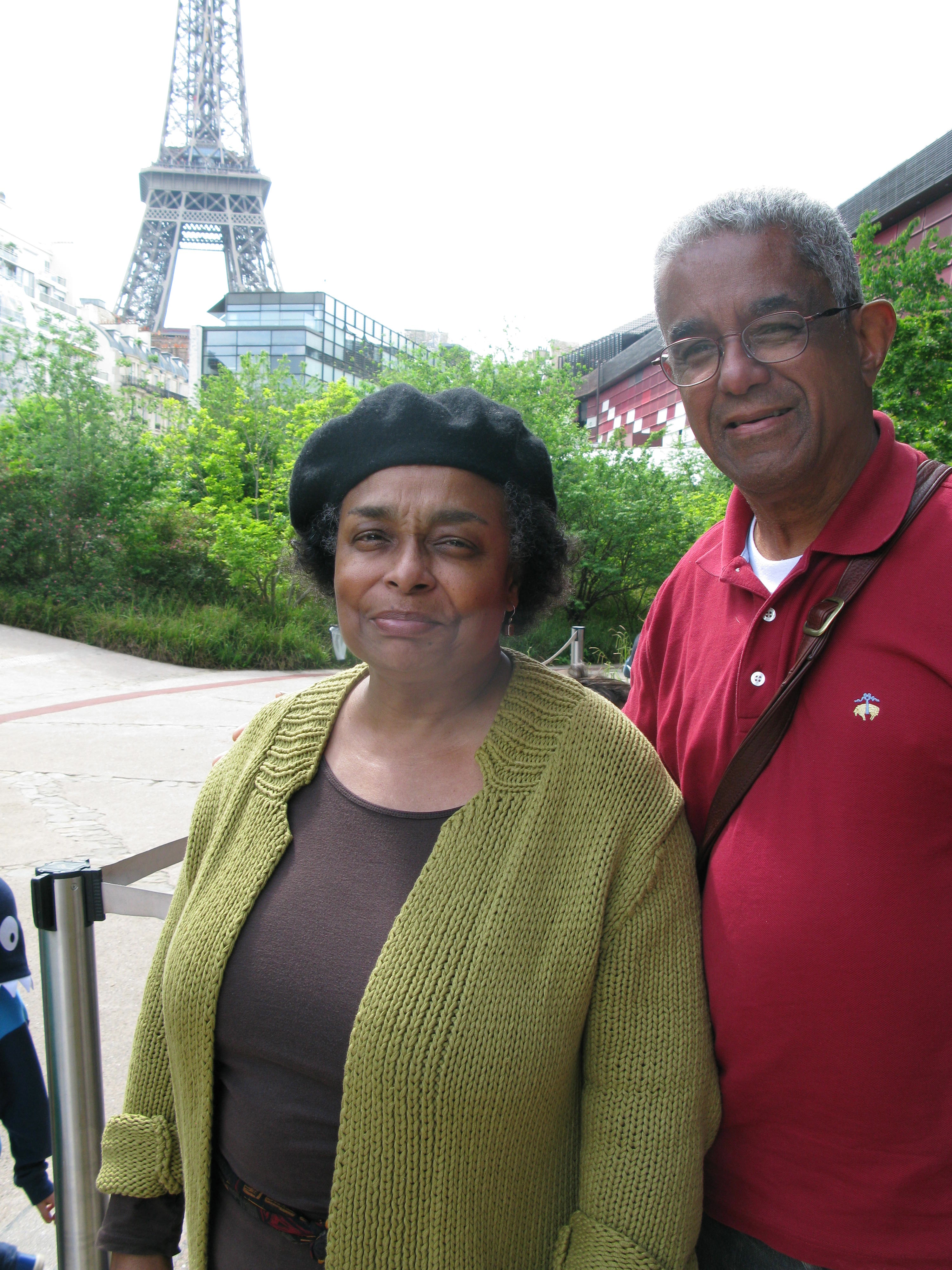
On the morning of our departure from Verzenay, we all had breakfast together before heading to Reims. After many hugs and bisous, we boarded the train to Paris to see our Parisian son, Louis, who spent a year with us ten years ago as an AFS (American Field Service) exchange student. We had not seen him since. Now he is a chef in a Paris bistrot, God Save the Kitchen. Although he knew of our visit, it was difficult to reach him. Repeated phone calls proved futile. Fearing that our trip would be in vain, we went to his restaurant only to discover that it was his day off. But we did have a nice lunch there. Finally, after many unanswered phone calls and e-mails, we were able to connect with Louis on the last day of our Parisian stay. He invited us to the restaurant where he works. And what a wonderful three-hour reunion, reminiscing and catching up on his life in the intervening years! When he came to the States, his English and mannerisms were those of an American. Then he wanted to be recognized as American. He spoke impeccably well having learned English since the age of four in a bi-lingual school. An obviously brilliant kid, Louis’ only ambition that year was to skateboard. He had no interest in studying and got into mischief at home and at school. Several years ago, we were astonished to receive a long letter from him apologizing for his behavior. Though older and more mature, Louis still retains his playful charm. When asked by Melanie what he got most out of that year with us, he mentioned gratitude. He was thankful for all that we had done for him. In his AFS application, he had expressed a strong desire to be in a family with a father. His mother, a writer, was raising two adopted children, he from Brazil, and a daughter from Russia. And now we can look back and appreciate his time with us as well. During his year with us, Louis spoke lovingly of his grandfather who told him that ordre et discipline were the keys to success. Though those were lacking when he attended high school in the States, it is quite obvious that those lessons finally took root. He’s enjoying his success as a chef. “I want to make people happy with the food I prepare,” he chimed. Before saying good-bye, he treated us to one of his specialty dishes, a chili of shredded beef, prepared à la Louis. He’s making a name for himself and gave us a copy of a Parisian pamphlet that featured him on the cover with several of his recipes included. He also makes a jambalaya that he says the Parisians love. Other highlights of Paris included our visit to the Rodin museum and the Musée du Quai Branly where we met Diane Pinderhughes, a Notre Dame professor and fellow congregant at St. Augustine’s who was in town for a few days to attend an academic meeting.
 The Rodin museum and its surrounding gardens is a must-see.
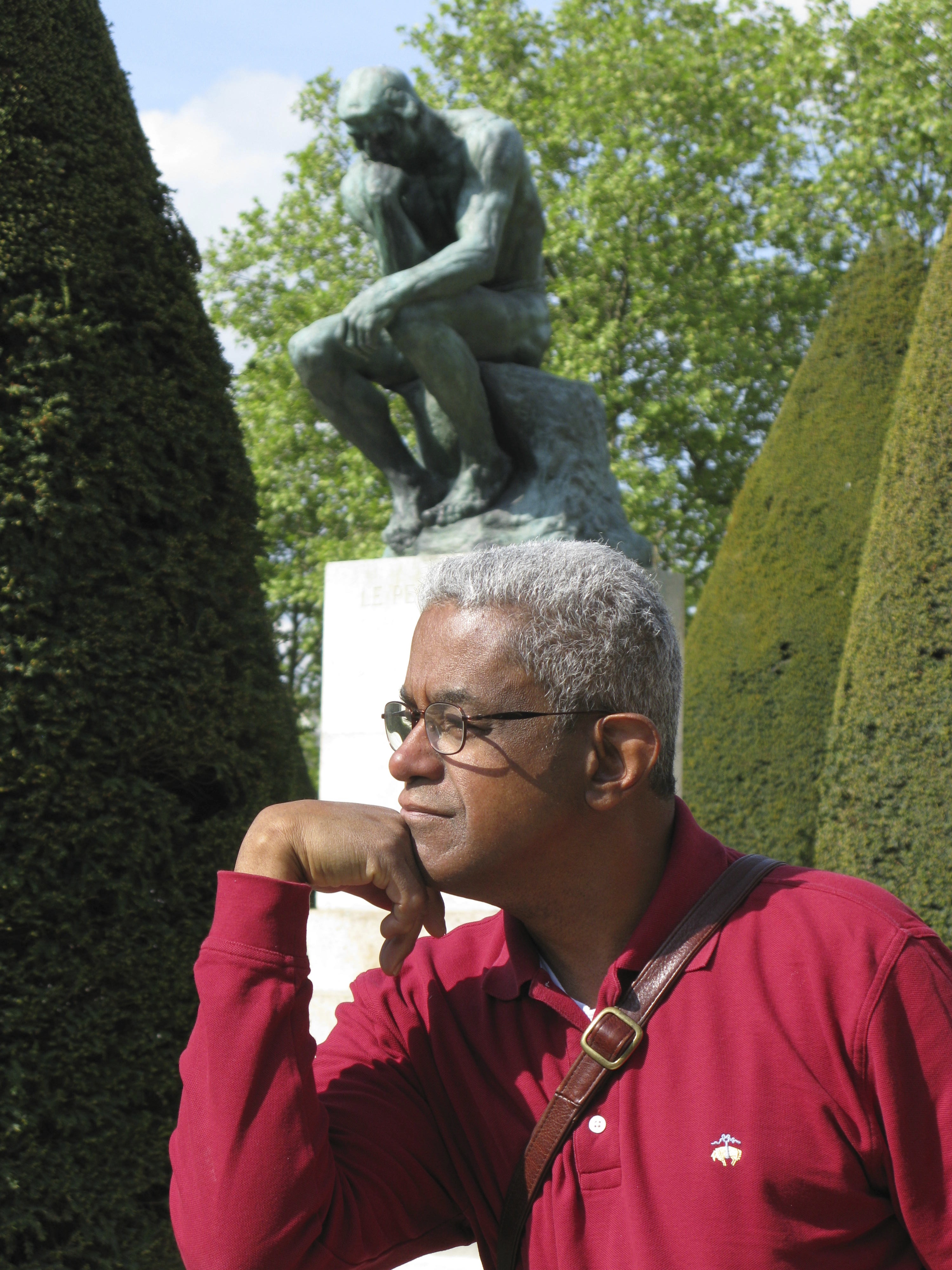
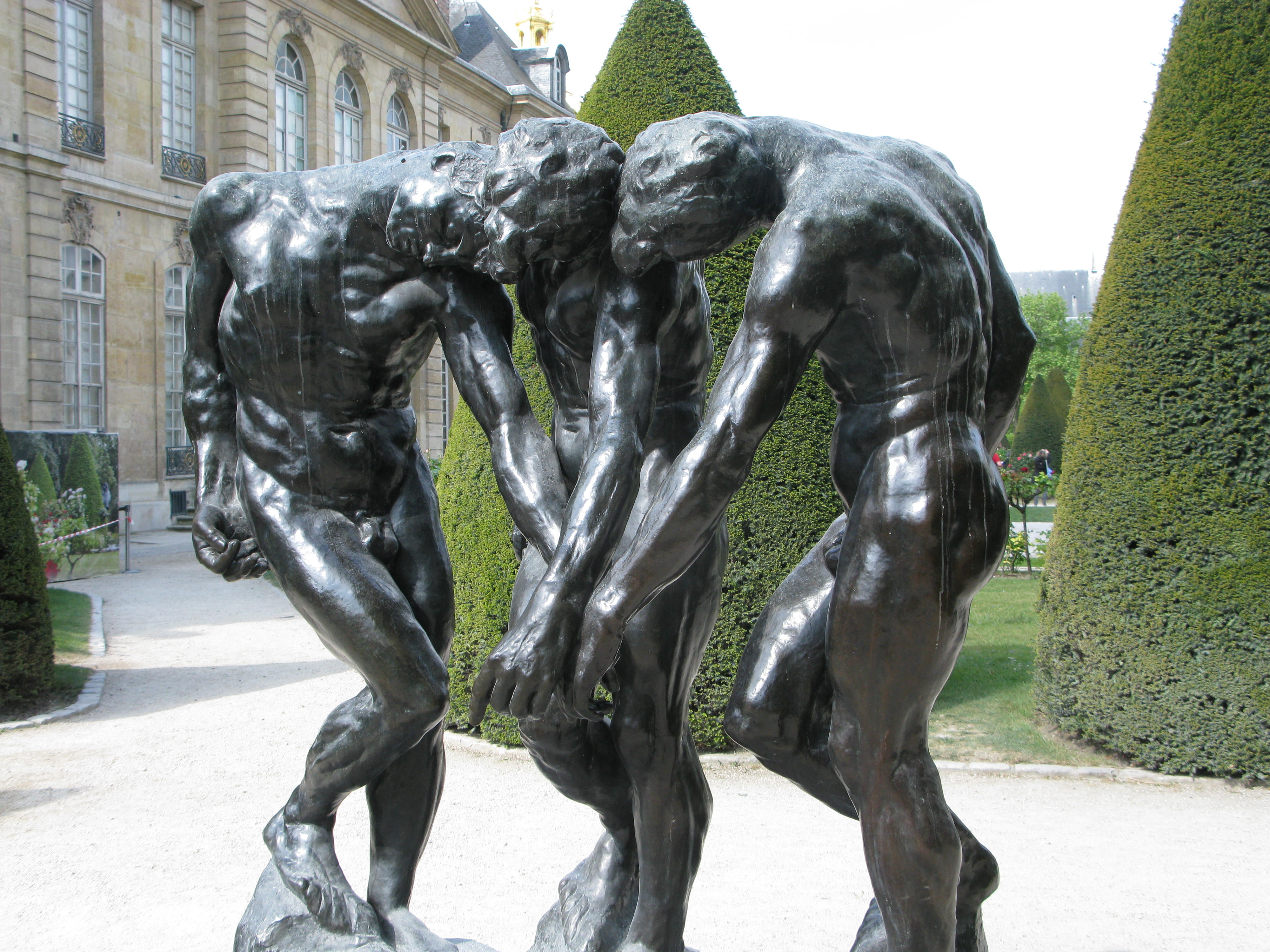 Majesty and power seemed to emanate from the tall dark bronzes spread over the gardens, each a testimony to the genius of a masterful sculptor. Each bronze with its realistic and graceful stature held secrets for the viewer to unveil. I could not resist having my picture taken with perhaps the most recognizable Rodin, The Thinker.
  Within the museum itself were other sculptures from which we could follow Rodin’s maturation as a sculptor. Even his earliest work showed indications of a great artist. Alongside some of the pieces was a special exhibit of Robert Maplethorpe whose textual and sensual black and white photography was influenced by the same elements in Rodin’s sculpture. Like Rodin, Maplethorpe’s contorted poses of the body mimicked the forms and shapes of the natural environment. But unlike Rodin whose poses also evoke sensuality, Maplethorpe’s sought to shock. At the Branly museum where we met Diane, time allowed for a visit of only three exhibitions, one on Nancy Cunard, one on the American Indians of the Plains, and the third on the cultures on Oceania. The Cunard exhibit was particularly fascinating. Shamefully, I had never heard of Nancy Cunard, and I should have since I’ve studied the art and literature of the Harlem Renaissance. Nancy Cunard was a rebel English heiress who fraternized with the likes of André Breton, Ezra Pound, T. S. Eliot and other literati and artists. She bristled at global and ethnic inequality and inequity and used her wealth and influence to fight these injustices. In 1934, she published a massive tome, Negro, an anthology of art and letters. The exhibit featured her vast collection of bracelets, period jazz music, and Langston Hughes reciting his familiar poem, “I, Too, Sing America.” We had initially decided that we would bypass the Plains Indians exhibit because it was a theme far too familiar to us, but at the last minute we decided that we could pass through it quickly. Oh, how wrong we were! To our surprise, it was a large exhibit, tastefully done, respectful, detailed with a rich and accurate depiction of American Indian life. The exhibit in many ways paid homage to the traditions of the Plains Indians while at the same time exposing the horrors of the forced land abandonment and migration by the American government. Unlike most exhibits of this kind, the narrative was told in reverse, from the traditions and modern cultural arts, and the living conditions of the twenty-first century reservations to the period before the Native Peoples’ encounters with the European invaders. The last exhibit — and I could have spent the entire afternoon there — was an exhibit on the cultures of Oceania. The masks, and the rituals in which they were used, were the most appealing of all the artifacts.
 Examining the tools, the wooden boats, modes of dress, ceremonial objects, and the like, gave me a perspective on a world I know so little about. To anyone visiting Paris, a visit to the Musée Branly is on par with a visit to the Louvre or to the Musée d’Orsay. Nearby are the Eiffel Tower and Les Invalides, where Napoléon is buried. No visit to Paris is complete without a concert of classical music. In France, and throughout Europe, concerts and theatrical events abound. Musical concerts are often held in churches at little or no cost. On the Left Bank, a stone’s throw from Notre Dame, in the Medieval church, St. Julien-le-Pauvre, we heard beautiful renditions of Chopin and Lizst. I remembered walking in that church many years ago as a student and happened upon a rehearsal of organ music. The deep tones of the organ still resonate in my brain.
  In Paris, we also met a colleague whom we met a couple of years ago in Brussels where I gave my talk on the literature of the Louisiana gens de couleurs libres. Melanie and I met Jean-Marc for a coffee and then a couple of beers at a well-known nineteenth century café, Le Rostand, near the Sorbonne. Jean-Marc had just spent the day in the library doing research; he is working with several scholars from across the globe on literatures of the Atlantic. Our visit to Paris was too short. To appreciate all of Paris’ artistic and cultural life, its architectural splendor, its gastronomic delights, its night life and the joy of walking through its gardens, would require a lifetime of leisure. Alas, our three days were just a soupçon. Luckily for us, this was not our first visit to Paris, and hopefully, not our last. From Paris, we took the train for Amsterdam to visit Melanie’s high school friend, Beverly and her husband, Jan. Details of that visit to follow in the next blog.
It’s Melanie again in italics. Leaving Provence really changed the nature of our stay in Europe. In the Toulon area we had a home base rooted in a small town outside the city. We took day-trips and came back home. Only once, when we went to the Antibes area, did we stay over night before returning. We didn’t feel like tourists. We felt like long-term residents, albeit non-French ones. Once we left our car in Marseille, we were on the road staying only three or four nights before moving on. Even though we felt that we had not learned everything possible about the Toulon area, we stayed long enough to revisit places that we liked, to go dancing three times, to go to the movies, to shop at the open-air market on Fridays and get to recognize our favorite vendors, to have a “carte de fidélité” (a grocery story frequent shopper card!), to invite friends to dinner, and to explore the smaller, more intimate sights that weren’t at the top of the tourist agenda but which gave us a deeper understanding of the rhythm of everyday life. Alfred got his hair cut, we had a flat tire repaired, we sat in cafés sipping a drink and reading as we watched the ocean and the people walking by, we had long conversations with people about their health care and their politics. We feel so grateful to have had this time to explore one place in depth. Of course, it was also wonderful to visit people whom we haven’t seen for years. My former 19-year-old ESL student, Alexandra, has grown into a lovely mother of three, who manages the family business while her husband works the land and produces champagne.
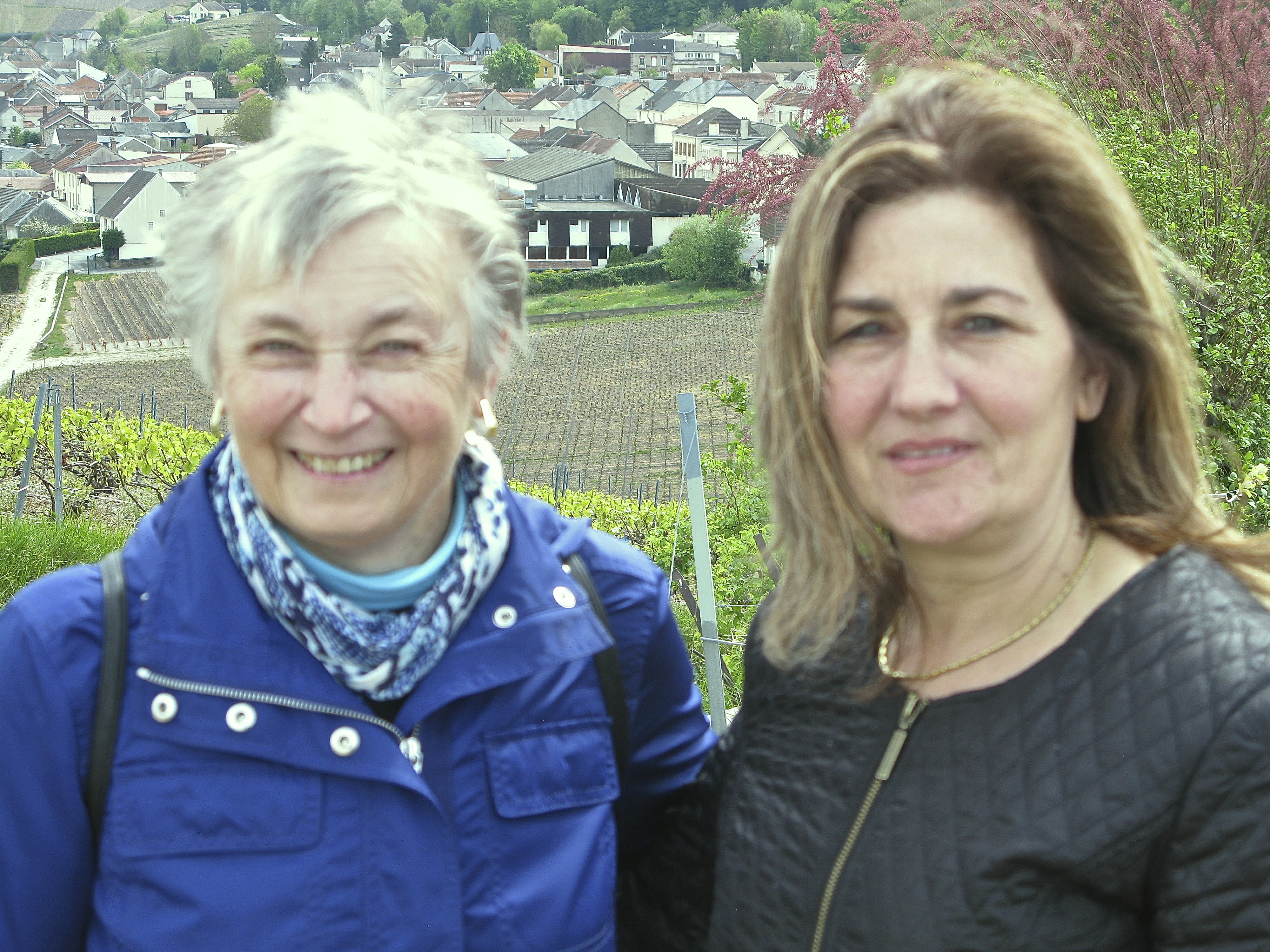 She speaks 5 languages, so she can handle exporting champagne all over the world. It was so much fun to see her brother in Juan-les-Pins in his restaurant and then bring greetings and photos of that reunion to his sister in Champagne. And visiting with our former exchange student, Louis, in Paris was a great three-hour review of where he had been when we knew him to appreciating the young man he has developed into. What a treat to see his excitement about his culinary creations and his growing confidence and maturity. This short but intense meeting made our quick travel to Paris worth it.
The Continuing Provençal Travelogue
Driving in France offers its challenges. The narrow passageways of ancient towns and villages that easily handled the flow of ox carts and pedestrians present obstacles for modern day modes of transportation. Sometimes traffic flows in both directions with little space separating the passing cars.
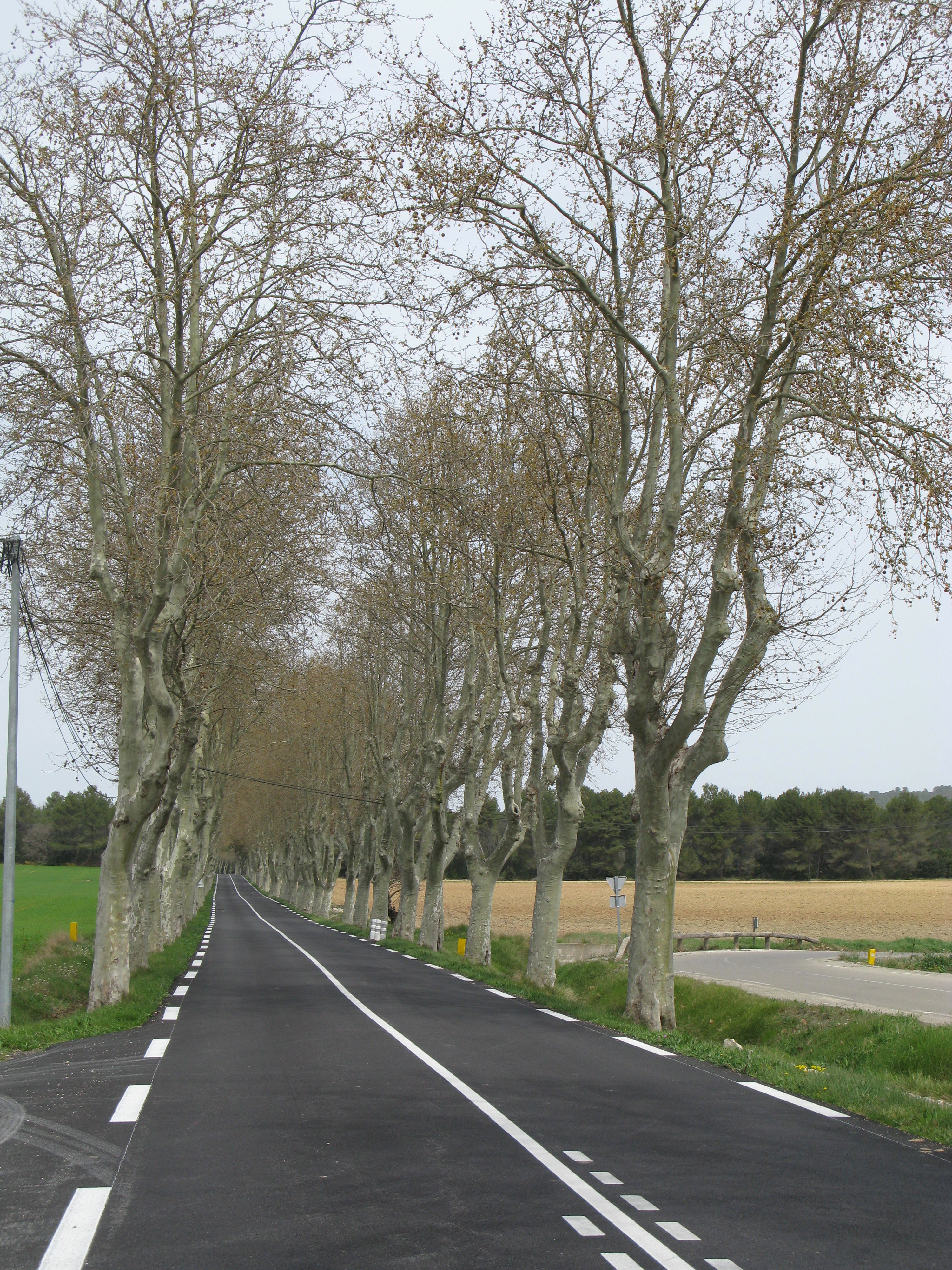
Row of platanes; typical along French national roads.
And there are times when only one vehicle can pass through. Even in the more urban areas, vigilance is de rigeur. Not much space separates vehicles and pedestrians. After five weeks, I have a heightened attentiveness to my surroundings. Pedestrians have priority; motorists have to be ready to stop on a dime as pedestrians often launch themselves forward into oncoming traffic. Adding to driver anxiety are motorcyclists who unexpectedly weave in and out. Even the open road has its unique trials as shoulders are lacking on many of them. Inattention can result in a precipitous drop along winding hillside roads. A hairpin turn, and there are many, can spell disaster for the unobservant driver who unexpectedly happens upon a group of bicyclists. But these are just minor distractions obviated by the joys of driving in the captivating Provence countryside.
Since my last blog entry, our wayfaring journeys through Provence have taken us to distant northern towns like Moustiers-Sainte-Marie, in the east along the Riviera to Antibes, and toward the west to Aix-en-Provence and Marseille. Along the way I’ve reveled in the luscious greens of the rolling hills, the reddish orange tinge of the rocks, the crisp blue of the Mediterranean sky, the deep aquamarine of the sea, and the rustic wooded colors of the ubiquitous vineyards spread out in the valleys or tucked away among the hillsides, lazily soaking in the sun’s rays. The olive trees too, in neat rows, parade their gradated green foliage. Everywhere the colors of spring are teeming as trees and flowers bloom. Small wonder how this land seduced artists like Cézanne and Van Gogh!
Of all the places we’ve visited within the last couple of weeks, it’s hard to pinpoint a favorite. Each has its unique joy. At Aix-en-Provence, we visited Cézanne’s hillside studio. As I listened to our guide give details of Cézanne’s daily routine, I imagined him painting in this squared space with large wide windows on facing walls. The windows draped with curtains permitted him to alter the incoming light from diffused to intense as he worked on his canvases. I particularly enjoyed walking around the gardens surrounding his home. We also walked further up the hill to a favorite spot where across the valley Cézanne enjoyed a panoramic view of Mont Sainte-Victoire. That view, repeated in several of his tableaux, was instantly recognizable. Four of the nine paintings of Mont Sainte-Victoire
 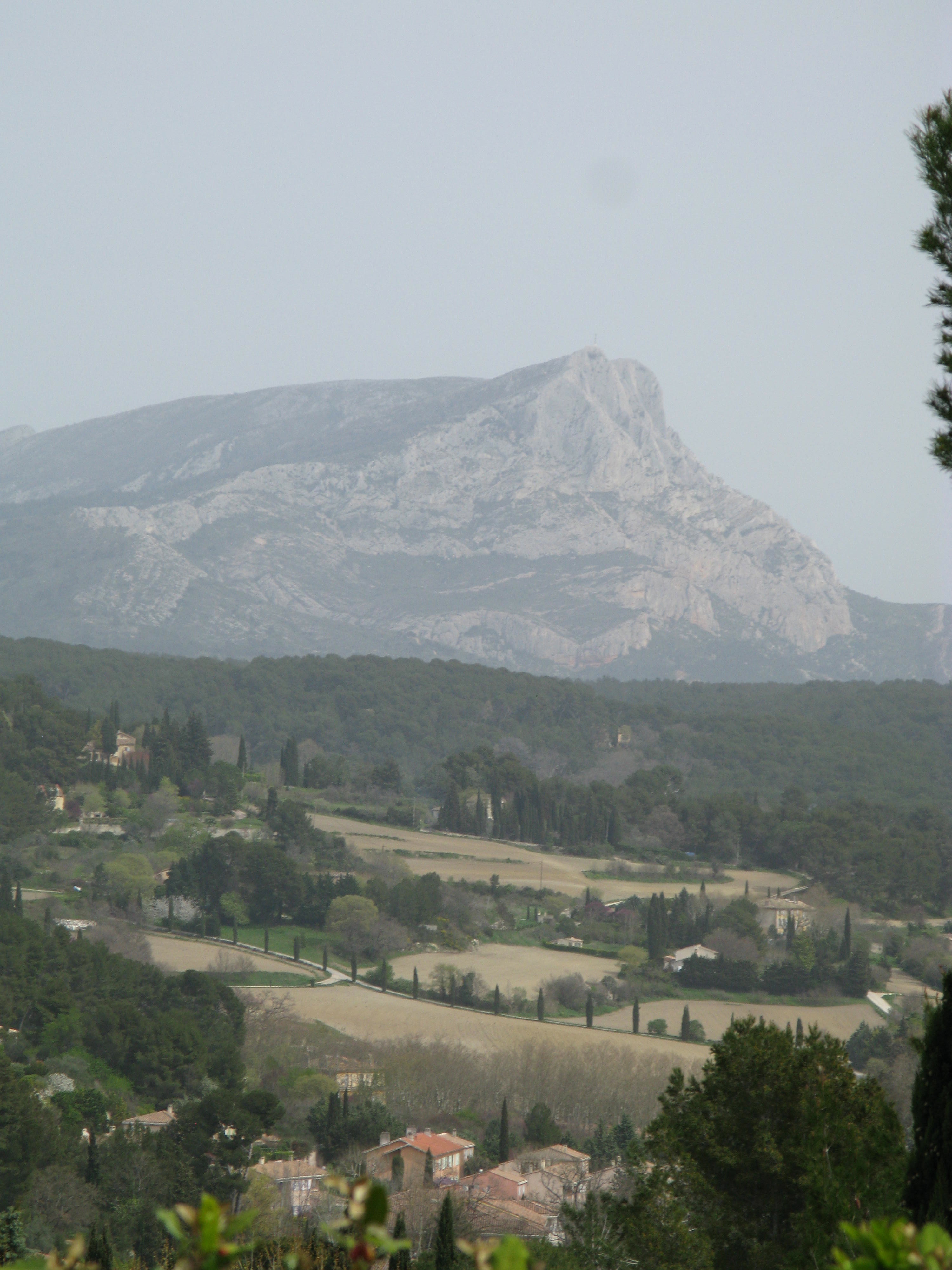 that I am aware of are in the United States, at Princeton University, Kansas City Museum of Art, the New York Metropolitan Museum of Art and the Philadelphia Museum of Art. Although the exact location where Cézanne sat with his brushes and easel is now heavily urbanized, the valley below and Mont Sainte-Victoire remain unchanged from the way I imagined he saw them.
Not far from Aix was our visit to the Abbey Silvacane. Like the other two Cistercian abbeys in Provence, its graceful architecture mirrors the simplicity of the monastic life. And like the others, the acoustical sound in the chapel is impeccably crisp. During the late spring and summer months, concerts are held there regularly. We’ll keep this in mind when we schedule our next trip. Imagine IUSB’s Euclid String Quartet performing there!
Another favorite trek was to Moustiers-Sainte-Marie, a Medieval village in north Provence in an area called la Verte Provence, Green Provence. Nearby is the area called the Grand Canyon of France. Situated atop a hill, as many of these Medieval villages are in Provence, Moustiers is noted for its faiencerie (ceramics). Though the day was overcast, we enjoyed walking through the tiny cobblestone streets of this isolated place. As we climbed the steps, meandering from one small street to another, we happened upon a little restaurant, tucked away from the center of town, La Grignotière. There we had a delicious lunch. Melanie ordered the plat du jour of pork filets with the most delicious ratatouille imaginable. We were among only three customers, and much to our delight, we idled the time away chatting with the cook (the proprietor) and her daughter, our server. Luckily for us, the high tourist season had not yet begun, allowing leisure time for conversation and pictures. We chatted also with the other customer, an accountant who travels occasionally to Moustiers on business.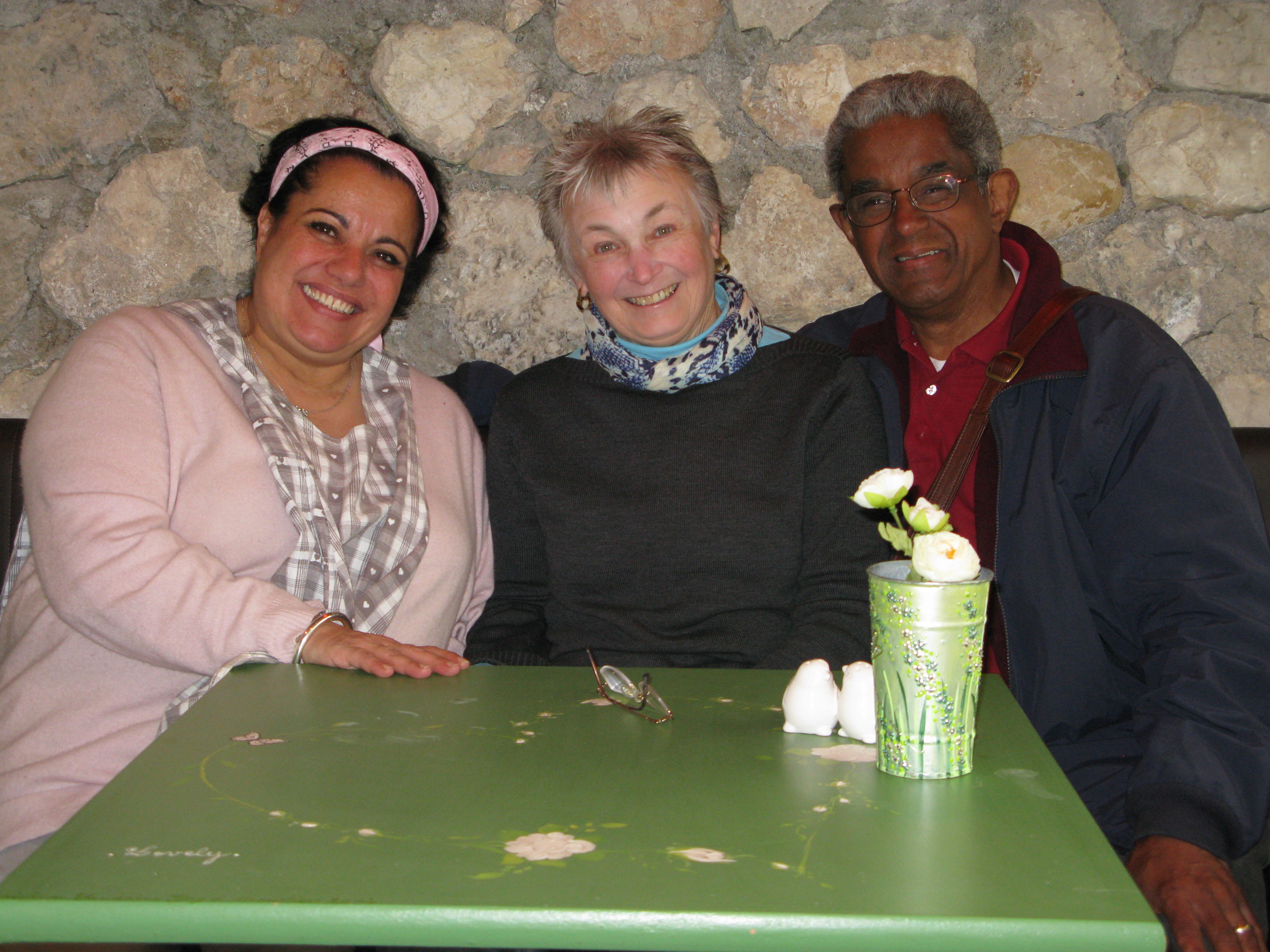
In a week of highlights, our visit to Saint-Paul-de-Vence, another perched village from the Middle Ages, was equally spectacular. There we visited Fondation Maeght whose permanent collection of paintings and sculpture is indisputably impressive. The collection of buildings, where art and architecture come together in conversation, was designed in 1964 by Spanish architect Josep Lluis Sert in concert with other artists like Miró. The open and airy glassed-framed spaces create unimpeded distance between interior and exterior environment. Sculptures by Miró, Giacometti and Picasso grace the gardens creating a gallery of art contiguous with the art by Chagall, Léger, Braque and others in the interior spaces. At the front entrance of the buildings a potpourri of Miró sculptures across a grassy green lawn greet the visitor. In the middle of two of the buildings sits a sculpture garden of Giacometti pieces, at the end of which lies an expansive panorama of the valley below. To the right of the Giacometti garden is a labyrinth of Miró sculptures planned by both Sert and his friend, Miró.  Prior to this visit Melanie and I had never known Sert. Apparently, he is one of the major architectural giants of the twentieth-century. Many buildings in European cities bear his signature. He was also a former dean of the Harvard Graduate School of Design . Several buildings on campus bear his architectural imprint.
After our visit to the Maeght Foundation, we took a stroll in the old village with its charming maze of narrow streets and alleys. For the first time, in our stay in Provence, we encountered hordes of tourists, mostly English and Italian. Saint-Paul-de-Vence is the most visited village in France. And we now know why. The village is a center of chic clothing stores and high-end art galleries. We didn’t dally long, preferring to leave the crowds, but not before walking to the end of the village where over a lovely vista sits the cemetery and Marc Chagall’s grave.
From Saint-Paul-de Vence, we headed to Antibes and Juan-les-Pins to visit the Picasso museum and to say hello to the brother of one of Melanie’s former English as a Second Language students. And we celebrated my sixty-seventh birthday there. In fact, we visited two Picasso museums, one in Antibes and the other in Vallauris. In Antibes, Picasso established his studio in the Grimaldi chateau along the Mediterranean. The museum housed a number of his paintings, sculptures and painted ceramic plates. The painting that struck me most for its simplicity of line drawings, made all the more enchanting by suggestive playful movements and shades of coloring, was La Joie de vivre. The wall of painted plates of faces and linear, triangular and octagonal drawings, might have seemed bland done by an artist whose name was not Picasso. The Vallauris museum was less impressive, save for its powerful wall painting, La Guerre et la Paix in the chapel of the chateau there, and the statue, L’Homme au mouton, that Picasso made of himself and gifted to the town. In Vallauris, a town noted for its ceramics, we stumbled upon an interesting exhibit space of Jean Marais paintings and ceramics. Marais, an actor in La Belle et La Bête, starred in many Jean Cocteau films. After retiring from film and theater, he took up residence in Vallauris and learned the trade of ceramics from some of the masters. Melanie and I were quite impressed with his work.
Closer to home, we visited with friends, Jacques and Daniele Martin, the Museum of European Civilizations and the Mediterranean (MUCEM) in Marseille. Opened about a year ago, the museum at the end of the Vieux Port is a catalyst for urban renewal. Indeed the site offers expansive vistas of the city and the sea, where we watched the car ferry from Algeria arrive. The MUCEM grounds are also a gathering place for visitors and local residents alike. As our friends say, the French like to denigrate the tawdriness of Marseille but take great pride in its ancient and cultural history. It’s well worth the visit to the MUCEM to explore the ancient beginnings of the civilizations along the Mediterranean. There were also two fascinating temporary exhibits, one on the Roman sculptures of Morocco and the other on Mediterranean and European carnivals. After a two-hour visit and then lunch, we walked through the immigrant quarters of town near the old port to La Charité to see an exhibit of Picasso, Warhol, and Magritte, titled Visages (Faces). Ninety artists were represented in three themes: Visages de la Société, Visages de l’intimité, and Visages de l’esprit. I’m not a fan of the modern abstract idiom, but I found myself liking several pieces, particularly by an exiled Prague artist, whose name I remember as Marie Tolen, but whom I can’t find on an internet search. Like so many in the exhibition, her pieces were melancholic and dark. But it was an excellent introduction to artists that were new to me. There were, of course, several Warhol pieces, but was deeply disappointed that there were only two canvases each by Picasso and Magritte. I’ve been to exhibits like this in the States, where the name of a famous artist is used as a ploy to attract visitors. Not long ago at Notre Dame, there was an exhibit of Mary Cassatt and her generation; a fine exhibition but, disappointingly, only one tableau of hers.
It seems as if this accounting of continuous Provence travels has been a survey of art exhibitions. And indeed, the seduction of this beautiful region is its rich artistic and cultural legacy. But we’ve spent lots of time with friends here, almost always around a good meal accompanied with the requisite cheeses and wines. On the very first really warm day here, our friends Jean-Louis and Catherine gave us, with several of their other friends, the first barbecue of the season at his vineyard, Chateau Trians.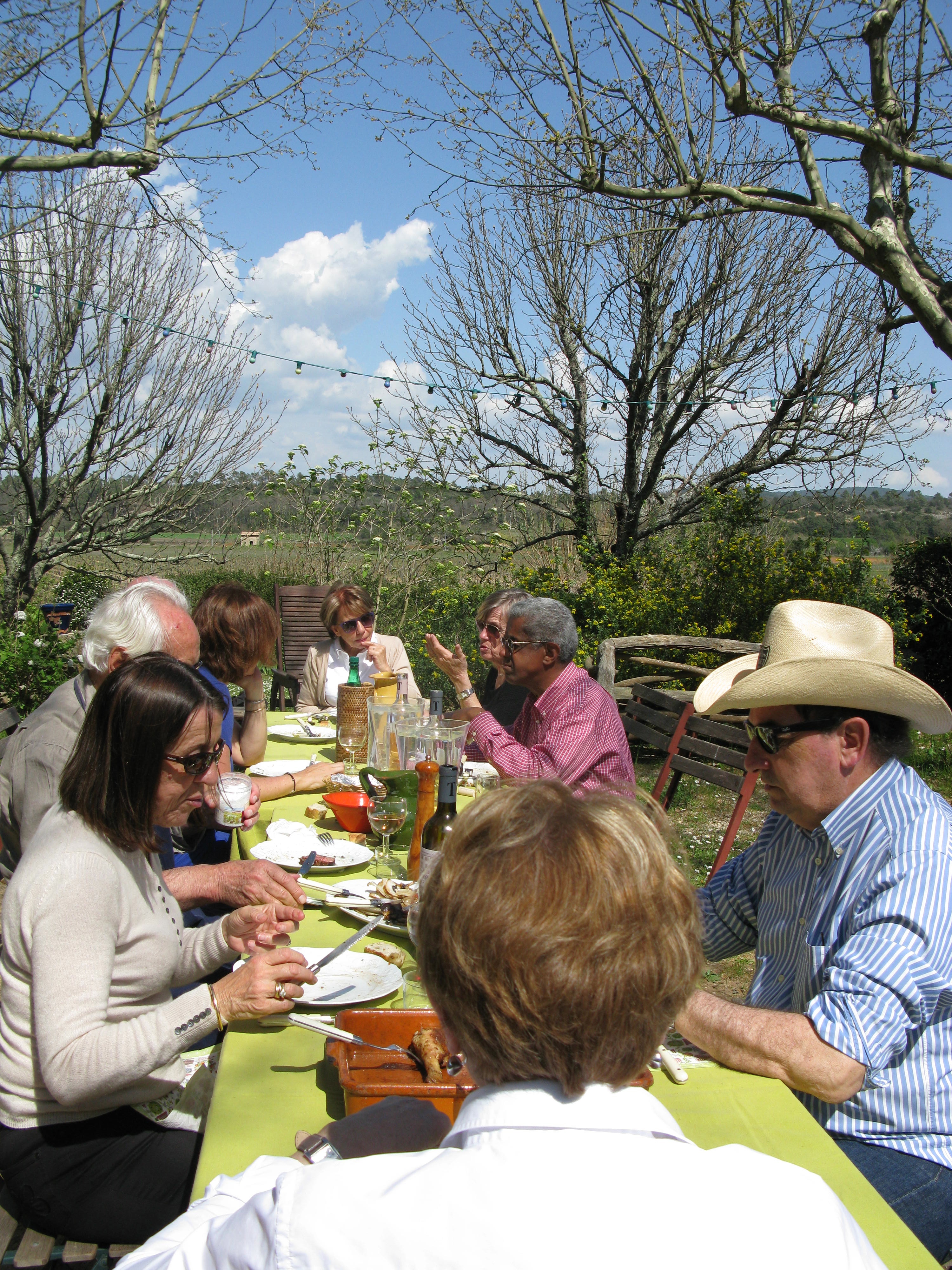 Jean-Louis is a financier who has worked in New York, London and Paris and now Monaco. Catherine teaches Chinese in a lycée. I met her a few years ago when she was teaching at the university in Toulon.
One evening Melanie prepared a Moroccan fish tagine, which is becoming one of her signature dishes. It was such a hit that we’re going to have the same dish again tonight for other friends. Locally, we did a tour of an olive orchard not far from our apartment where we listened to absorbing facts about the cultivation of olives and the production of olive oil. And we spent an afternoon in the neighboring hamlet of La Garde walking through –you guessed it — the Medieval section. But the most unusual thing we did was to search for wild asparagus in the nearby woods with our friend MariThé. Later that evening, Melanie made a delicious omelet with them.
Within a week, we’ll be in champagne country and Paris, and then a few days in Amsterdam before heading home. I’ll miss Provence and treasure the memories as I hold her dearly in my heart, taking comfort in knowing that I’ll travel this way again.
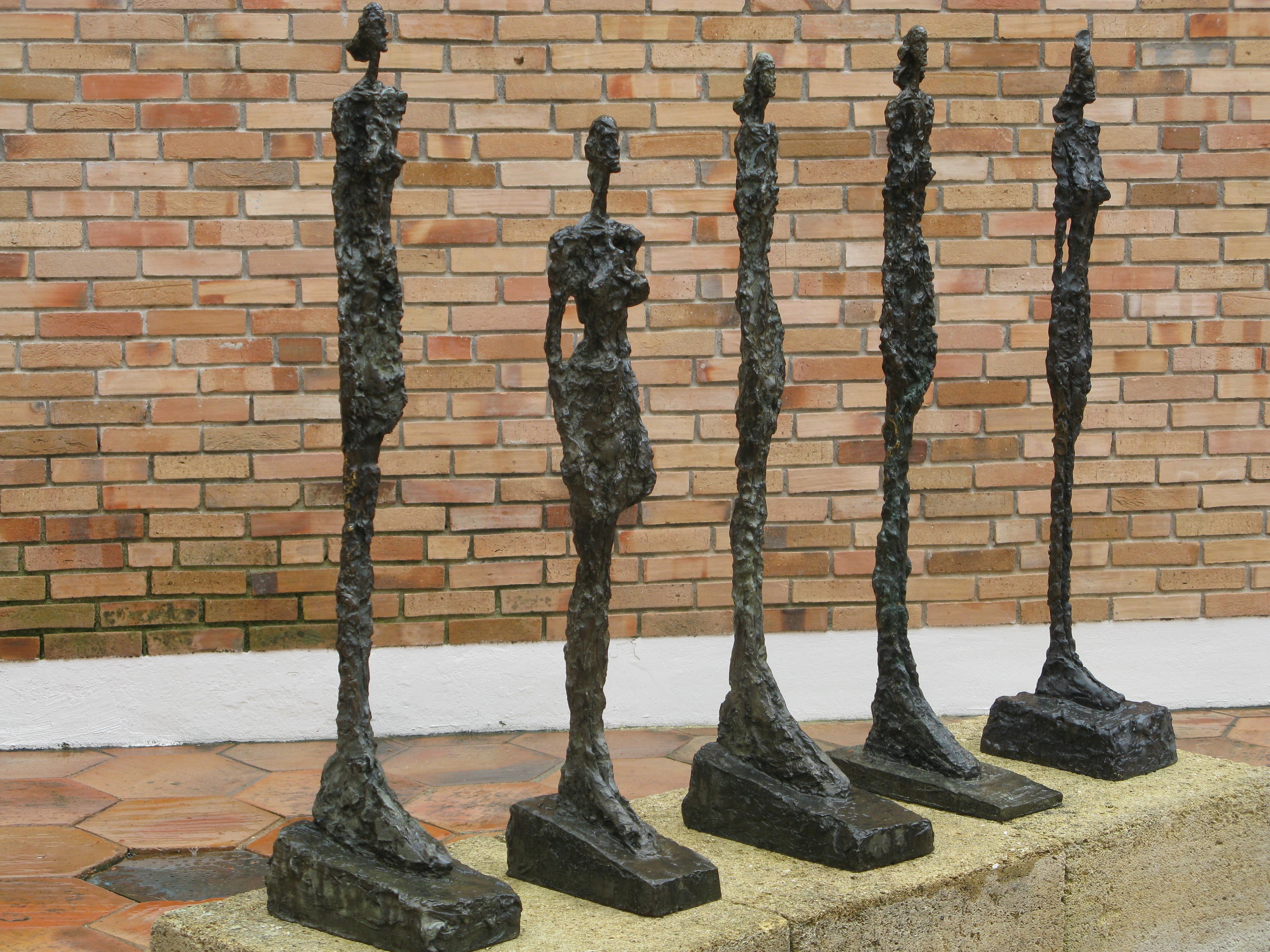
Giacometti’s Sculpture at Fondation Maeght
Melanie in italics again
Alfred spoke of the small streets and the tight driving conditions. But what has fascinated me is how the French have adapted to this close living. For the driving, it’s obviously smaller cars, narrower lanes and parking spaces, making narrow streets one-way or eliminating traffic altogether and creating pedestrian areas, which have the advantage of opening up a communal and festive space. In those pedestrian areas, sidewalks are used as dining rooms for restaurants, sales spaces for small stores, and places to erect a merry-go-round for children. On market day, parking lots and/or streets are closed to make space for vendors of clothing, flowers, and fruits and vegetables. Then when the market is over, a truck comes through with water hoses to clean up, and the space becomes a street or parking lot again. Multiple uses.
One of the things that has really impressed me is the French ability to parallel park. You can imagine on a busy narrow street through the village, a person who cannot parallel park well. That driver would stop traffic in one direction while he/she tried multiple times to get into a tiny space. Tempers would flare. Well, over and over, we have watched as drivers make perfect 3-point maneuvers in a matter of seconds. Sometimes this also involves putting two tires up on the sidewalk. Other drivers wait patiently and then proceed quickly.
Parking can really be a problem so most people walk to the market and carry their own baskets or take their rolling carts. Others walk to the stores and then take the bus home as another lady and I did week. Uphill with groceries is not a picnic.
The other thing is bathrooms. Where do you put restrooms in a small building that originally didn’t have any? Once again, one learns to adapt. Many restrooms are unisex, others are separate but the hand-washing station is for both sexes outside the toilet area. A corner can be used to make a triangular area with tiny sink. Or restrooms are public in parking lots or squares. And we have been impressed at how clean the modern ones in big cities are.
As I used to say to my students over and over, customs fit the culture; they are not good or bad necessarily, just different.
“Ils Font Une Fête”
“Ils font une fête dimanche.” Those are the words spoken by our landlady on our way to dancing rétro. It’s what they call ballroom dancing here. We had just driven past a dance club, but she decided there were not enough cars in the parking lot, a strong indication in her view that the band was not very good. But she was quick to add that there would be a big party at this place on Sunday. When asked what was the occasion, she simply responded there was none. So such is the ease of life here in Provence, along the Mediterranean. So we continued our journey across Toulon to Seyne-sur-Mer to a different ballroom with expectations that the orchestra would be a better one. And we were not disappointed. We arrived at the dance hall about 3:30 in the afternoon. The hall was packed. Obviously, this is not the working crowd; they were mostly gray-haired folk like us. There were many couples for sure, but, like our host, there were many unescorted ladies for men without partners. The music had a distinctive European flair, dominated by the accordion with fewer brass horns. The popular dances were samba, tango, rumba, rock (swing), cha-cha, Viennese waltz , Paso Doble and merengue. Popular dances also included line dances European style (la tarantella).
The style of dance was different as well. Practically all the waltzes were Viennese; dancers glided across the floor in a fast-moving tempo. The quick-step was also popular, a fast-moving foxtrot. The other dances were more measured. Though line of dance was lacking; the dancers typically moved within a confined space, their dance movements more closed and controlled. Watching them dance reminded me of two of my favorite Renoir paintings, The Dance at Bougival and the Dance in the City. Melanie and I are accustomed to the Arthur Murray style of dance as taught by our dance studio, Dan O’Day, that includes larger steps that travel across the dance floor accentuated with expressive body movements and, depending on the dance, wide outstretched arms. Only one waltz (They call it le Boston) was played at the moderate tempo, and although we do not do the quick-step, we did manage a couple of foxtrots, and we squeezed in a couple of boleros, foxtrots, cha cha, rumba, and tango. All in all, we had a grand time. We’ll go back next week with our host to a different dance hall and dance the afternoon away.
But dancing is certainly not the only fun activity we’ve had. We’ve been feted to wonderful evenings of dining with friends. Last Saturday evening we drove with Gabriel to Brignoles for dinner at Karine Tournier-Sol’s family. Karine was the exchange professor from Toulon two years ago. The pouring rain made the drive less pleasant, particularly in the dark, among the rolling hills. Laurent and Karine’s three children, Lucie, Noé and Tom are just delightful (Tom, the youngest, is missing in the picture because he went to bed early). The next day, Sunday, the winds (le Mistral) were howling. But that did not prevent us from taking a walk along the coastal cliffs, which was interrupted by a posted sign advising us of soil erosion and deteriorating conditions. So we had to abandon that journey, but we’ll try again in a different location, perhaps next week. The cliff walk abandoned, we took a casual stroll
  along the beach where we watched a game of pétanque, a very popular game played mainly by men, similar to horseshoe, and of the young and athletic, wind surfing.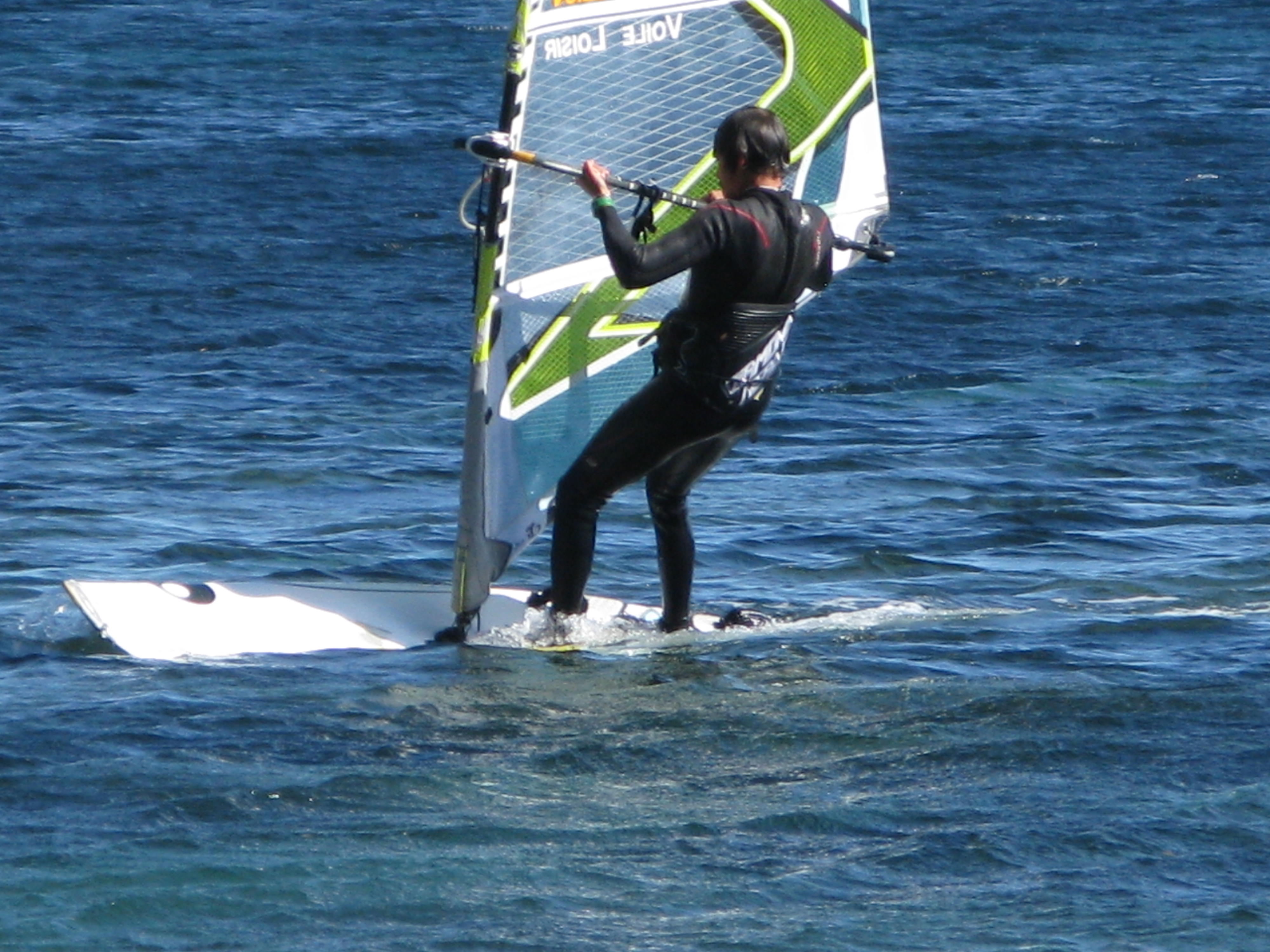
Sunday was also election day. Melanie and I were amazed at the large numbers of people walking on their way to vote. We learned later that 69% of the eligible voters participated. If only we can have that caliber of interest in the United States!
On Monday, we explored the neighborhood, walking downtown, visiting the small, but very nice park in the center of town. A circular small path in the park offered several exercise stations, several of which we tried. During our trek homeward, we walked through a wooded garden and followed a path up a hill that ostensibly would lead to our apartment. Unfortunately, we took a wrong turn that led us back to the main street in town. Next time, we’ll hopefully choose the right path.
Tuesday, we explored an old Roman village, Fréjus, about a hour and half drive from where we live. We had a lovely day exploring the old parts of the village but were disappointed to find only vestiges of Roman ruins. On top of the old ruins of the ancient Roman theater and arena, the city had built modern steel and metal structures that were not aesthetically pleasing. However, we could take comfort that these places have been repurposed and continue to retain their original functionality. Underneath the arena, we were able to walk through the passageways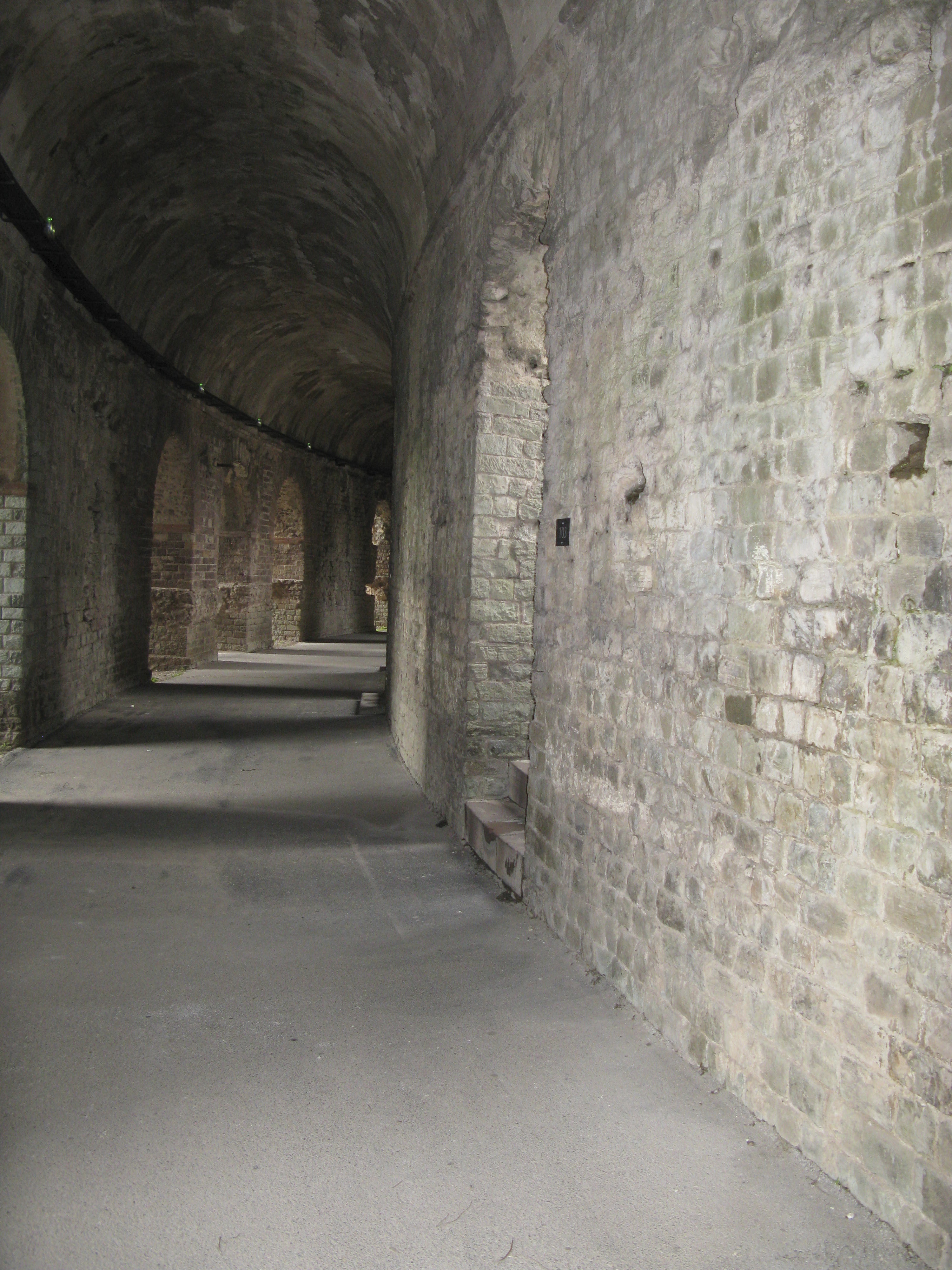 where placards told the stories of Roman times. We also visited the Episcopal Group, the collection of buildings (the church, the cloister, the large baptismal fount with its Corinthian columns, the cathedral) that housed the bishop and served as the center of the diocese. Most impressive was the archeological museum attached to this conglomeration of buildings. This small space had beautiful stone and marble sculptures and a representative collection of ancient decorative and household artifacts.

Two faces of Fréjus
In Fréjus, we were surprised to see hordes of police downtown, particularly around the town hall. Our curiosity piqued, Melanie asked a vendor at a local boulangerie why. Apparently, the far right wing party, the Front National, made significant gains in the elections and the police were preparing for any troubles that might ensue. Though we stayed the majority of the day, things remained calm; there were no demonstrations, at least from what we could tell. Here in Le Pradet, in the mayor’s race, the right won, displacing the current mayor, much to the chagrin of our landlady whose political persuasion is on the left. As she related to us, the right is not good, but the far right is worse (in her words, pire).
Wednesday, we lunched with a friend at her home. Marie-Hélène is the former university librarian who came to IUSB in 2000 as a Fulbright Scholar. Also invited was the current head of the library, a delightful and charming guy. In my academic career, I’ve never met a head librarian with whom I haven’t good relations. Generally, I find that librarians have a genuine openness to others and a friendly demeanor; and, they are fascinating people with inquiring minds. In the afternoon, we toured the Asiatic Museum here in Toulon. For a small museum, it had an impressive collection of Asiatic art and artifacts dating centuries before Christ up to the late nineteenth-century. We thought the Chinese collection of jade and ivory artifacts was the most impressive. It was a wonderful way to cap off a lazy afternoon.
Thursday’s activities are captured in the opening paragraphs. Friday we spent a lovely evening with Jacques and Daniele Martin dining on Coquilles St. Jacques (scallops) on a bed of creamed leeks, ratatouille and lamb chops, followed by the requisite cheese plate. Dessert was a delicious serving of vanilla ice cream topped with grillotines, a small tart cherry in liqueur. We arrived at 7:30 and didn’t finish our meal until 11:45pm. But no complaints here, a sumptuous meal and great conversation aided by exquisite regional wines and tasty cheeses made a perfect evening à la française.
To cap off the week’s events, we spent the afternoon at La Sanary-sur-Mer beginning with lunch at Le Bar d’ô overlooking the Mediterranean. Melanie and I both ordered salmon dishes but prepared differently.  She had salmon prepared on a plank over a hearty serving of lentils, and I, marinated smoked salmon with fennel. Sitting on the sunny terrace with beautiful Provençal homes on one side of us and the expansive blue horizon of the sky and the sea with the wind slightly blowing were moments of unparalleled spiritual peace.
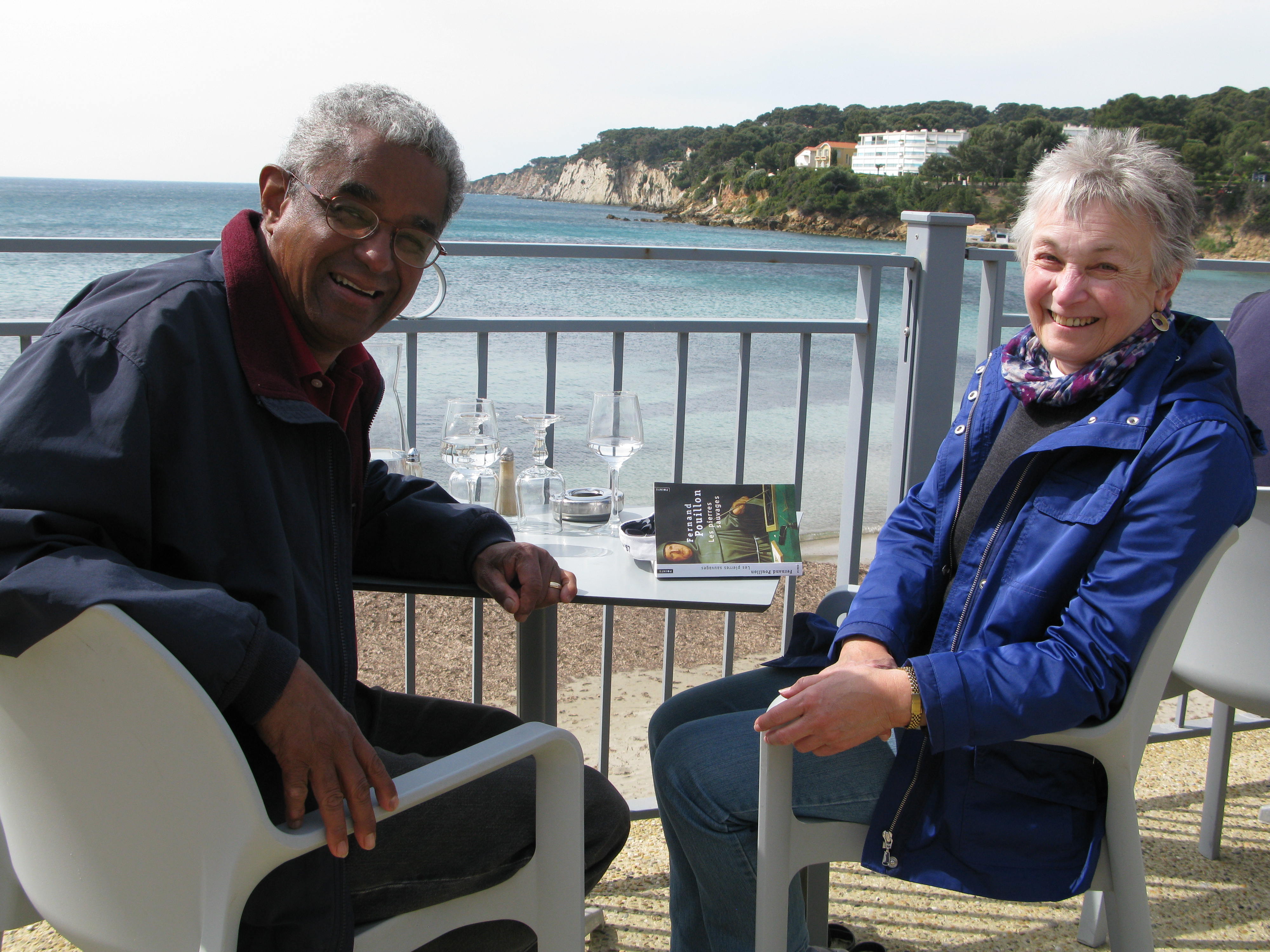 I feel so fortunate to be here, but more on that in a later blog.
Time is passing so fast I’m wondering if we should have scheduled three months instead of two. I say to our friends here that we’re fast becoming Provençal. The weather here has been ideal – moderately warm days and cool nights, so unlike the cold weather and snow that continue to assault northern Indiana. Perhaps spring will arrive by the time we return to Granger.
This is Melanie in italics again. I wanted to add a few things.
In the cloister in Fréjus, there was a wooden ceiling, which we had never seen before and along the top of the wall there were dozens of plaques of wood that had been painted with scenes of daily life from the 12th century — scenes of devils, animals real and imaginary, a woman washing her hair, people working. Beautiful colors were illustrated in a video, though of course, they had faded on the real plaques. A really unique artistic look at that time.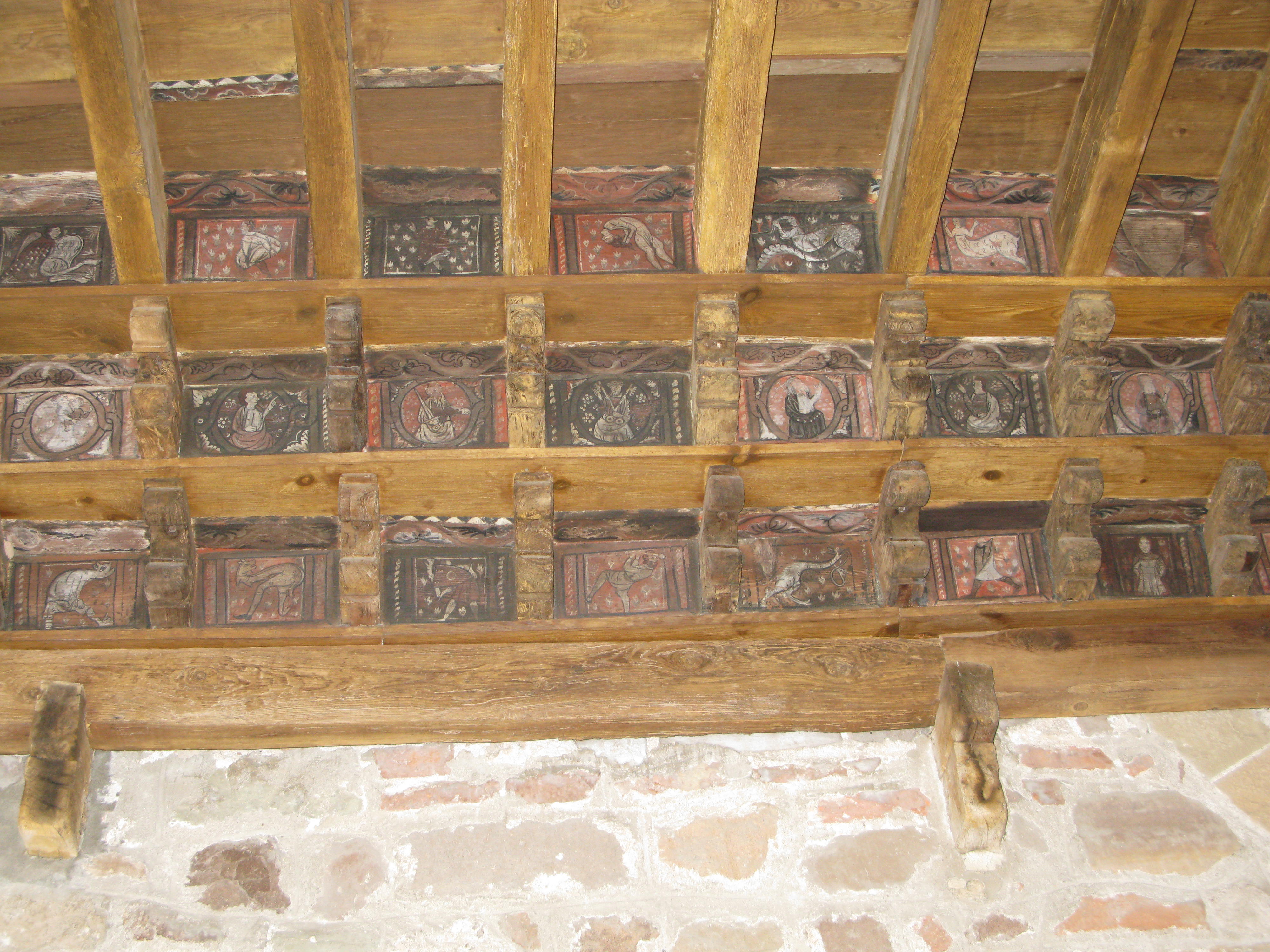
We’re really impressed with the parks here. The one in downtown Le Pradet, in addition to having the exercise course, also has a huge aviary where there are all colors of parakeets and related species and a large gazebo where we speculate that marriages are held in good weather. (Many people here get married twice — once in the church and the obligatory civil ceremony at the Mairie afterwards on the same day.) There is also the ubiquitous monument to the citizens who died in the “Grande Guerre” 1914 . Even in little towns the list is long. But here in Le Pradet there was also a list of sailors who died in the Second World War. As we looked at the list it became apparent that all of them had died on the same day or a day after in August of 1944. This history lesson was about the “débarquement” of the Allies in Southern France.
In the park on the sea coast in Toulon we saw 5 or 6 matches of pétanque, a skateboard course for kids on scooters and bikes too, two huge trampolines for little kids, basketball courts being used, the activities on the ocean that Alfred described, lots of dogs being walked, people sitting in- and outside in cafes and restaurants, soccer balls being kicked around, cyclists, families with strollers and lots of people out for a stroll. Lots of facilities for the young and old and lots of people taking advantage of them.
One more comment about the Asian museum in a lovely old house on the coast which belonged to the son and grandson of Jules Verne. The city runs this museum and you can go for free. Most of the artifacts were brought back by sailors from Toulon who had been in Southeast Asia or other Asian ports. A history lesson also of the town and it’s opening to the world because of its position on the Mediterranean.
Art and Architecture of the Sacred
Now in our third week, we’re comfortably settled into the pace of life here. My morning walks are refreshing; we’ve had several one-day excursions exploring the region; we’ve had late dinners with friends, enjoying splendid conversations well into the evening. Most of all, we’ve enjoyed being immersed in the language and culture. And to keep up with the rhythm of being French, we speak French to each other. Each day, we pick up new conversational phrases that aren’t to be found in Flaubert or Zola. Evidence that our integration is taking hold is a paucity of media news of the United States. We’ve avoided for the most part reading the American newspapers online, preferring to get news from French television and newspapers. In the French press, and, I suppose, as it is elsewhere around the world, there is great interest in the Russian and Ukrainian crisis. Locally, the French press is focusing on election scandals of former President Nicolas Sarkozy. And there is practically no mention of the domestic situation of the current president, François Hollande. When President Hollande visited the White House recently, the American press seemed obsessed about his personal life. The French are fairly blasé, allowing the president to have his personal life without public scrutiny. What I find most refreshing about the news here is the extensive coverage of Africa and Asia. The American press gives little attention to these continents unless there is some crisis.
Life here is also a continual lesson in art and architecture. The buildings in the villages and towns dating from Medieval times have interesting stories to tell. The simplest to the most ornate constructions are works of art. Their durability, lasting through the centuries, affirms how the science of mathematics and the aesthetic arts merged to create the optimal practicality for daily living. In every place we visit, we are drawn to these structures. Each town has a plaza, and at its center is a church, a reminder of how integral the church was in the dictates of the political and cultural life of the people. From that simple little chapel of the penitents in Grimaud to the grand and majestic basilica of Sainte-Marie-Madeleine in Saint-Maximin-la-Sainte-Baume to the equally imposing cathedral of Saint-Sauveur in Aix-en-Provence, stands indisputable evidence of the religious fervor of the congregations and the overarching power of the Church. Inside the larger churches, the tall stone pillars ascend toward the heavens, symbolically transporting the prayers of the faithful. Their towering height stands in contrast to the humbleness of the prayerful congregation. The Roman and Gothic architecture recall the engineering abilities and artistic tastes of the period. Engravings, sculpture and painting adorn the interior and educate the faithful. The walls of these damp and dark interiors are lined with beautifully detailed tableaux depicting the life of Jesus. Many of the artists of these huge canvases are little known or forgotten. I’m intrigued by a studied look at their composition, marveling how the artists use light, or lack of it, to evoke a sentiment or deliver a message. These paintings, often austere, can provide a light moment. At Saint-Maximin-la-Sainte-Baume I stood for a long time gazing at a retable, altarpiece, by the sixteenth-century artist, Antoine Ronzen,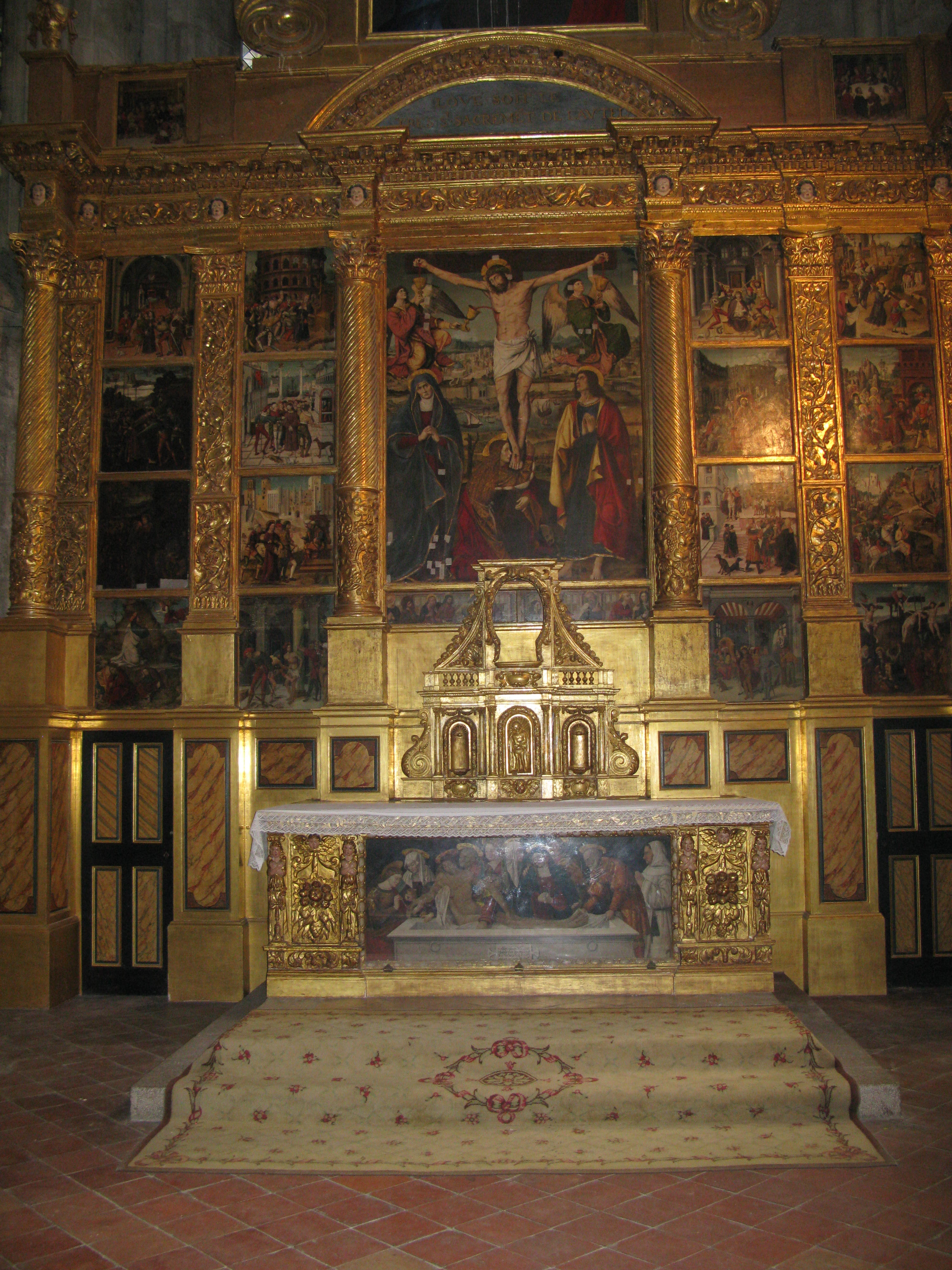 which depicted various New Testament themes. The various tableaux, darkened over the years, still illuminated rich, deep, coloring that added to the rich and intricate realistic portrayals by the artist. In a painting of the Holy Family in the basilica in Saint-Maximin, dating from the Middle Ages, the face of the baby Jesus was re-done in the nineteenth century to resemble Napoleon Bonaparte!
Of the two cloisters that we visited, the cloister at Saint-Sauveur was the most impressive with its decorative columns.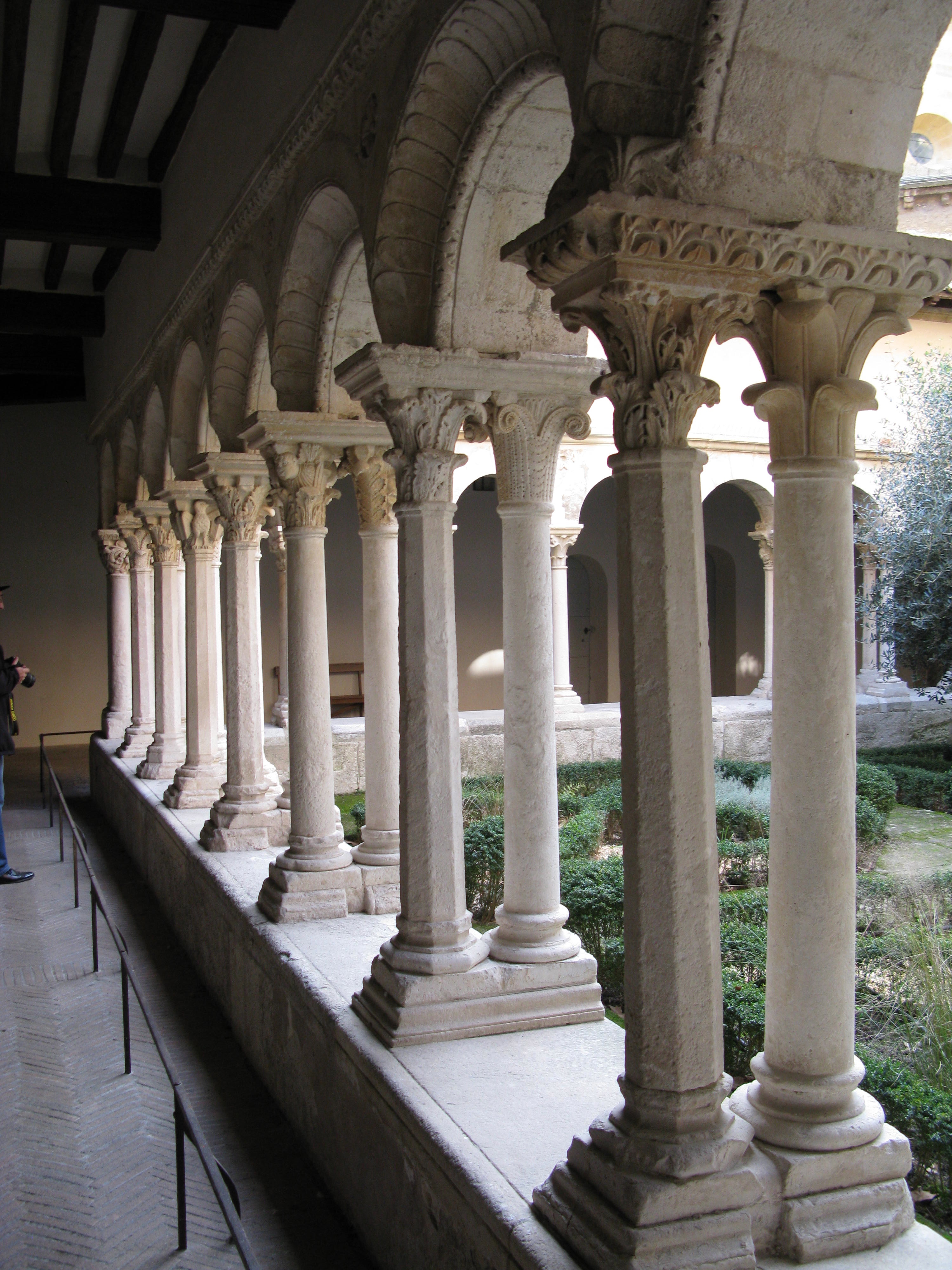 At the top of each of the four corner columns were decorated reliefs representing a story in the life of Jesus as told by one of the four gospel writers. And only one column showed a realistic image of St. Matthew pointing the way to the sanctuary. Atop the other three columns were symbolic representations of the Mark, Luke and John. The cloister at Sainte-Marie-Madeleine was plain, void of any reliefs, but still architecturally beautiful with its graceful arches. Walking through these inner sanctuaries of monastic life brought vivid images of monks in silent prayer or singing together the evening’s vespers in the angelic resonance of Gregorian chant.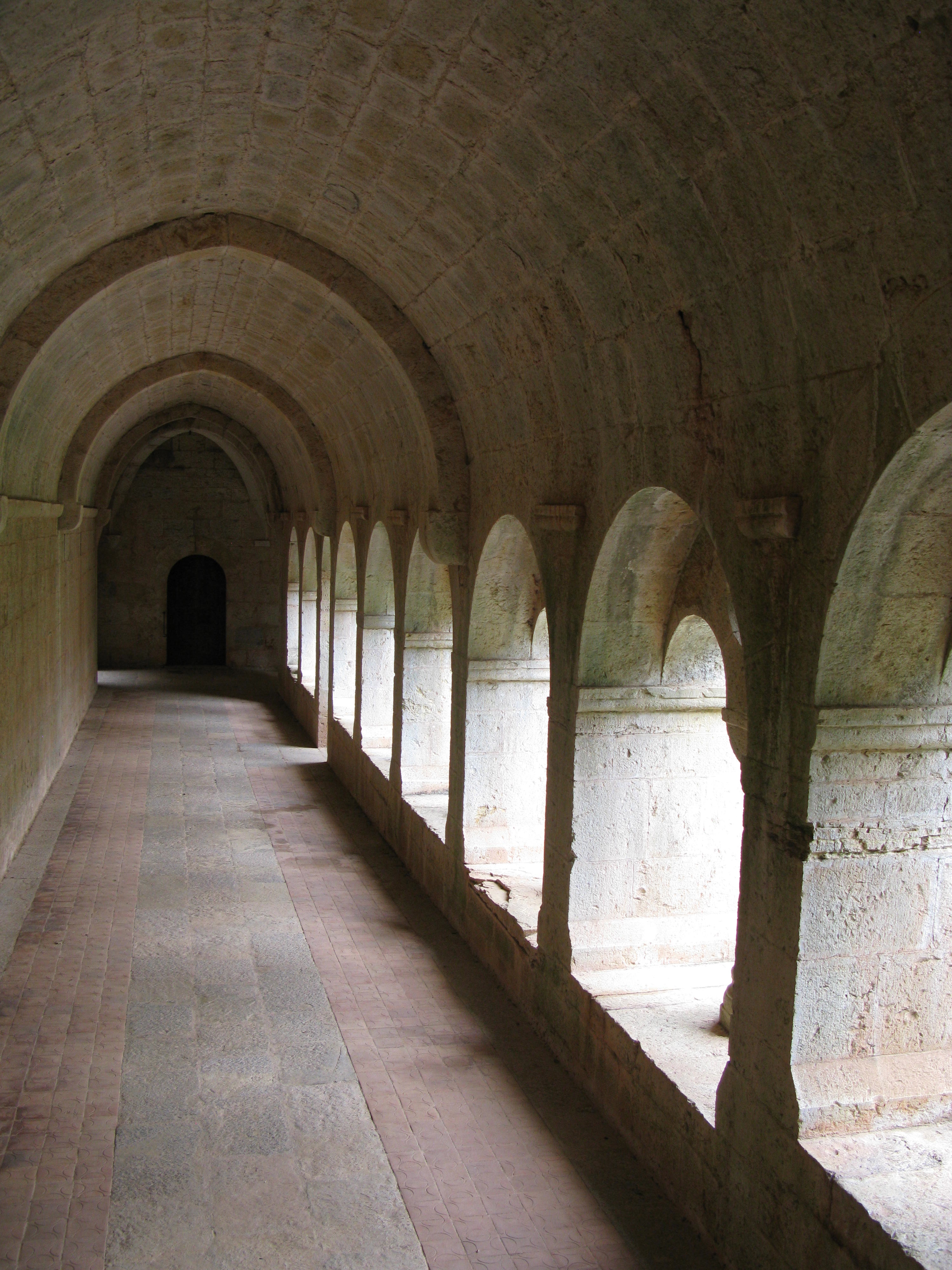
Earlier this week we visited one of the three Cistercian abbeys in Provence, Abbey Thoronet, dating from the twelfth century. Built in the Roman style of architecture, its plain design and its isolation in the surrounding hills announced a serenity of time and space. The beautiful stones with their geometric simplicity and clean lines reflected the austerity of the monastic life. The inner cloister recalled a life dedicated to prayer, made more chillingly apparent when, in the church, our guide sang a Gregorian hymn that resonated throughout the structure producing a sound that seemed to pour from the stones themselves. I closed my eyes in meditation, believing the cantor stood the whole time in front of me, when in actuality she was moving about the church. It was the purest sound of surround-sound music I’ve ever heard and a testament to the genius of Medieval acoustical engineering and architecture.
Another architectural detail that we’ve noticed peculiar to Provence is the open-air metal bell towers (les campanilles)  atop the churches that allow the wind to pass through and carry the sound longer distances.
Appreciation of these centuries-old structures began in my interdisciplinary freshman year seminar in the humanities at Xavier University of Louisiana. There we studied the convergence of art, science, literature, religion and philosophy. What I learned in that course marked the way I viewed texture, form, structure, line, shape, and color, lessons that ultimately illuminated my approach to aesthetics and art. Once I retired, I sat in Professor Andrea Rusnock’s art history class to deepen my understanding of art and architecture. It was well worth the investment of time; I find myself re-thinking how I view art and more fully appreciating its effect on me.
The drive to Thoronet was also fascinating as we drove through magnificent countryside and through the most charming small villages. Along the winding ascending and descending roads were swaths of vineyards. In the distance were verdant hills varying in color from a forest green tint to a greyish green. One of the towns, Entrecasteaux, had a beautifully manicured French garden.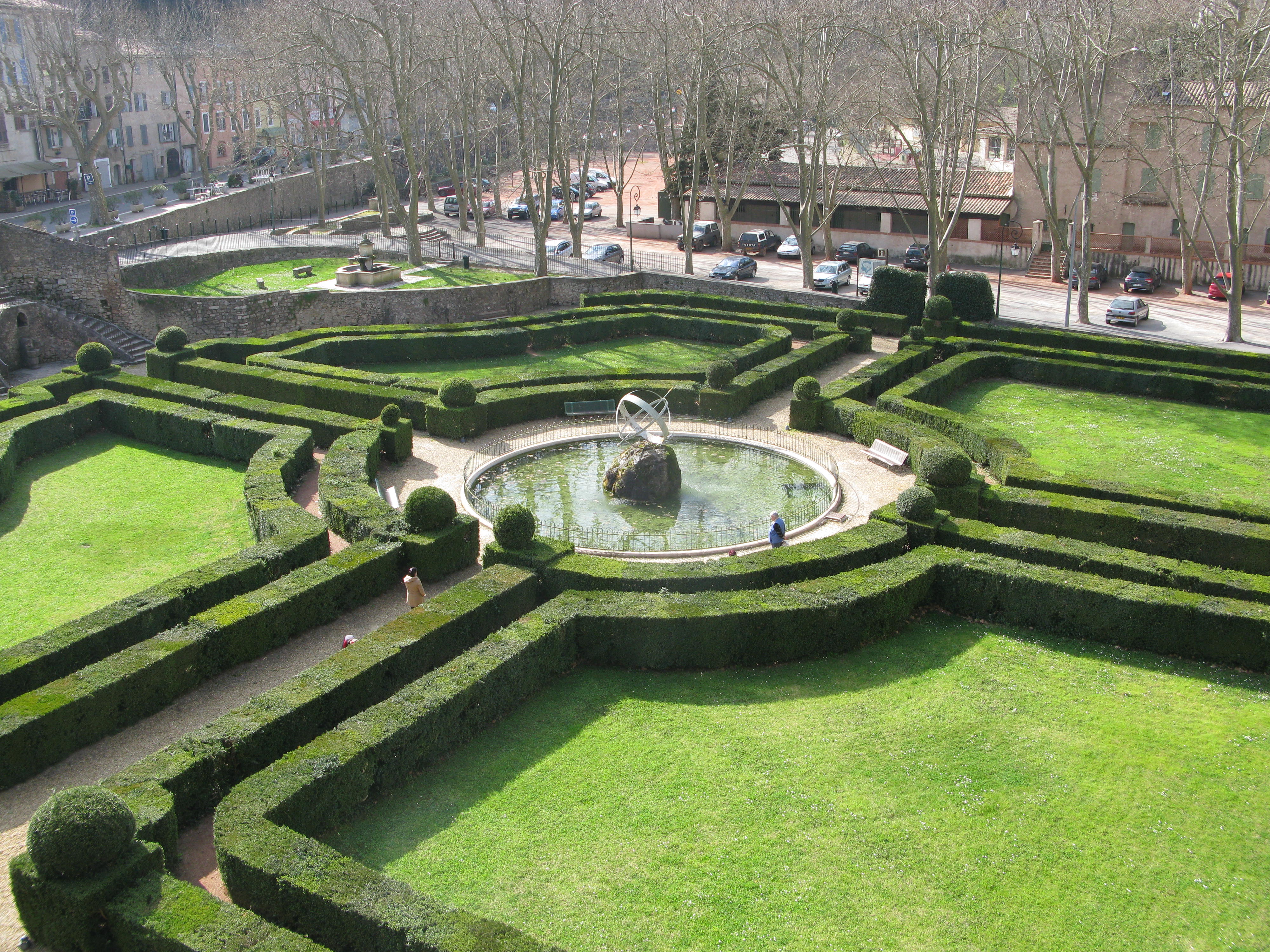 In our search for faiencerie, we stopped in Salernes, noted for ceramics, but managed to find only a small tile to our liking. I’m confident that we find what we’re looking for before our departure.
This time in Provence is allowing us to do what many locals do, sitting or lunching in cafés. Two weeks ago we lunched in Aix-en-Provence with our friend from Granger, Cheryl Barker, and her family.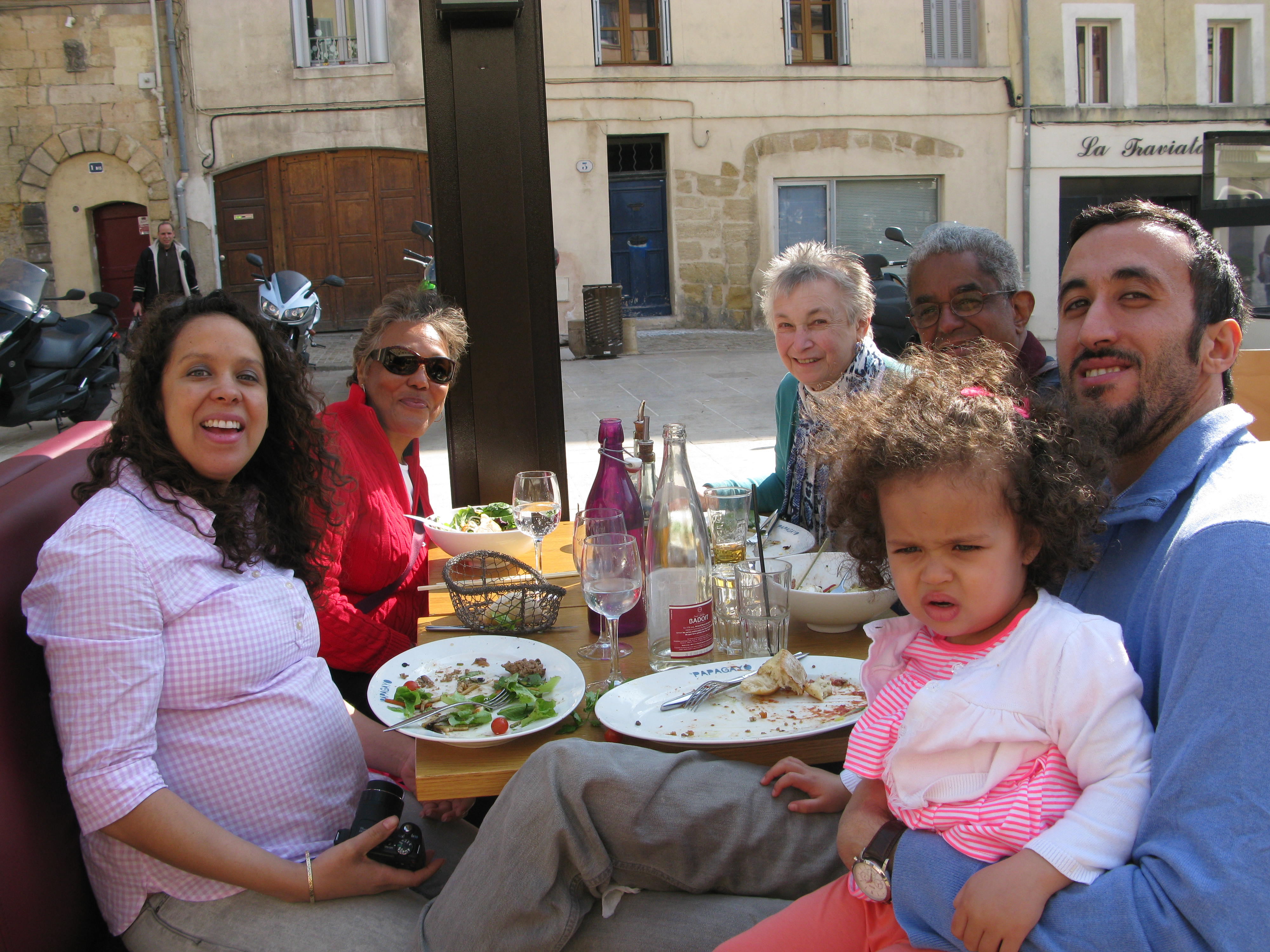 Cheryl’s daughter and her husband, and their daughter, live in Fos-sur-Mer. Earlier in the week, we went with a friend to visit her daughter in a town adjacent to Cannes. We lunched at the port and then took a pleasant drive along the seashore in Cannes. There, mobs of people were on the beach; others walking along the shore. Traffic was horrendous, and it isn’t the summer season yet. We did manage to see the infamous red carpet of the Cannes Film Festival. There were no stars there, just another curious mob. Last week we lunched with Gabriel Popescu
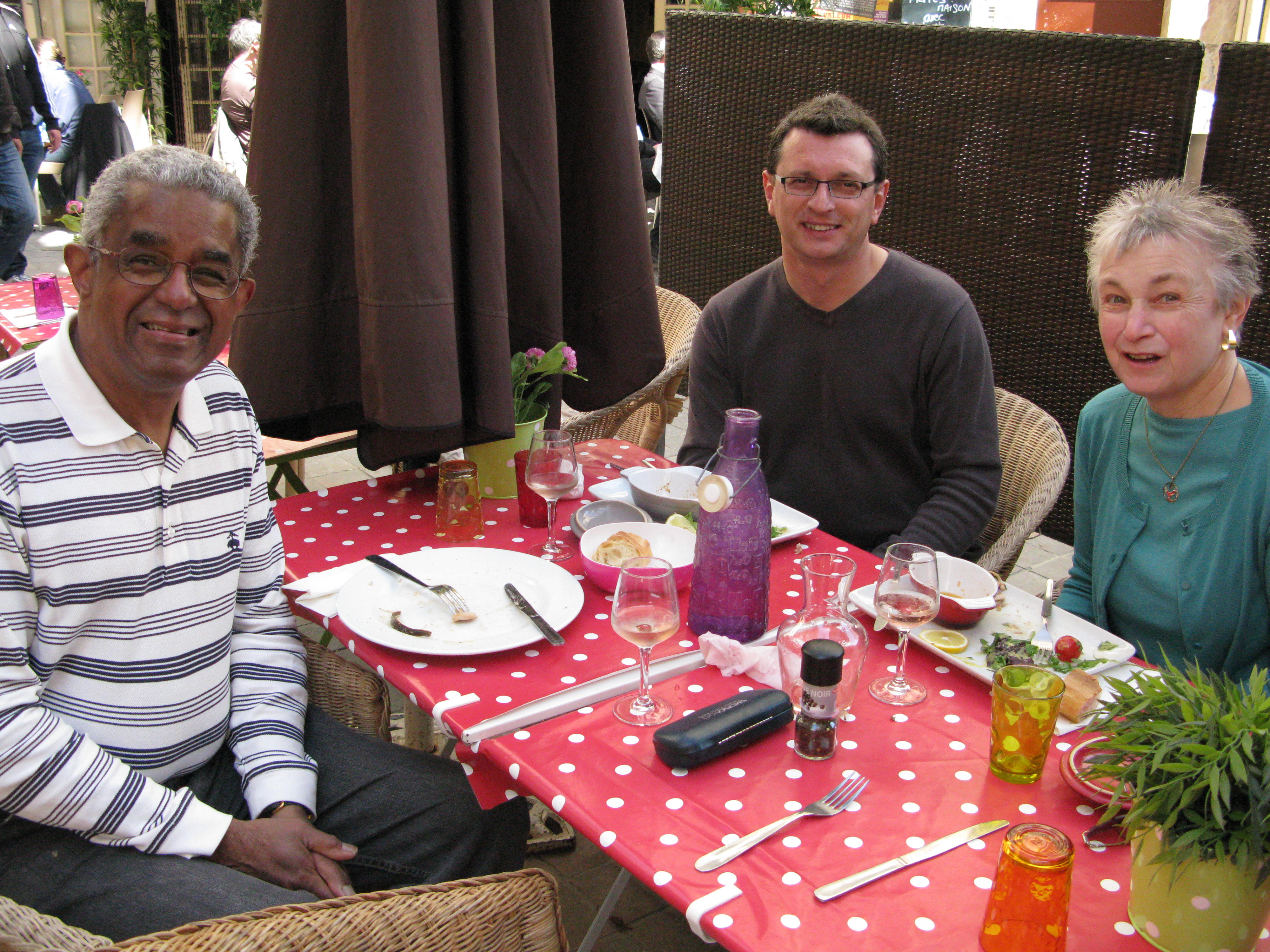 who is here in Toulon as an exchange professor. He’s giving a public lecture on Monday on geopolitics. Today we had lunch with two exchange students from IUSB. As we did with Gabriel, we lunched at a quaint crêperie we discovered in the old town of Toulon. Kudos to their French teachers at IUSB, Lesley Walker and Anne Magnan-Park, the students were quite comfortable in speaking French with us. Tonight we’ll pick up Gabriel and drive to Brignoles to dine with Karine Tournier-Sol and her family. Karine was an exchange professor at IUSB a few years ago.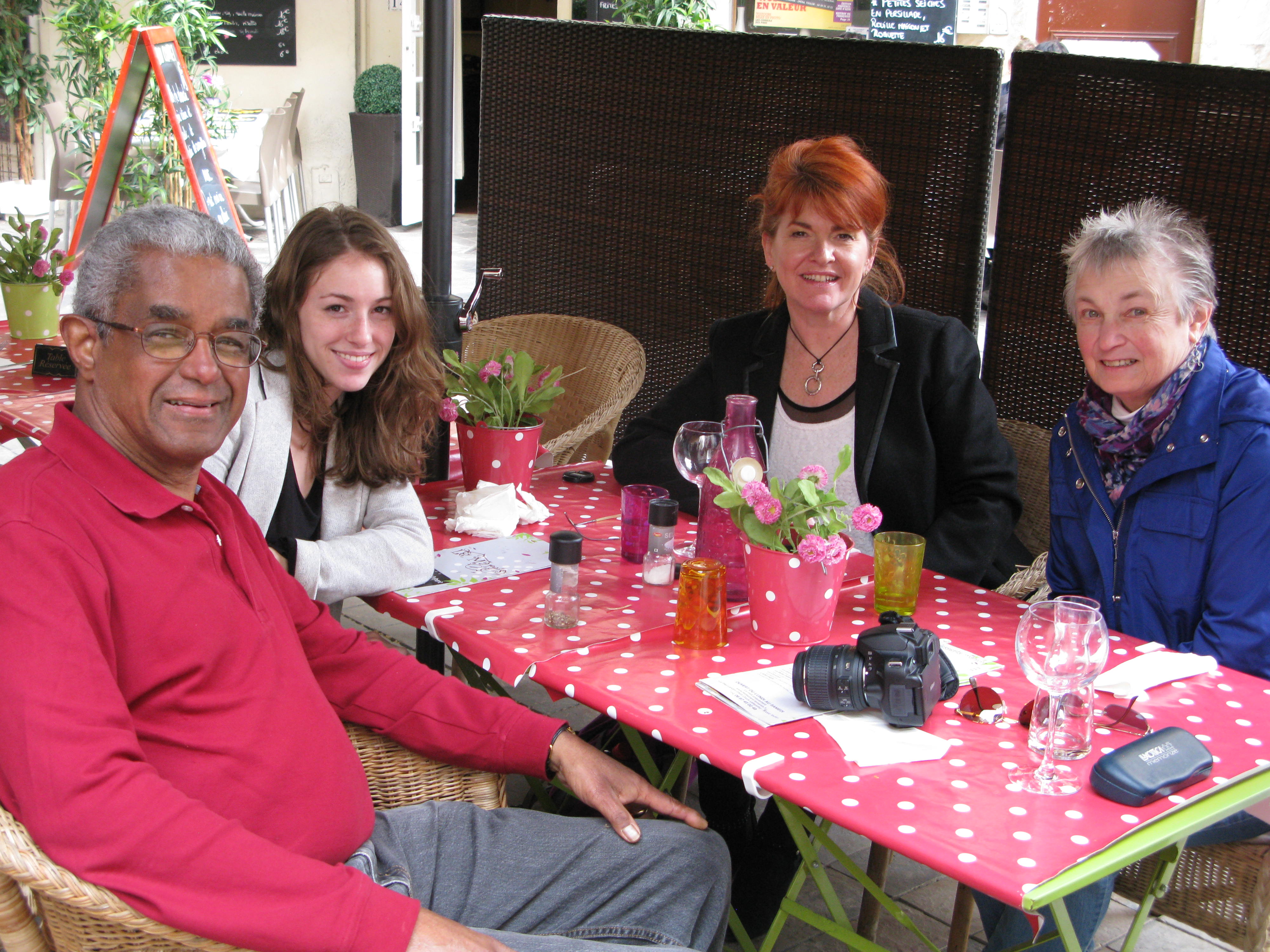
Eating, and eating well, is important here. And we have certainly had sumptuous meals here, but we do eat modestly. In the evenings, we are often content to sit in our apartment with a bottle of rosé or muscadet, with a salad, bread with cheese and some fruit and dine royally. While eating may seem a pastime for the French, I’ve noticed that there is increasingly emphasis on eating healthily. Posted on the walls of the bus stops are cautions not to nibble between meals, and on the television there are rolling bands across the screen encouraging the viewer to eat five fruits and vegetables a day. In the States, I remember the strong reactions against Mayor Bloomberg’s attempts to limit the size of sodas in NYC and Michelle Obama’s efforts to get sweets out of the schools and her campaign against obesity. Some Americans viewed these efforts as an assault on personal liberty.
In a future blog I will write about the colors of Provence. Traveling across the highways and byways it’s easy to understand why the Impressionists like Cézanne, Van Gogh and Gauguin were drawn here to paint. This sunny region of vineyards and olive orchards tucked among rolling hills and sea views offers a spectacular palette for the eyesight.
This is Melanie in italics again. We are really enjoying renewing friendships with professors and others whom we have met before. 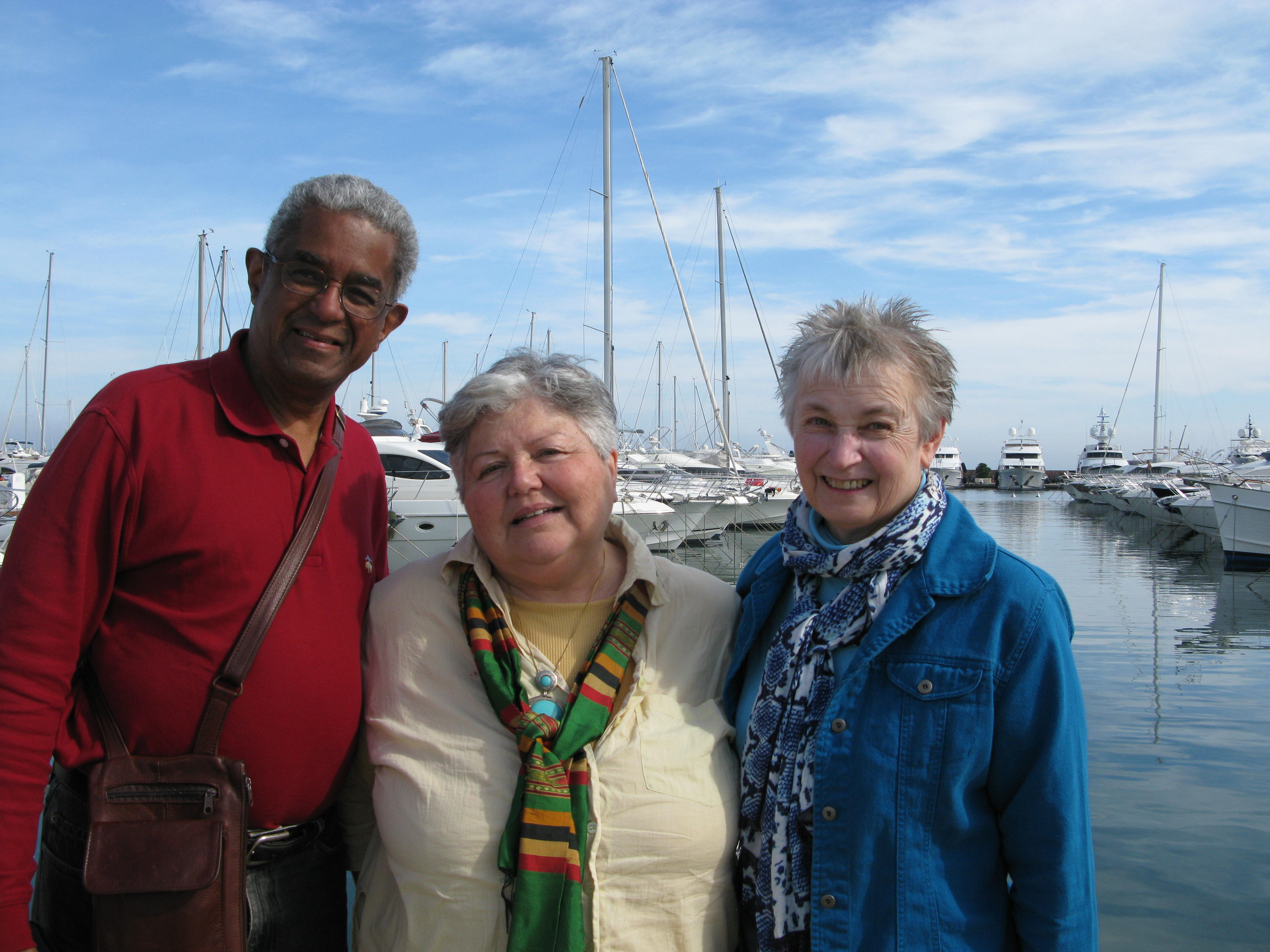 We’re able to talk with real French people about their everyday lives, from family concerns and worries, to how to travel most efficiently (the bus to this town because the parking is horrendous or the train because what you want to see is near the station or recommendations for cheap hotels or other places to see), to how to retire gracefully and happily, to where are the places to go ballroom dancing. It’s the real life here with people who live here that is so much fun. We’re going to the marché every Friday, discovering hikes in the area, finding the movie theaters that play films in the version originale (not dubbed), trying the flea markets and the yard sales. It’s really fun.
Little vignettes. When we went into the cathedral in Aix-en-Provence, Alfred gave a coin to the woman begging outside the cathedral. We got separated when leaving and I couldn’t find Alfred. I looked outside and then went back inside and didn’t find him. When leaving a second time, the woman begging at the door, noticed that I was looking and told me where Alfred was standing. A little bit of grace from an unexpected quarter.
Living in a land of drought. Showers with very small water output. A rain barrel in the yard across the street. Toilets with dual flushes.
Talking to the English class of a friend about the American education system. A young music student in the class was chaffing under the French system of having to study only classical music and having to think and write only in prescribed ways. He wanted to go the Berkelee School of music in Boston and play jazz and broaden his horizons. Alfred, since we go often to Boston, offered the young man his email address. Our friend, the teacher of the class, remarked that this was a very American thing to do, offer friendship and access to one’s private contacts to a stranger.
This morning at the market. Our friend Mari-Thé had told us about the best cheese stall at the market. When we went there, the fromagier (cheese seller) smiled at us and said in French, “I hear we have an acquaintance in common.” So off we went asking him about the best cheeses that he would recommend. I asked how much our purchases would cost and an elderly lady waiting next to us hearing the repartee looked at us and with a big exaggerated wink and a smile said that the purchases were free.
At the Abbaye de Thoronet that Alfred described. The moving, mystical, otherworldly sound of the young woman singing the chants of Hildegard of Bingen. With my eyes closed I would have said that there were several people singing instead of just one because of the reverberations in the church.
Living à la Provençale
We’ve been here a week and seem to have settled into the rhythms of daily life. Our neighborhood in Le Pradet is becoming our own. The center of town is full of little shops and cafés. We now know where to find the best bread and pastries (la patisserie et la boulangerie), where to get meat (la boucherie et la charcuterie) and the best place to find fruits and vegetables (le marché aux fruits et légumes). We frequent the nearby supermarket for other staples. The downtown square with the small church at its center is lined with shops and cafés, and always full of life. People gather to talk; they sit seemingly for hours in open-air cafés; they greet and chat in small groups. In the shops and on the narrow sidewalks neighbors greet each other, if only for a moment. There is vibrancy in this small village. In my daily morning walk, I watch the town awaken as merchants begin to open their shops. Tables and chairs are being set up outside the restaurants and cafés. The warm and inviting whiff of pastries and recently baked bread fills my nostrils. Mothers and fathers are dropping off their little ones to school, bidding goodbye with kisses on both cheeks (les bises). The bike path that runs through the center of town where I take my brisk walks is a thoroughfare of speeding bikes in each direction. At the end of my exercise, I often stop for croissants and bread at our chosen boulangerie, one of five near the central square, before climbing the hill homeward. Read More…
 Alfred Guillaume
Recent Comments