Île de Beauté


For several years we’ve talked about visiting Corsica. Now we have, but not before a two and a half hour late start of our ferry from Toulon and spending the first two days with a stomach virus. Most of the ferry ride was spent lying on a couch or sleeping upright. The next day, I passed on my gift to Melanie. Once we disembarked, and in spite of our weakened state, we managed to visit Île Rousse and Pigna before heading across the mountains to St. Florent. The next day we retraced our journey, crossing once again the fifty-eight kilometer trek across the mountains toward Calvi and stopping for a brief visit at Algajola, a quaint little village along the coast. Since Melanie did the driving the day before, and was still not feeling well, I summoned enough courage to drive to and from Calvi. All the while I thought of my friend, Randy, who knows my fear of driving at high altitudes. Driving in the mountain pass last summer from Victor, Idaho to Jackson Hole, Wyoming, I was so paralyzed with fear that I had to let Randy drive the rest of the way. But this time in Corsica, I succeeded. Admittedly, there were butterflies in my stomach at each hairpin turn.
In Calvi, a beautiful medieval town situated along the Mediterranean, I spent the afternoon walking the narrow streets of the Citadel while Melanie rested with a book in a café at the port. Calvi is one of three cities that claim Christopher Columbus as a native son. A bronze bust of him sits prominently along the ramparts leading to the Citadel. Along the outer walls are spectacular views of the port, the surrounding mountains and the sea.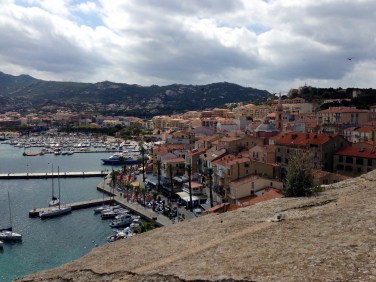 Within this walled fortress, I visited the thirteenth century cathedral, St. Jean-Baptiste, which sits at the summit of this massive stone city. I sat there for several minutes in meditation, as Melanie and I typically do in these ancient holy places, but it was in the oratory of St. Antoine, just a few cobblestoned and winding streets away, where I sat the longest giving thanks for the wonderful gifts in my life.
Upon our return to St. Florent, we had a fabulous meal in a traditional Corsican restaurant, Ind’è Lucia, where I had a superb Corsican vegetable soup. We were the first to arrive at 7:30pm; by 9pm practically every table was occupied with twenty-six patrons, including a couple who had sat at a table next to us the evening before in a different restaurant. The owner of the restaurant was busy with her young daughter when we arrived. As she took our orders, the child quickly joined her grandmother in the kitchen. The décor of the restaurant was warm and homey with an open fireplace on which the woman cooked sausages. We sat beneath the head of a sanglier, the wild boar that we had hoped to see live in the wild.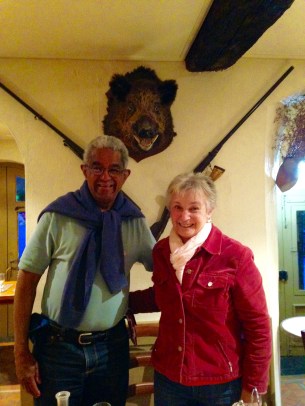
Our only regret with St. Florent was not being able to visit the ancient cathedral of Nebbio, Santa Maria Assunta. Built on an old Roman site, the church represents one of the best examples of Corsican religious architecture. When we arrived, several groups of people between the ages of twenty to forty, all dressed in black, were standing outside. We learned from a couple of young women that a deceased friend of theirs was laying in wake. Out of respect we did not enter. The next morning we left for Cap Corse.
And Melanie did the driving. Cap Corse is a narrow strip of land, a finger, jutting from the island’s northern border. Most of the trip was a continuous zigzag of narrow roads along kilometers-high rock-hewn precipices. Squeezed between the empty space of the sea below on one side – a long drop – and the hard mountain rock on the other side, the drive demanded a heightened vigilance. At a juncture in the road, the sea half had completely fallen, leaving one lane open for traffic in both directions. Meanwhile a crew with heavy equipment was repairing the road. Setting aside the stress, the panoramic, expansive views of the sea and the rustic verdant valleys below were breathtakingly beautiful. We passed through several medieval villages etched in the mountains or perched on precipices overlooking the sea far below. In one of these hamlets, we stopped at a small café for sandwiches and a can of juice. In the dimly lit interior, two elderly men were sitting at a table, one speaking animatedly on his cell phone, the other reading the newspaper. A much younger man, simply gazing, was seated on a stool at the bar on the other side of the tiny room. We inquired of the bartender if sandwiches could be made, and with an affirmative nod, he quickly disappeared in a backroom and returned several minutes later with two charcuterie-filled baguettes. Once on the road, I began to wonder what daily life was like in the Cap Corse villages and how people occupied themselves.
On our way south, we stopped briefly in Bastia, a fairly large urban area. As we walked exploring the old city, we arrived at the church St. Jean Baptiste, on the Place du Marché, just in time to join the procession of Ste Zita, the patroness of gardeners.
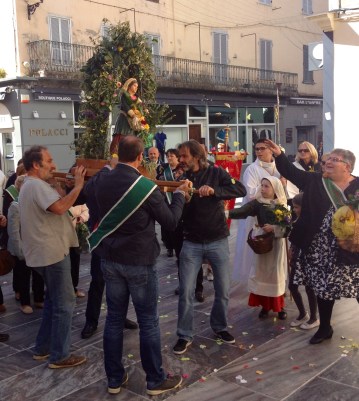
Procession of Ste Zita
Once we reached the southern part of Corsica, we were welcomed warmly by Dominique, at whose home we would spend the next week. Dominique is a charming and gracious gentleman of ninety-four years who is a friend of our friend, Martine, whose apartment we are renting in Le Pradet. Dominique, too, has an independent lower apartment attached to his home in Bocco d’Oro, between Porto Vecchio and Bonifacio. During our stay, we were also invited one evening for an apéro at the home of Dominique’s sister and brother-in-law, Marie-Jeanne and Guy, who live just a few doors away. With them, we enjoyed spirited conversation over Corsican charcuterie and rosé, topped with a fiadone for dessert. Marie-Jeanne also gave us several yeux de Sainte Lucie, distinctive sea shells with a spiral. These are thought to bring luck.
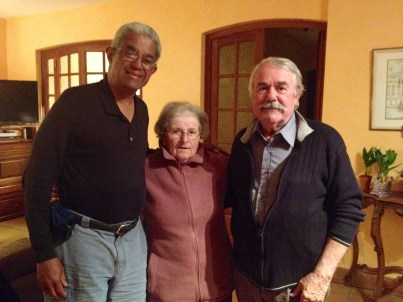
Alfred, Jeanne-Marie, Guy
We spent considerable time in Porto Vecchio, or Porto Vech – the Corsicans have a tendency to leave off the final vowels in conversation. On Sunday morning, we went to Mass at the cathedral where we heard beautiful music and the scripture readings recited in French, Portuguese and Italian. At the end of Mass, the priest asked the congregation to come in great numbers “to celebrate with our Portuguese brothers and sisters” the feast of Our Lady of Fatima at another church later that week, noting that the Portuguese community came to the church to worship with the French/Corsican speakers, so the latter should show the same solidarity with them. Upon leaving Mass, we asked a couple of ladies why the scriptural readings were in three languages. They told us of the large population of Portuguese and Italians (Sardinia can be seen across the Mediterranean on a clear day) residing in the area. And one of the ladies chimed, “There are many languages, but only one Church and one God.” That afternoon, in the center of town, was the annual race of hand-made boxcars and other inventive wheeled contraptions, the Carruleddu. We opted instead to spend that chilly afternoon at Polombaggia, considered to be the most beautiful beach in Corsica because of the large red boulders that frame it.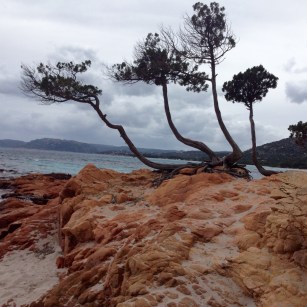
Highlights of our stay in southern Corsica included a concert of Corsican music at one of the churches in the old part of Bonifacio. From the beginning of the polyphonic singing at 9:30 pm until its end at 11:30 pm, goose bumps covered the skin. In Bonifacio, we also walked passed the house where Napoleon once lived. Another day we visited the Èglise Ste-Marie (Santa Maria Assunta) in Sartène, where on Good Friday a member of one the societies of penitents carries the Cross with chains on his feet. 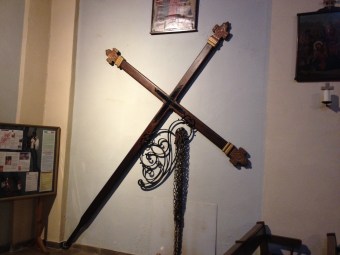 The same day of our visit we happened upon the annual town Carnaval with lots of merrymaking. We managed to escape the crowd and took refuge in a quaint restaurant, Le Jardin de l’Echauguette, where we had a delicious meal in a shady outdoor terrace. Later in the afternoon, on our way home, we stopped by the Plateau de Cauria, a site of prehistoric standing stones, “menhirs” and a “dolmen”. To get there we drove several kilometers on a dusty winding road, and once there, we walked for a half hour before reaching these simple, yet stately, stones, evoking a sacred time eons ago.


Another day we went north to the Bavela forests with its rocky mountainous points and dense pine trees. We stopped several times along the way to gaze at the natural beauty that surrounded us. In our next trip here, we will drive less and do more hiking. As we traveled through the forest, we also stopped at Lake Ospédale, near which we had a picnic lunch. Our full day trip ended by passing through the Zonza forest before our descent to the shore and back home.


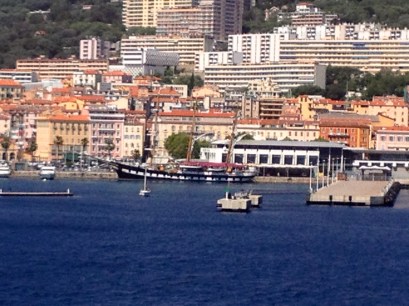
On our last day in Porto Vecchio, we had a sumptuous lunch of salmon at U Moulu, a restaurant at the port. The next morning we started our journey back to Toulon driving to Ajaccio via Corte, another beautiful medieval town in the island’s interior. Arguably this central part of Corsica is the most beautiful because of its hidden valleys and snow-capped mountains. In Ajaccio, the native city of Napoleon, we spent the evening at a chambre d’hôte, a bed and breakfast. The morning of our departure, we sat on the terrace of our host’s home overlooking the port and the city and witnessed the arrival of a gréement, an old three-mast ship.
 Madame Bartoli was a gracious host with whom we enjoyed chatting. Now a widow and retired, she had spent twenty years teaching in Uganda and regaled us with stories of her time there. At one point in the conversation, she blurted, “I have a passion for Africa.” Our bedroom was decorated in an African theme. As wonderful as she was a conversationalist, she was equally adept as a pastry chef. She had prepared delicious homemade pastries for our breakfast, one of them a moëlleux, made with hazelnut flour, for which she gave us the recipe. We could have spent the entire morning talking with Madame Bartoli, but alas our Corsica trip was coming to an end and we had to embark on the ferry. But once on the ferry, I discovered that I did not have my man-purse with me. I panicked. We called Madame Bartoli who found it on the terrace and since she was only ten minutes away she graciously agreed to bring it to the ferry. Since we were not allowed to walk off the ferry, we had to leave in our car. Luckily, there were no cars impeding our exit. After much trial and error figuring where each of us was located at the port, we finally managed to find each other. Separated by a fence, Madame Bartoli reached through the rails to hand Melanie my man-purse. With bisous (kisses on the cheeks) through the fence and many thanks we said good-bye before re-embarking on the ferry just a few minutes before its departure. Another misadventure of a wayward wallet ending well!
All in all, our nine-day visit to Corsica was memorable. Though it was overcast, rainy and at times windy, our enthusiasm visiting this land of incredible beauty did not wane. Corsica easily charmed us with its welcoming people, spectacular landscapes and limitless panoramic vistas from the ocean to the forested, mountainous interior.


Traveling Corsica has its challenges though. Driving its incessant sinuous and narrow roads at high altitudes is tiresome. It’s nearly impossible to travel from one place to the other without driving over rolling hills or climbing steep mountains. The constant rise and descent of serpentine and dizzying turns is stressing and requires vigilance. A distraction could prove disastrous. And the rapid speed at which the Corsicans drive adds unwelcome tension. At every opportunity we had (and there were few), we moved slightly to the right to allow a parade of cars to pass by. On the road to Corte all traffic was stopped as a herd of goats crossed a country road, where, because of construction, only one lane of traffic served cars in both directions.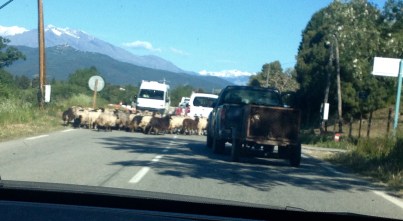
Corsicans are proud of their traditions and way of life. As one of the singers mentioned the night of the concert we attended in Bonifacio, there is a constant tension between being French and being Corsican At the archeological museum in Calvi, we learned more about the rich traditions deeply entrenched in Corsican life. Some Corsicans would like to see an independent Corsica. We saw graffiti, “A Francia Fora” (France Out) in several places. Some street signs that are in both French and Corsican were spray painted over the French. When asked about Corsican’s desire to be independent of France, our hotel receptionist in St. Florent said that it’s not likely but if it did happen, there would be economic disaster quickly in Corsica. Corsicans take great pride in the wide variety of their products: honey, pastries, made with chestnuts, chestnut beer, wine, charcuterie and seafood. We tasted and enjoyed them all. Corsica, the first part of France to be liberated by the allies, and France’s island of beauty, definitely warrants a return trip.


 Alfred Guillaume
Recent Comments