Living à la Provençale
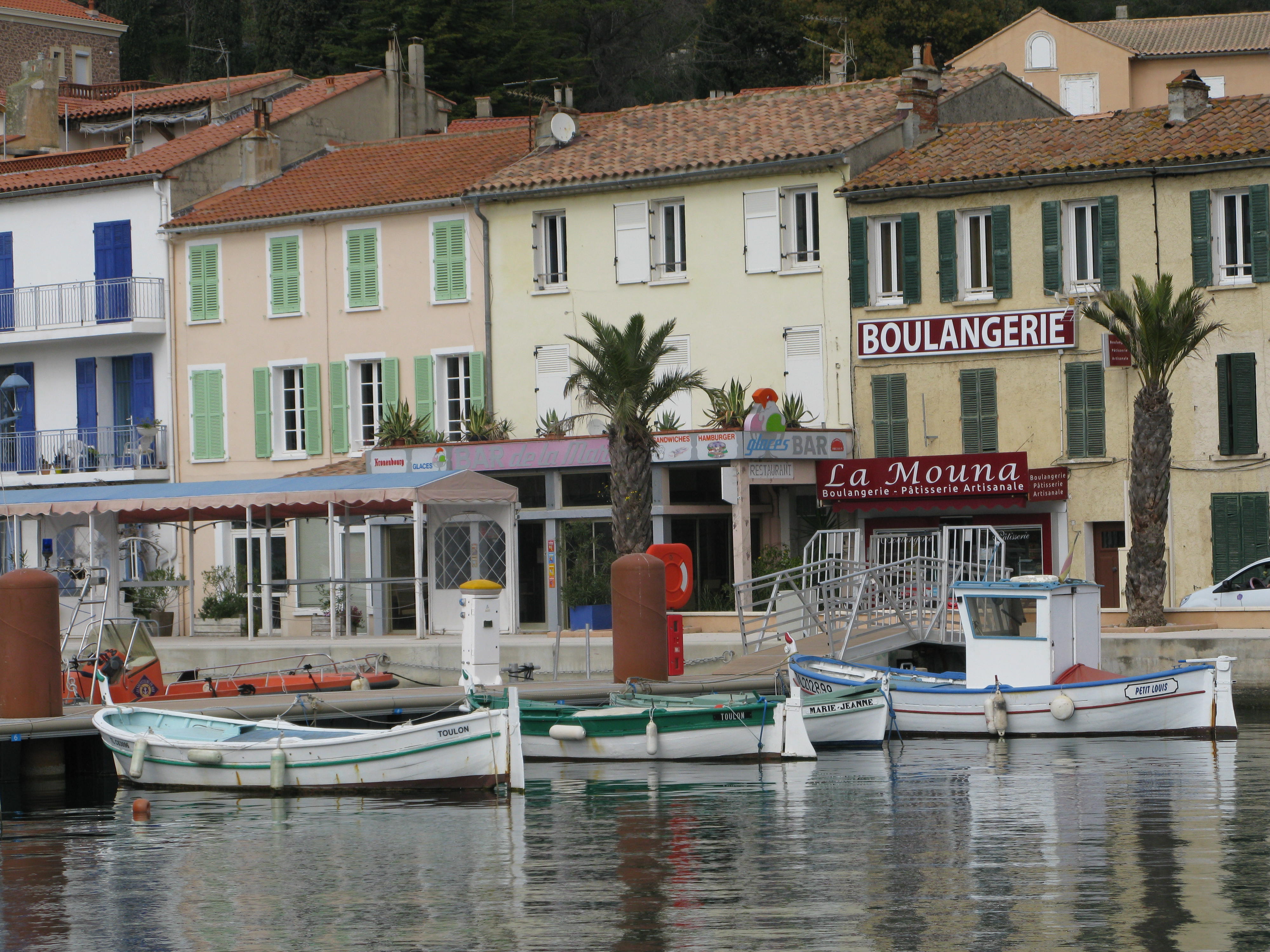
We’ve been here a week and seem to have settled into the rhythms of daily life. Our neighborhood in Le Pradet is becoming our own. The center of town is full of little shops and cafés. We now know where to find the best bread and pastries (la patisserie et la boulangerie), where to get meat (la boucherie et la charcuterie) and the best place to find fruits and vegetables (le marché aux fruits et légumes). We frequent the nearby supermarket for other staples. The downtown square with the small church at its center is lined with shops and cafés, and always full of life. People gather to talk; they sit seemingly for hours in open-air cafés; they greet and chat in small groups. In the shops and on the narrow sidewalks neighbors greet each other, if only for a moment. There is vibrancy in this small village. In my daily morning walk, I watch the town awaken as merchants begin to open their shops. Tables and chairs are being set up outside the restaurants and cafés. The warm and inviting whiff of pastries and recently baked bread fills my nostrils. Mothers and fathers are dropping off their little ones to school, bidding goodbye with kisses on both cheeks (les bises). The bike path that runs through the center of town where I take my brisk walks is a thoroughfare of speeding bikes in each direction. At the end of my exercise, I often stop for croissants and bread at our chosen boulangerie, one of five near the central square, before climbing the hill homeward.
I use my walking time to meditate, reflect and observe the Provençal life around me. The posters attached to walls tell stories about what’s happening in the village or reveal some political sentiment. The flow of traffic and the whirling of diesel engines of the small cars affirm how conscious the French are about energy conservation. The cost of fuel here is high. We recently filled the tank of our rented diesel Peugeot at an equivalent cost of ninety-three American dollars. There aren’t many SUVs or large sedans around here. And as a reminder that driving can be hazardous here as anywhere, on my walking route, I’ve stumbled upon two bouquets of dried flowers tied to trees, a symbolic reminder that someone died in a traffic accident. These are ubiquitous in the States, but here the Christian cross is not to be found. The French are primarily Catholic but not outwardly religious. Though they claim Catholicism, they remain for the most part non-practicing. France’s cultural politics is defined by secularization, the identification of the state apart from religion.
As expected, life in the provinces moves at a slower pace than in the big cities. But cars are indeed everywhere and parking is always a challenge. I am amazed how polite drivers are, stopping at crosswalks for pedestrians. Somehow that politeness fades on the open road. The drivers here are aggressive, and I’m learning in this land of continuous roundabouts to be equally aggressive when entering them. A too long and timid pause could result in being rear-ended. Since many of the streets in the connecting villages are one lane in both directions, the roundabouts allow swift movement of traffic.
Although we’ve been here just over a week, it feels as if we’ve been here a while. We’ve done a lot in a short space of time. We’ve seen some of our friends; others are traveling in either Switzerland or Singapore and we’ll see them soon. We’ve taken advantage of our time simply relaxing. Having the time to read has been a joy. I’m reading a rather disturbing book by Jonathan Littell, Les Bienveillantes, that won the Prix Goncourt in 2006, one of France’s most prestigious literary awards. The book relates in the first person an executioner’s view of the extermination of Jews, gypsies, homosexuals and others considered odious to Hitler’s Germany. The tale is terrifying and repulsive but I am determined to finish its over thirteen hundred pages. The novel, written in flawless prose, offers insights into diabolical minds. It is difficult to fathom how in civilized society such wanton violence and barbarity could ever have been perpetrated on human beings. Yet we know from recent history, genocidal wars still occur.
But having quiet time to read is only part of how we’re choosing to relax. Traveling around Provence, an area rich in history, arts and culture, is occupying our time as well. Last week we drove to Grimaud, a beautiful medieval town in the Massif Central. As we walked through the tiny stone streets, 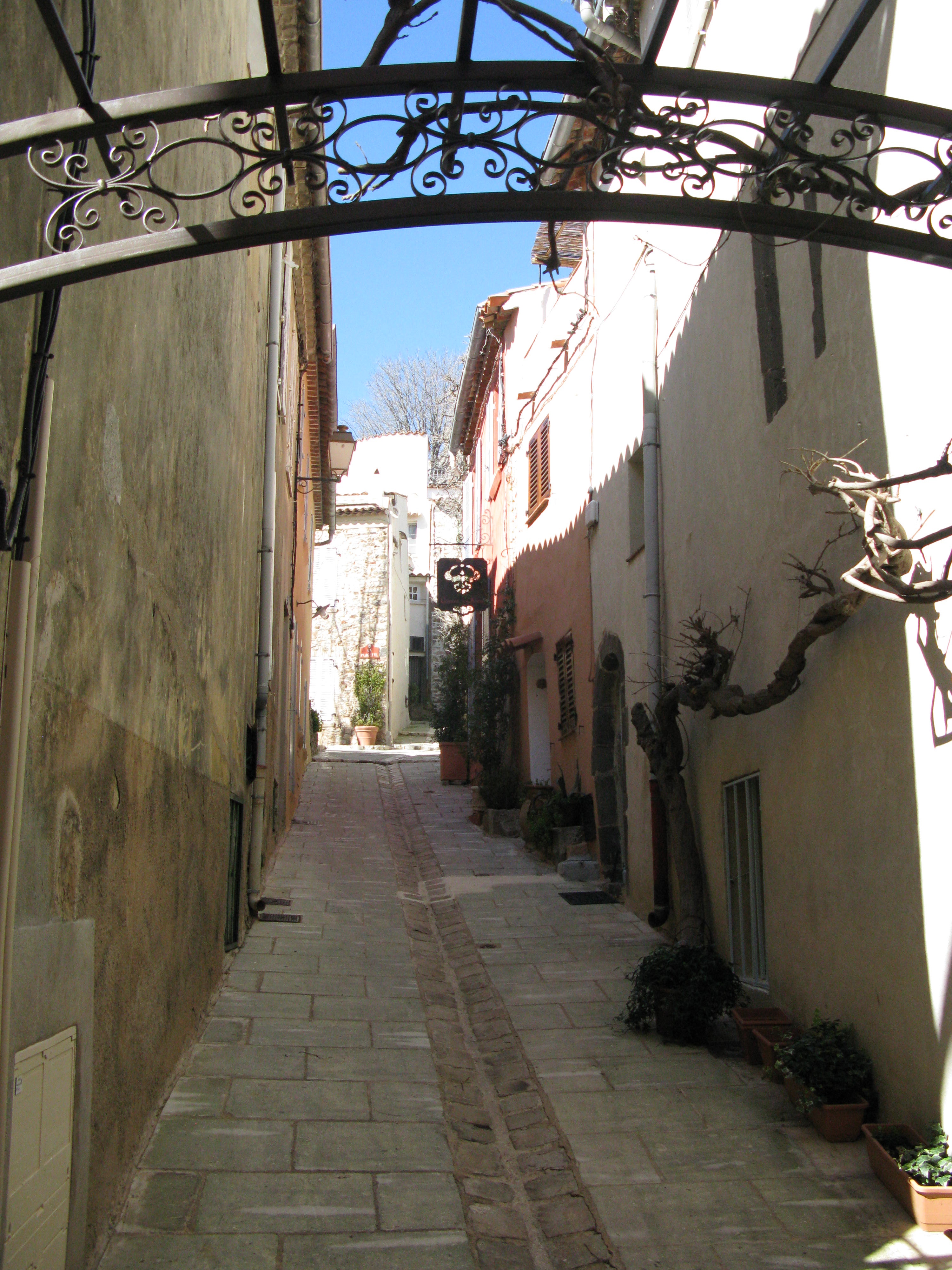 I imagined what life was like in this small village in medieval times. I would love to hear the secrets of hundreds of years of history witnessed by the ancient stonewalls of the buildings. Behind the doors of residences, tinged in the muted Provençal hues, I imagined life unfolding over the centuries. But I was also interested in knowing what life is now like, and was tempted on more than one occasion to knock on those doors and invite myself in. Like these homes, the churches in Grimaud still held their medieval flavor. St. Michael’s is simple but inviting, and the small Chapel of the Penitents whose architecture reminded me of churches in the American southwest
 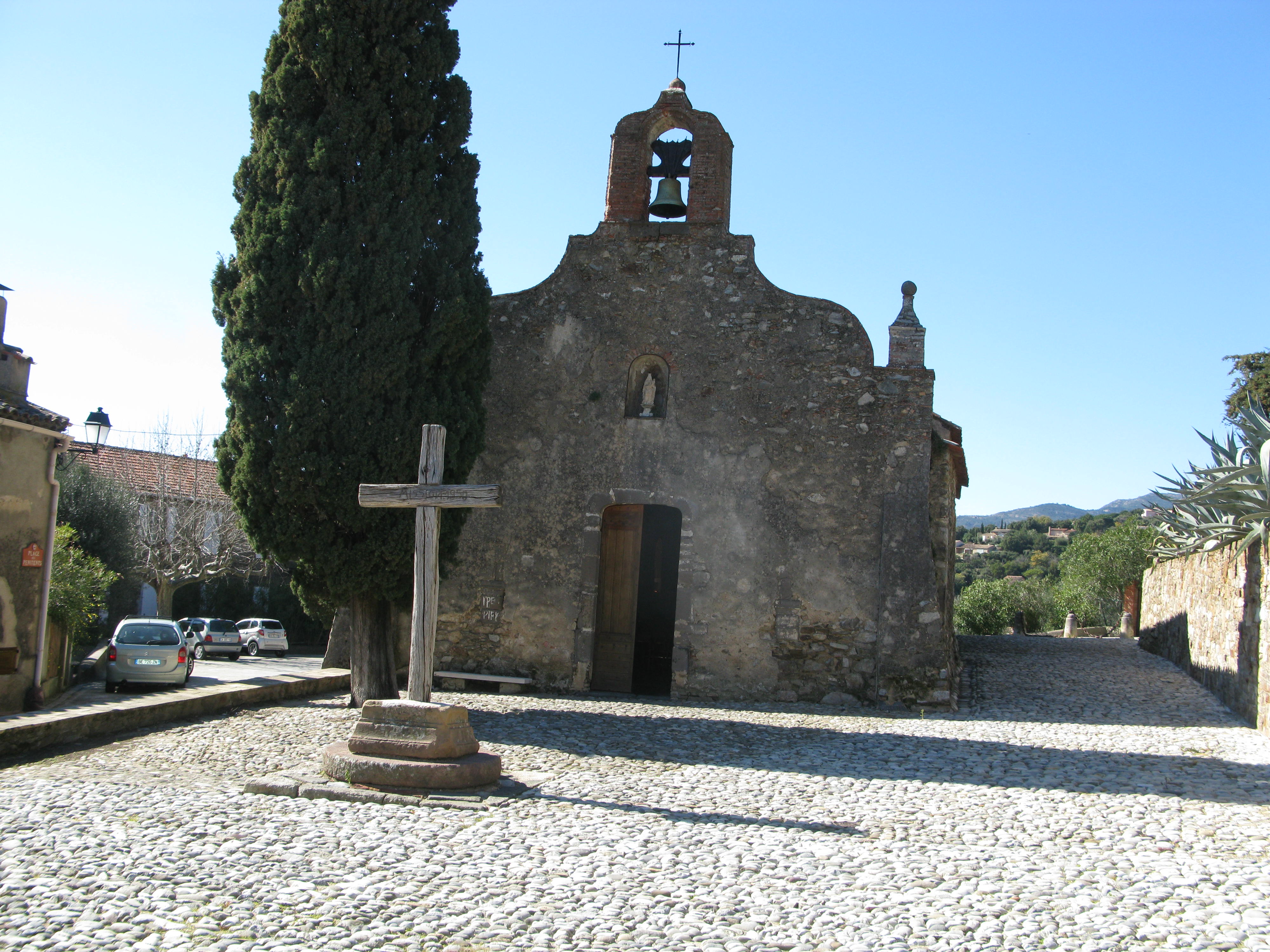 was more decorative but still somber. I imagined penitents walking barefoot on the stone plaza in front of the chapel seeking ablution of their sins. We also climbed the ruins of an ancient castle that gave us magnificent views of the Mediterranean and the countryside below. As we descended the steep hill, we discovered a plaque on a wall dedicated to the twentieth-century author, Suzanne Prou, who sought inspiration for her work in Grimaud. I’ve never heard of her, but now I have an excuse to read her work.
Another small town we visited was Hyères, a town where Jonathan Nashel and Rebecca Brittenham stayed when Jonathan was an exchange professor at the Université de Toulon-Var several years ago. We’ve been there before and it’s one of our favorite places to visit. It’s much bigger and more modern than Grimaud, though its old town is similar to Grimaud’s. There at the top of the old town we visited a public garden and chateau where Edith Wharton lived on her many visits to the region. We also passed in front of Alphonse de Lamartine’s home, now a hotel. No doubt, we’ll visit Hyères again, if only to sit in the central plaza of the old town either drinking a glass of rosé wine or eating crêpes at the local crêperie.
One of the exciting things we’ve done so far is a visit to the flea market, le marché aux puces, in a neighboring town. Our friends have told us there are bargains to be found there. To our amazement, the flea market is the largest we’ve ever seen, at least the size of four football fields, if not larger. And although we only bought French translated paperbacks of Martha Grimes and Danielle Steele to read later, we know we’ll return. One never knows what treasures there are to be discovered.
To vary our pace and stay closer to home, we took a ferry to the town across the bay from Toulon, St. Mandrier. 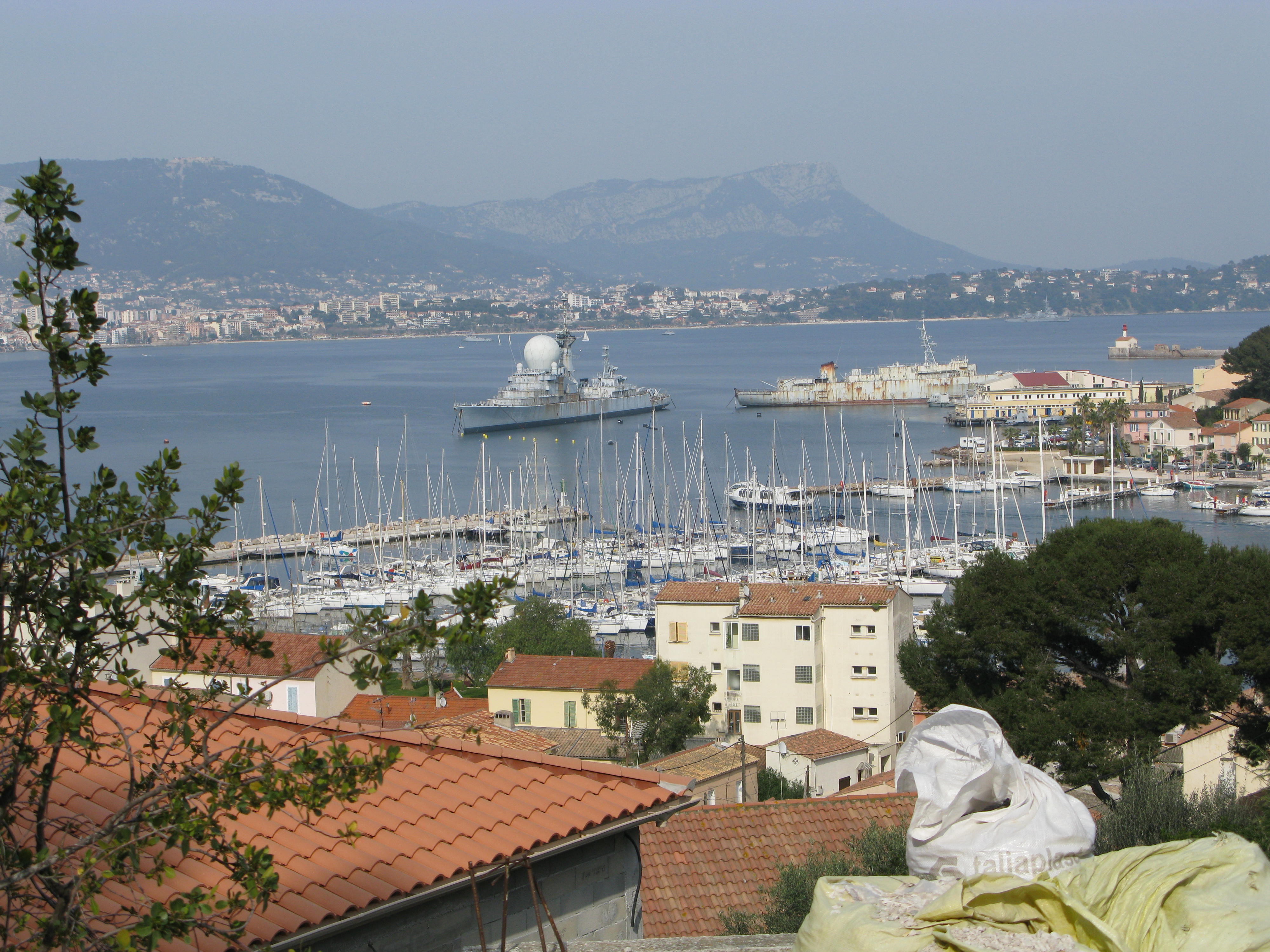 Instead of walking along the port, we decided to be more adventuresome and climb the hilltop where homes with spectacular views of the bay had lovely gardens. After an arduous climb on meandering roads, we reached a neatly kept cemetery akin to what you’ll find in New Orleans with its burial plots above ground. Each of the plots had beautiful bouquets of flowers in porcelain. Many had portraits of the departed with inscribed remembrances. One of the most touching, and one that I’ll remember, was “As long as there is someone who remembers you and speaks your name, you’ll always be present.”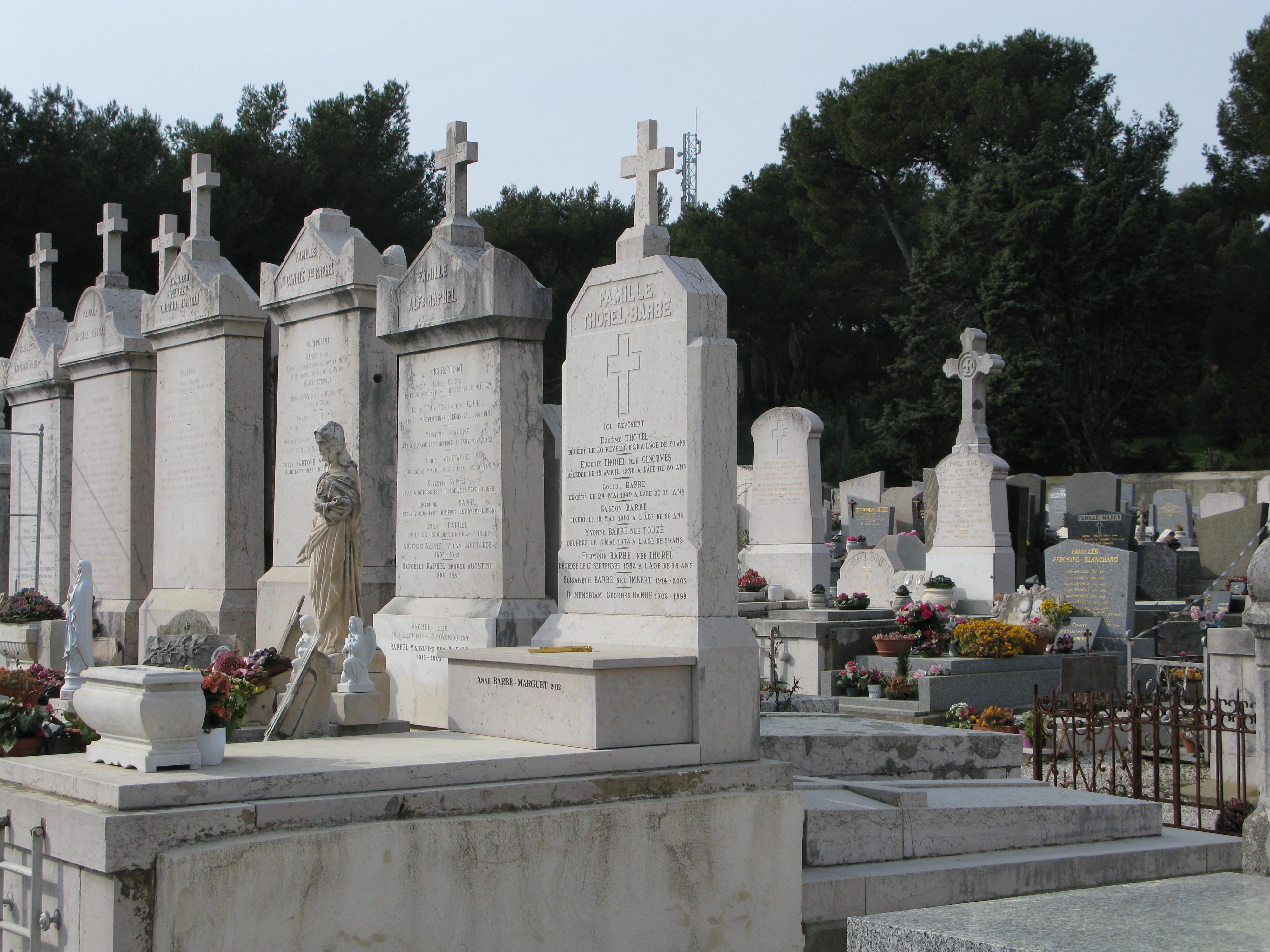
This is Melanie speaking in italics now. One of the other inscriptions in the cemetery that we saw more than once was “May your sleep be as sweet as your heart was good.” The arduous climb that Alfred mentioned included a staircase and path that went through people’s backyards, fenced but right there. I mentioned to Alfred on the way back down that the stair maker must have drunk a lot of wine because every stair seemed to be of a different height and a different depth. The views along the way were breathtaking, vistas of the bays on both sides of the peninsula where St. Mandrier is. It’s a place where we’d dream of renting a villa for a couple of weeks just to sit on the terrace, drink the local rosé and take in the beautiful surroundings.
One of the things that I have been so thankful for here is the exchange that Alfred started with the university here. Over the last 12 or so years, we have been able to make friends with a number of French people and also with Americans who have, like us, made the trip to stay here and have also welcomed the French to our town. It is so wonderful to be welcomed in a foreign country and also to feel so much a part of the culture. We have been invited to dine with several friends (and en famille with the mother, sister and brother-in-law of our host) and also we will be able to entertain many of those friends in our own little apartment. This week we will have lunch with the American prof who is here and later visit with the two American women who are students here. There’s a warmth and mutual understanding that grow when people understand that it’s challenging yet so rewarding to explore a rich culture other than one’s own.
 Our hostess has made us flan, veal with grapefruit, crêpes flambées, fresh raw oysters and mussels, baked apples with cherry filling, to name a few. And then there was the lovely casserole of cauliflower, ham, gruyère and béchamel—an old-time recipe that was true comfort food. She’s a wonderful cook. We are doing easier meals – salade nicoise, omelet with spinach and mushrooms, ham and cheese sandwiches on wonderful baguettes with Moutarde Maille, croissants from the local boulangerie. Simple and delicious.

4 responses to “Living à la Provençale”
Leave a comment
Recent Comments
 | Tim Size on Provençal Homecoming |
 | rnpamela on Provençal Homecoming |
 | dlsmithmd57 on Nerdy New Orleans |
 | Don Wycliff on Nerdy New Orleans |
 | Paul Guillaume on Nerdy New Orleans |
 Alfred Guillaume
So glad that you two are having a wonderful time! I love reading your entries – so reflective and descriptive. Thank you for taking the time to write and share with your friends! If you see Marie-Helene, please tell her I said hello. And when you get back to South Bend, let’s try to get together.
Alfred: I can only wish you didn’t write quite so well, but happy for your joy:) Tim
As usual, reading your descriptions make me hungry, (and jealous for the lovely weather you seem to be having.) We’re still in the throes of cold weather. I’m eagerly anticipating some green to grow through all the accumulated grime of the winter. Your plants are thriving, and your cyclamen is blooming. A cheerful pink flower has been a nice reminder of what I’m hoping is on its way!
Love reading about your adventures, especially the food! Love the pictures of the church and cemetery. The church absolutely looks like the southwest of the US for sure. Enjoy!!